Clear Sky Science · en
Afforestation of severely desertified land in semi-arid areas promotes soil carbon and nitrogen accumulation through microbial necromass
Turning Sand into Living Soil
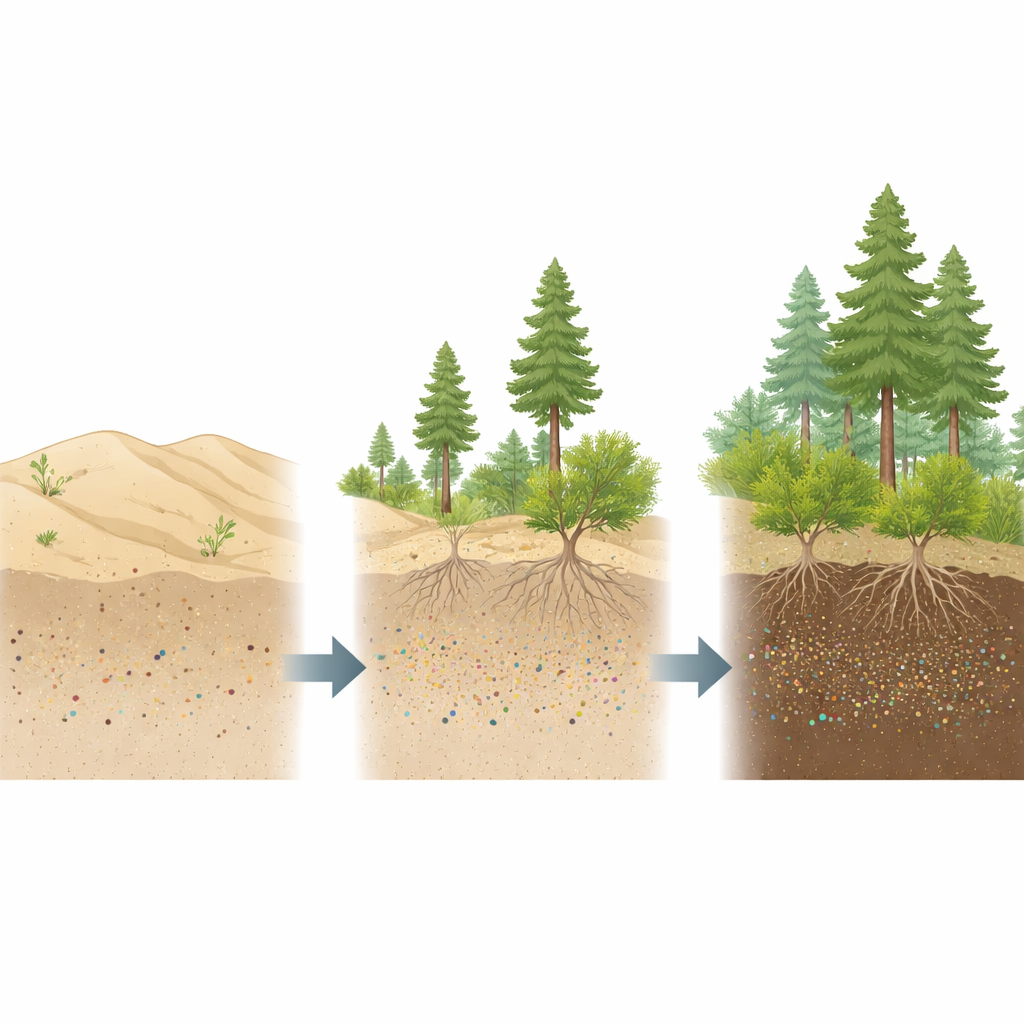
Vast stretches of northern China have been transformed by wind into shifting sand dunes, stripping away the fertile topsoil that plants, animals, and people depend on. This study asks a deceptively simple question with big consequences for climate and land restoration: if we plant shrubs and trees on these barren sands, how quickly can the soil come back to life and start locking away carbon and nitrogen again—and what hidden role do soil microbes play in that recovery?
Planting Life on Moving Dunes
The researchers focused on four major sandy regions in semi-arid northern China, where deserts have expanded into former grasslands. They compared bare mobile dunes with areas that had been planted 10, 20, or 40 years earlier using two common species: the nitrogen-fixing shrub Caragana microphylla and Mongolian pine (Pinus sylvestris var. mongolica). They also sampled nearby natural grasslands and mature pine forests as benchmarks for what a healthy soil should look like. From the upper 20 centimeters of soil at 180 sites, they measured how much organic carbon and total nitrogen were stored, along with a suite of soil properties such as moisture, texture, and bulk density.
Following the Footprints of Microbes
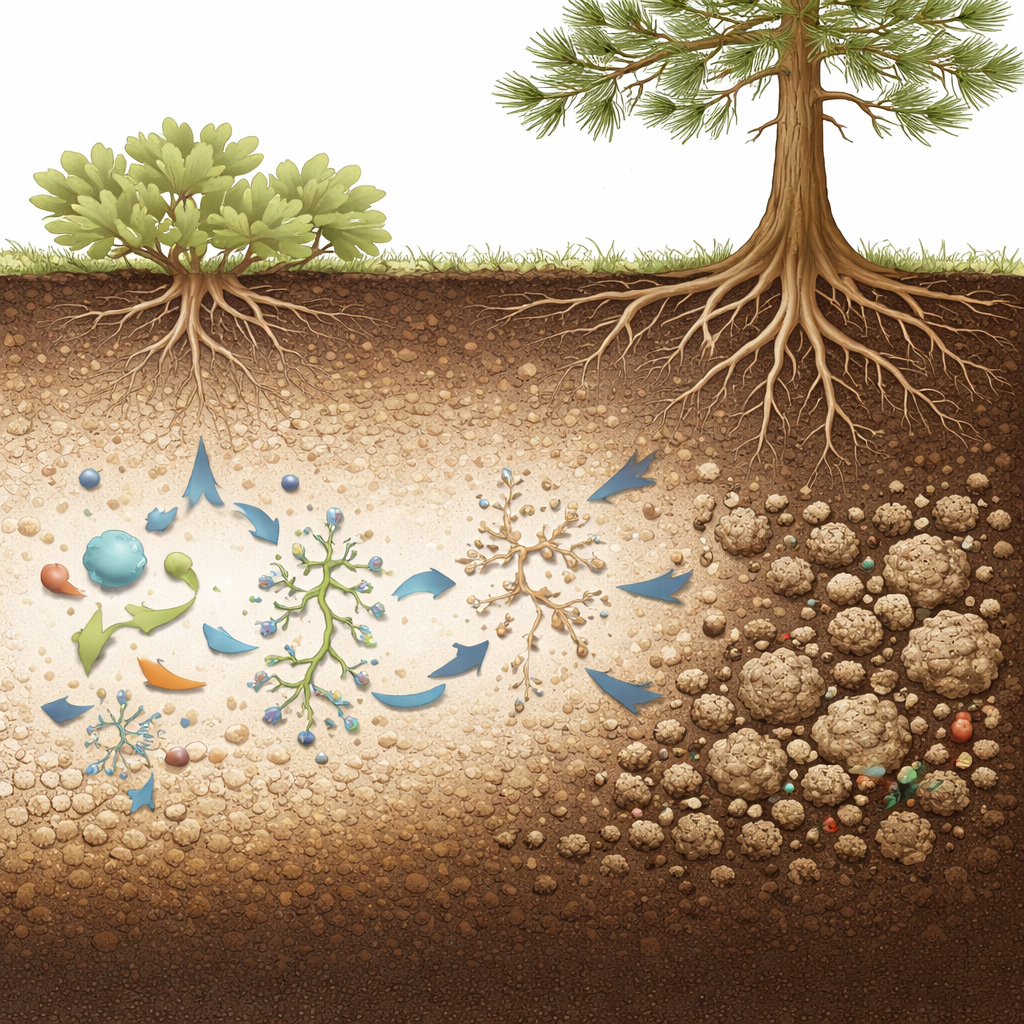
To uncover the invisible engine of soil recovery, the team tracked microbial "necromass"—the long-lasting remains of dead bacteria and fungi that become part of soil organic matter. Using amino sugar biomarkers that are unique to fungal and bacterial cell walls, they estimated how much carbon and nitrogen these microbial leftovers contributed to the soil. Across all sites, natural grasslands and forests held the most soil carbon, nitrogen, and microbial necromass, followed by long-established plantations and finally bare dunes. Afforestation consistently boosted both soil carbon and nitrogen, with values rising quickly in the first decades and then slowing, a pattern that mirrored the build-up of microbial necromass.
Slow Gains, Powerful Microbial Helpers
Even after 40 years of planting, the restored soils were still far from matching their natural counterparts. Based on current trends, the authors estimate it would take more than 110 years for soil carbon and nitrogen in former dunes to reach the levels found in nearby natural grasslands. Yet the potential payoff is large: if all severely desertified land identified in the year 2000 were successfully planted, the top 20 centimeters of soil could store an additional 26.3 teragrams of carbon and 2.5 teragrams of nitrogen by 2040. Crucially, microbial necromass played a major role in this buildup, accounting for roughly one-quarter to two-fifths of soil carbon and about one-quarter to one-half of soil nitrogen. Fungal remains dominated, averaging about four times the mass of bacterial remains, especially under pine, whose woody litter decomposes slowly and favors fungi.
What Controls the Underground Recovery
By combining multivariate statistics and structural equation modeling, the study disentangled which environmental factors matter most for rebuilding soil through microbial pathways. Soil physical properties—such as water-holding capacity, fine particle content, and low bulk density—emerged as key drivers of microbial necromass accumulation, with wetter, finer, and less compacted soils supporting more microbial residues. The ratio of nitrogen to phosphorus in soil was another strong predictor, revealing that nitrogen scarcity limits microbial growth and the formation of stable necromass, particularly for bacteria. Climate, topography, and vegetation influenced microbial necromass mainly indirectly by shaping soil moisture, texture, and nutrient balance, with water availability standing out as a central constraint in these semi-arid landscapes.
Lessons for Restoring Drylands
For non-specialists, the main takeaway is that planting shrubs and trees on severely desertified sand is indeed an effective long-term strategy to rebuild soil health and help lock away climate-warming carbon, but the process is slow and strongly governed by tiny organisms in the soil. Among the species tested, Mongolian pine performed better than the shrub Caragana for recovering soil carbon and nitrogen over many decades, while both supported substantial build-up of microbial necromass. Because fungal and bacterial remains underpin much of the new soil organic matter, restoration efforts that also improve soil structure and relieve nitrogen limitation—through careful planting densities, water management, and nutrient-sensitive practices—can accelerate the conversion of shifting sand into resilient, carbon-rich soil.
Citation: Chen, Y., Cao, W., Mou, X. et al. Afforestation of severely desertified land in semi-arid areas promotes soil carbon and nitrogen accumulation through microbial necromass. Commun Biol 9, 499 (2026). https://doi.org/10.1038/s42003-026-09775-9
Keywords: afforestation, desertification, soil carbon, microbial necromass, semi-arid ecosystems