Clear Sky Science · en
Calcium activation mechanism of a noncanonical aromatic L-amino acid decarboxylase from psilocybin mushroom Psilocybe cubensis
Why mushroom chemistry matters
Some mushrooms make mind-altering compounds such as psilocybin, a molecule now being explored as a treatment for depression and anxiety. Behind these molecules are specialized enzymes—tiny protein machines—that build and modify chemical structures. This study focuses on one such enzyme from the psilocybin-producing mushroom Psilocybe cubensis and uncovers how ordinary calcium ions, better known for strengthening bones, switch this enzyme into a more active and stable state. Understanding this mechanism could help scientists design better biocatalysts for making medicines derived from amino acids.
An unusual enzyme with a hidden helper
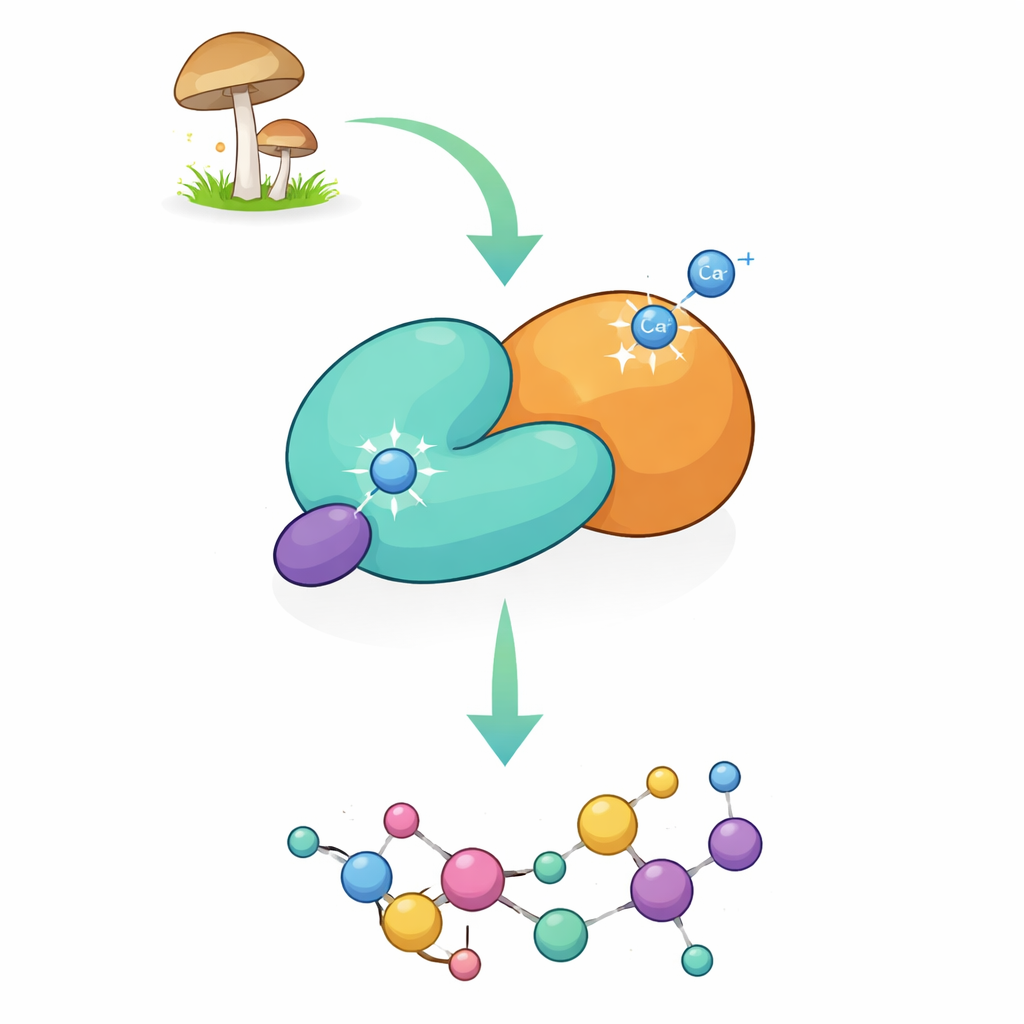
The enzyme studied here, called PcncAAAD, belongs to a family that transforms aromatic amino acids—such as tryptophan, tyrosine, and phenylalanine—into more reactive building blocks used in neurotransmitters and drug-like compounds. Unlike its counterparts in plants and animals, this fungal enzyme has two striking peculiarities. First, it carries an extra protein “tail” at its end, known as a C-terminal appendage, that is absent from standard versions. Second, its activity rises dramatically in the presence of calcium, but not sodium, even though both are common metal ions in cells. Earlier work showed that chopping off the extra tail nearly abolishes the enzyme’s activity, hinting that this appendage and calcium binding are intimately linked, but the structural reasons for this dependence remained mysterious.
Calcium as a structural stabilizer, not a chemical partner
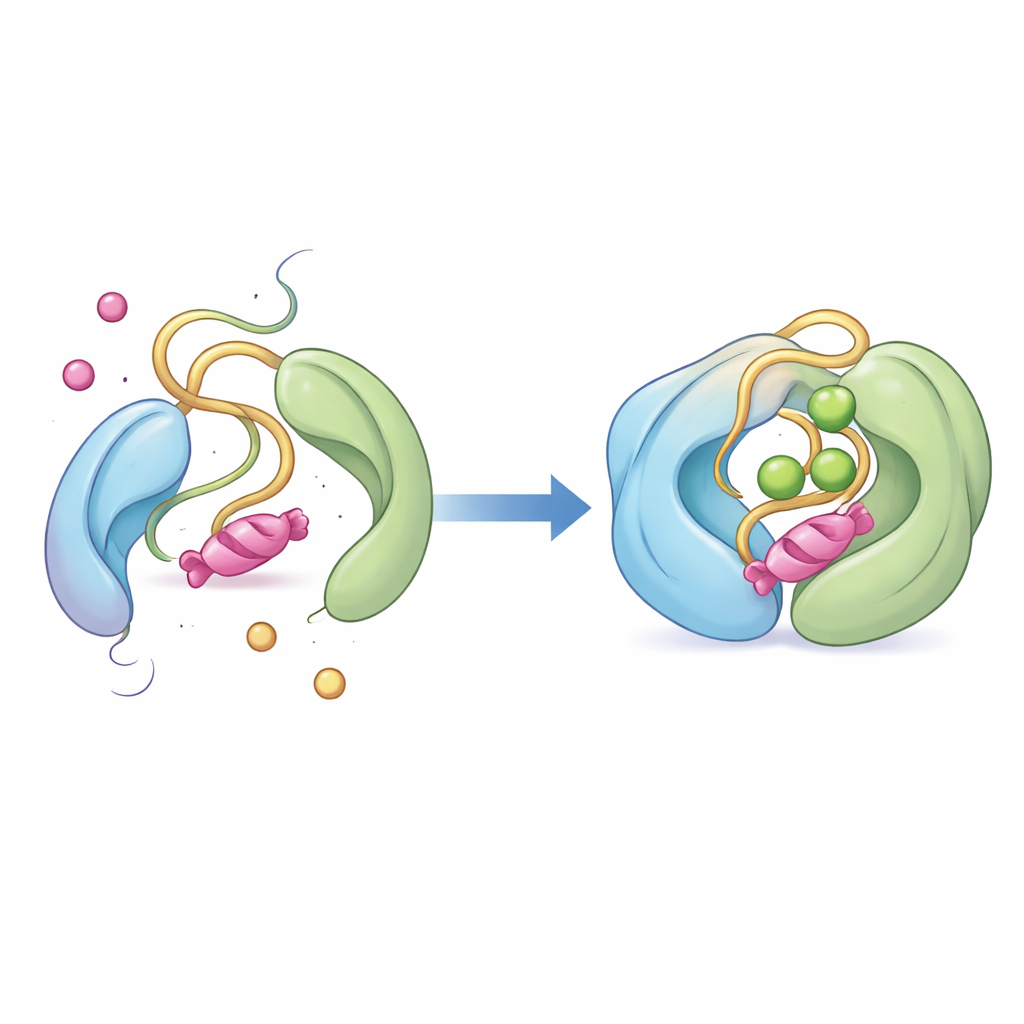
The researchers turned to long-timescale molecular dynamics simulations—computer experiments that track how every atom in the enzyme moves in solution—to compare its behavior in calcium- versus sodium-rich environments, and with or without the extra tail. They focused on a small “lid–rim” structure that sits directly over the active pocket where chemistry happens: a flexible loop (the lid) resting on a short helix (the rim). In calcium solution, this lid neatly caps the pocket and stays in place, keeping the environment snug for binding aromatic amino acids. In sodium solution, or when the tail is removed, this region becomes floppy: the lid flips away, the rim helix partly unfolds, and the hydrophobic cradle that normally holds the substrate falls apart. Importantly, the simulations showed that calcium does not enter the catalytic cavity or grab the substrate; instead, it exerts its influence from the outside by holding the protein’s shape together.
Two metal-binding sites with different jobs
Close inspection of the three-dimensional structure of PcncAAAD revealed two distinct metal-binding sites inside each enzyme subunit. Site A lies at the junction where the main body of the enzyme meets the extra tail, directly beneath the lid–rim feature. Site B sits farther away within the tail itself, between two barrel-like folds. Simulations and experiments agreed that calcium binds much more tightly than sodium at both sites, but the sites do not contribute equally to function. When the team mutated key acidic residues at site A so they could no longer hold calcium, the lid–rim structure collapsed, the active pocket distorted, and the enzyme’s reaction rate in calcium dropped to near its sodium-level baseline. By contrast, mutations at site B mainly weakened the overall stability of the tail, modestly reducing activity but leaving calcium’s boosting effect largely intact.
Scoring motions to predict function
To make sense of the many mutant and simulation variants, the authors devised a simple structural “scorecard” based on how far key regions of the enzyme drift from their shape in the fully active, calcium-bound state. They measured backbone deviations (RMSD) for three components: the main catalytic domain, the active pocket, and the lid–rim cap. They then normalized these values between two extremes: a stable, active reference in calcium and a completely inactive, tail-truncated form in sodium. Mutants whose structures wandered as much as, or more than, the inactive reference invariably showed little or no activity in lab assays. This relative conformational variation score thus became a practical way to flag destabilizing changes, and helped pinpoint the lid–rim region and site A as the central hub through which calcium stabilizes the enzyme.
What this means for enzyme design
By also simulating a “holo” enzyme bearing a bound reaction intermediate, the team confirmed that when a large catalytic loop closes over the active site, it tightly seals off the pocket so that calcium cannot slip inside. This strongly supports a mechanism in which calcium acts purely as a structural brace—anchoring the extra tail to the core and locking the lid–rim cap in place—rather than as a direct chemical participant in the reaction. The second site on the tail adds an extra layer of stability by holding two tail barrels together, which in turn helps maintain proper contacts with the core domain. In everyday terms, calcium behaves like a set of well-placed clamps that stiffen a hinged lid over a working chamber, ensuring reliable performance. These insights not only clarify how a psilocybin-mushroom enzyme is turned on by calcium but also offer a blueprint for engineering other metal-activated enzymes to be more robust and efficient catalysts for producing valuable aromatic amino acid–derived drugs.
Citation: Li, T., Reynolds, E.E., Wang, Z. et al. Calcium activation mechanism of a noncanonical aromatic L-amino acid decarboxylase from psilocybin mushroom Psilocybe cubensis. Commun Biol 9, 497 (2026). https://doi.org/10.1038/s42003-026-09756-y
Keywords: calcium-activated enzyme, psilocybin mushroom, aromatic amino acid decarboxylase, protein structural dynamics, enzyme engineering