Clear Sky Science · en
Olfaction in fruit flies (Tephritidae) balances detection and discrimination of host fruits
How Fruit Flies Sniff Out the Right Fruit
Fruit flies may look like simple kitchen pests, but the way they use smell to find the right fruit is surprisingly sophisticated. This study reveals that many fruit fly species do more than just detect any ripe fruit in the area. They also use subtle differences in fruit aromas to tell one species from another, helping them choose the best place to feed and lay eggs. Understanding this balance between “finding” and “picking” could improve environmentally friendly pest control strategies for valuable crops.
The Scented World of Fruits
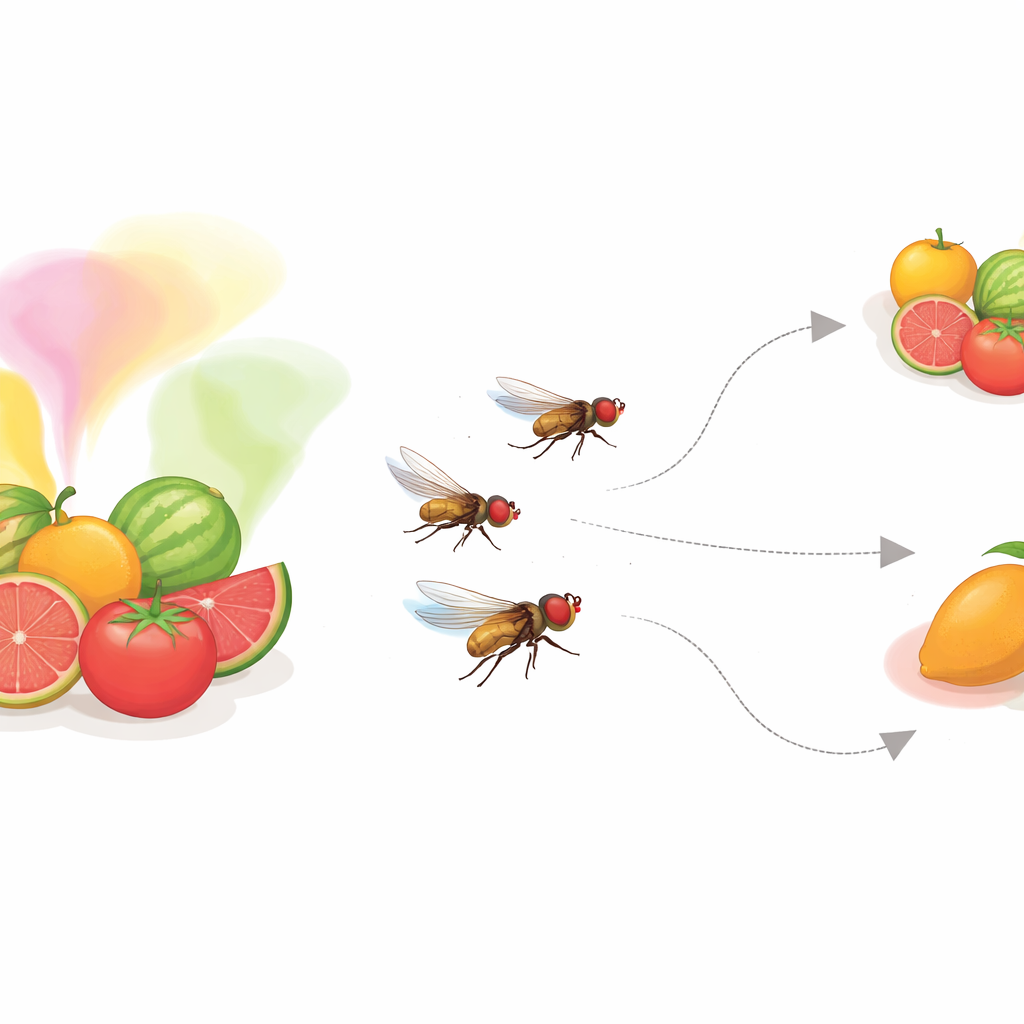
Fruits constantly release invisible clouds of airborne chemicals, creating a rich scent landscape. The researchers sampled the odours from 28 different fruit species, both intact on the tree and sliced to mimic damage. Using sensitive chemical analysis, they detected hundreds of distinct volatile compounds, dominated by esters and terpenoids, which are common contributors to fruity and floral smells. Each fruit species had its own scent signature, but there was also substantial overlap: some compounds were unique to a single fruit, while others were shared by many different fruits.
Shared Smells Versus Unique Signatures
A long-standing idea in ecology holds that insects which feed on many plant species mainly rely on the odour ingredients that those plants have in common. These shared compounds would act as broad “chemical bridges,” letting an insect recognize a wide variety of hosts without needing to learn every fruit separately. However, this view does not explain how such insects can still prefer some hosts over others, or change their choices when environments shift. The authors therefore asked whether fruit flies might instead be especially sensitive to the unique, species-specific components of fruit odours, and how that might coexist with the use of shared cues.
Listening in on Fruit Fly Noses
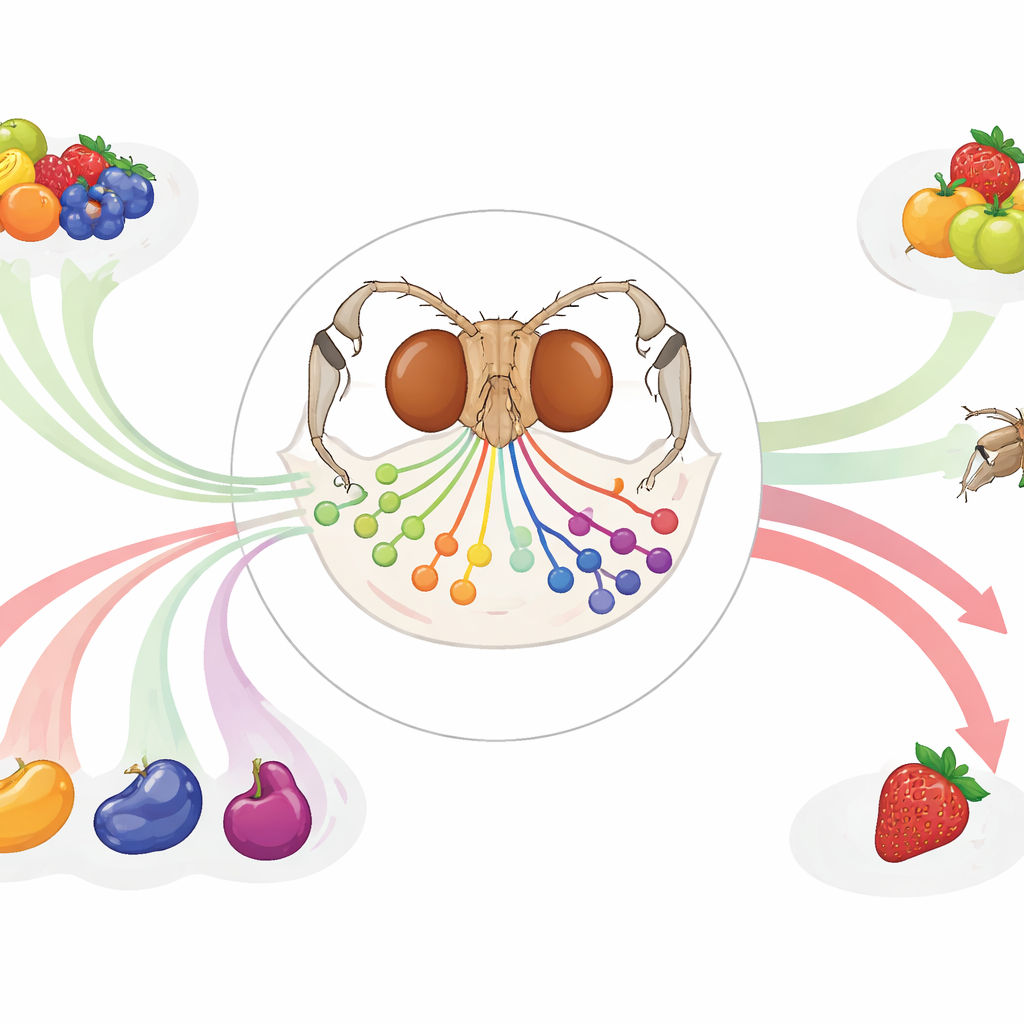
To probe what flies actually smell, the team recorded tiny electrical signals from the antennae of females from eight fruit fly species. They exposed the flies to carefully chosen synthetic versions of fruit odour compounds that ranged from rare, species-specific molecules to ones shared by many fruits. Surprisingly, the strength of the antennal responses tended to be higher for species-specific compounds and weaker for widely shared ones, especially in flies that attack many different hosts. This pattern held across different experimental methods and sets of fruits, suggesting that the peripheral nose of these flies is tuned to respond more vigorously to the distinctive components that set one fruit apart from another.
What a Simple Model Reveals
To understand why such tuning might evolve, the researchers built a computational model of a fruit fly’s smell system. The model simulated many possible ways that olfactory receptors could respond to fruit volatiles and asked which settings best supported two tasks: simply detecting that any host fruit is present, and telling different fruit species apart. The simulations showed a trade-off. Systems that were best at detection tended to respond to odour compounds that were common across fruits, whereas systems that were best at discrimination responded more strongly to species-specific compounds. Crucially, the model also revealed that an efficient system can combine both strategies if the probability of responding is biased toward shared compounds, while the strength of responses is biased toward species-specific ones.
From Nerve Signals to Real Behaviour
The team then tested whether this dual strategy shows up in actual behaviour. In choice tests, female oriental fruit flies (Bactrocera dorsalis) were offered two artificial scent blends: one made only of compounds shared by several fruits, and one made of mostly species-specific compounds. At low dose, flies were more attracted to the species-specific blend, matching the idea of high sensitivity to unique cues. At higher dose, the preference flipped and flies favoured the shared-compound blend, consistent with shared odours acting as strong general host signals when abundant. This dose-dependent switch mirrors the model’s prediction that detection and discrimination can be balanced by adjusting how strongly flies respond to different odour types.
Why This Matters for Crops and Ecosystems
In plain terms, the study suggests that polyphagous fruit flies use shared odour compounds as broad beacons to detect that “fruit is around,” but rely on species-specific odours to decide which fruit to use. Their noses are therefore built not just to find hosts, but to compare them. This insight helps explain why such insects can have wide host ranges yet still show clear preferences, and it offers practical guidance for pest management: effective lures may need carefully tuned mixtures of both widely shared and more distinctive fruit volatiles to work over a range of distances and concentrations.
Citation: Ramiaranjatovo, G., Charlery de la Masselière, M., Dekker, T. et al. Olfaction in fruit flies (Tephritidae) balances detection and discrimination of host fruits. Commun Biol 9, 512 (2026). https://doi.org/10.1038/s42003-026-09751-3
Keywords: fruit fly olfaction, plant volatiles, host selection, chemical ecology, pest management