Clear Sky Science · en
LICHEN enables light-chain immunoglobulin sequence generation conditioned on the heavy chain and experimental needs
Why matching antibody parts matters
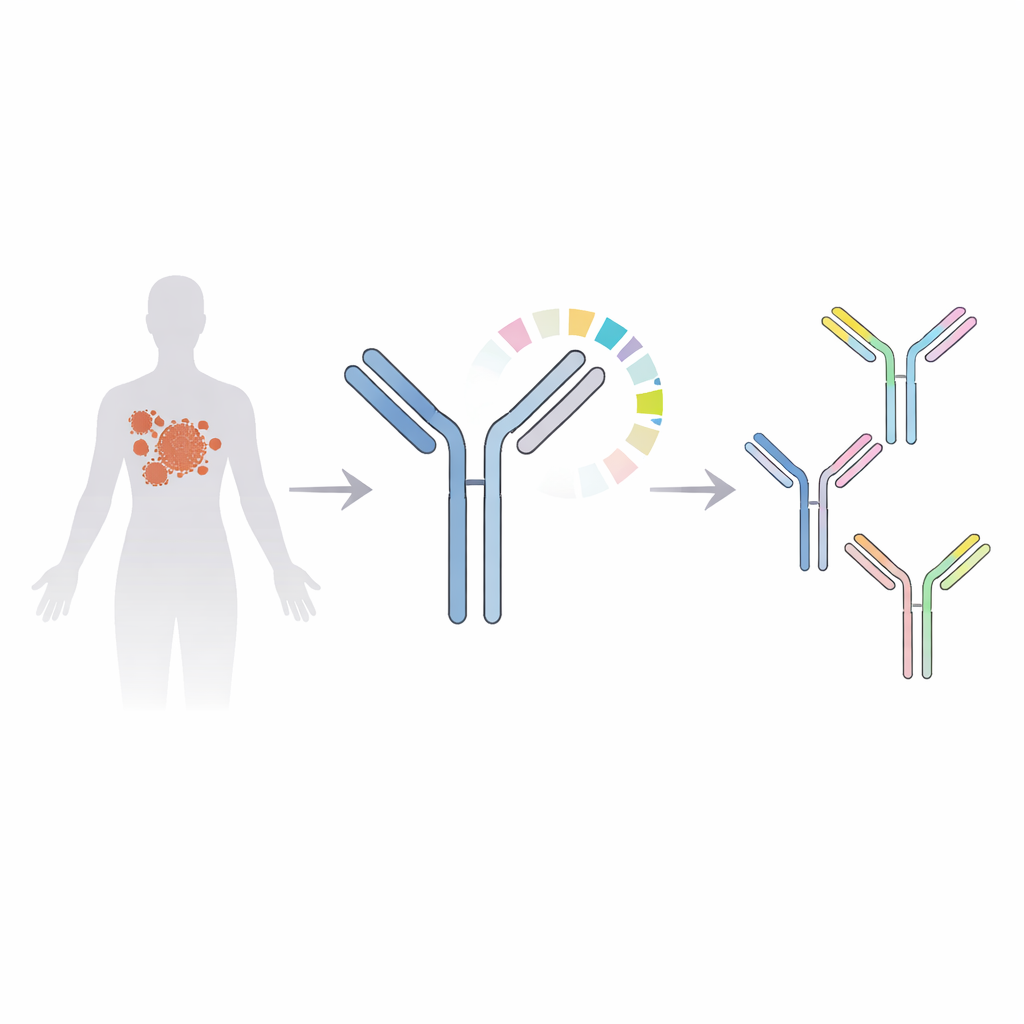
Modern medicines increasingly rely on antibodies—Y‑shaped proteins our immune system uses to recognize threats. Drug developers often focus on one arm of the antibody, called the heavy chain, because it varies the most and plays a key role in recognizing disease targets. But the lighter partner chain is just as crucial: if it does not pair well with the heavy chain, the whole antibody can fail to work or be difficult to manufacture. This paper introduces LICHEN, a computational tool that helps scientists design suitable light chains to go with a chosen heavy chain, speeding up the creation of safer, more effective antibody medicines.
A digital partner for antibody design
LICHEN is a machine‑learning model trained on millions of examples of naturally occurring human antibody pairs. Given the sequence of a heavy chain, the model generates many possible light‑chain sequences that should look and behave like real human antibodies. Instead of building random libraries and testing them blindly, researchers can now ask LICHEN to propose light chains that already respect patterns seen in human immune systems, cutting down on wasted effort in the lab.
Making sure suggestions look human
The authors first checked whether LICHEN’s suggestions resemble genuine human light chains. For hundreds of heavy chains, the tool generated batches of candidate light chains. Independent software that recognizes antibody sequences confirmed that almost all of these were valid light chains, classified as human, and could be modeled structurally. Their lengths and shapes matched those seen in nature, and their detailed structures—especially in the flexible binding loops at the tips—covered a broad range, rather than collapsing to a few common solutions.
Diversity without losing the heavy–light relationship
An important feature of real antibodies is that the heavy and light chains evolve together during the immune response, accumulating mutations in tandem to improve binding to a target. The authors showed that LICHEN has learned this relationship. When it generates light chains for a given heavy chain, the number of mutations in each chain tends to correlate, much like in natural antibodies and unlike in randomly paired chains. The model also assigns higher probability to natural heavy–light pairs than to artificial combinations where the light chain has been reverted back toward its original, unmutated form. At the same time, LICHEN explores sequence space broadly, proposing many distinct light chains, not just near‑copies of known examples.
Tuning designs to experimental needs
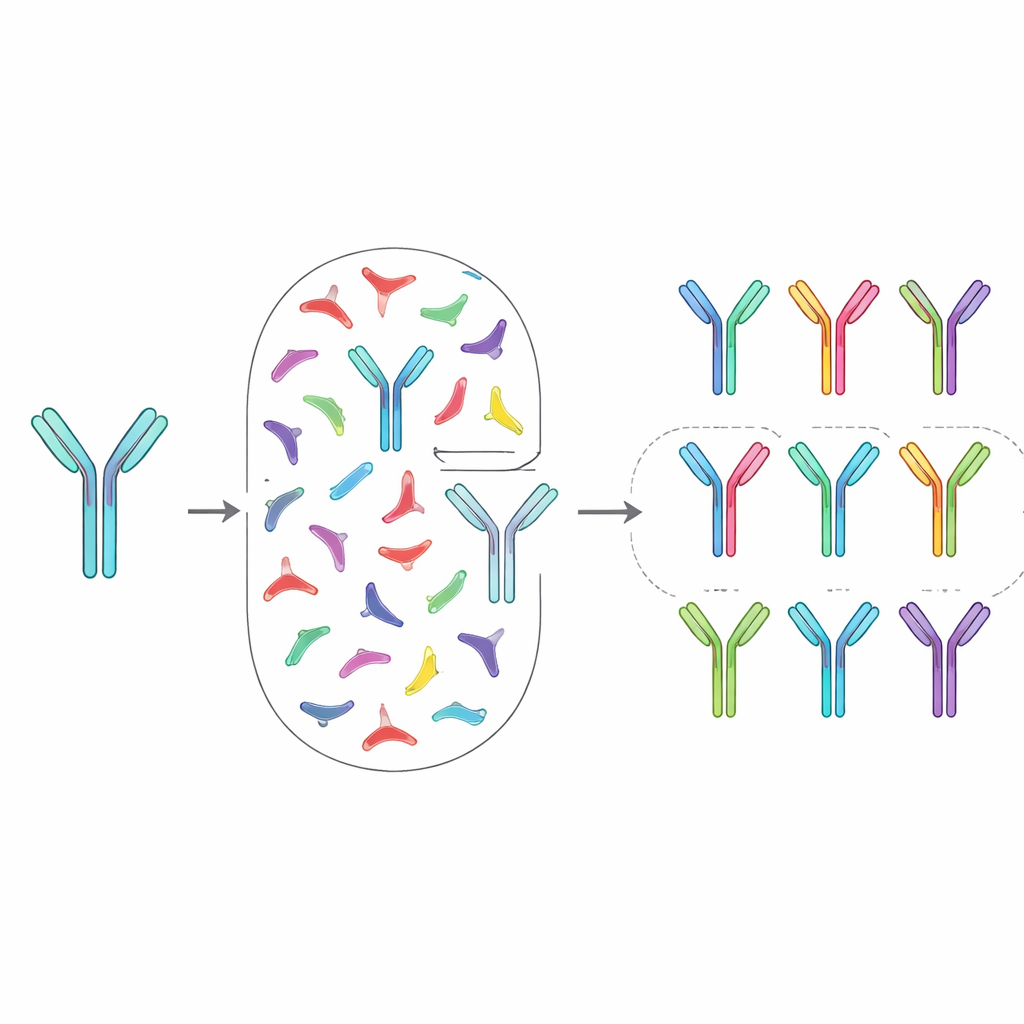
Beyond simple pairing, LICHEN lets researchers build in their own constraints. Users can request light chains from particular genetic families that are known to behave well in the lab or avoid those linked to stability issues. They can also lock in specific binding loops taken from an existing antibody—thought to be critical for recognizing a target—while allowing the rest of the light chain to be redesigned. In tests using two approved antibody drugs, adalimumab and pembrolizumab, many LICHEN‑designed light chains produced antibodies that expressed as well as, or better than, the originals. When key binding loops were preserved, most redesigned antibodies continued to bind their intended targets strongly.
What this means for future antibody medicines
For a non‑specialist, the bottom line is that LICHEN acts like a smart match‑maker between antibody parts. It learns from the human immune system how heavy and light chains naturally go together, then uses that knowledge to suggest new, human‑like combinations that laboratories can readily produce and test. By balancing realism, diversity, and user‑defined constraints, LICHEN offers a practical bridge between computational design and bench experiments, helping shorten the path from an initial antibody idea to a well‑behaved therapeutic candidate.
Citation: Capel, H.L., Ellmen, I., Murray, C.J. et al. LICHEN enables light-chain immunoglobulin sequence generation conditioned on the heavy chain and experimental needs. Commun Biol 9, 468 (2026). https://doi.org/10.1038/s42003-026-09727-3
Keywords: antibody design, machine learning, therapeutic antibodies, protein engineering, immune system