Clear Sky Science · en
Temporal signatures of thought—neurodynamics distinguish on- and off-task thoughts
Why our wandering mind matters
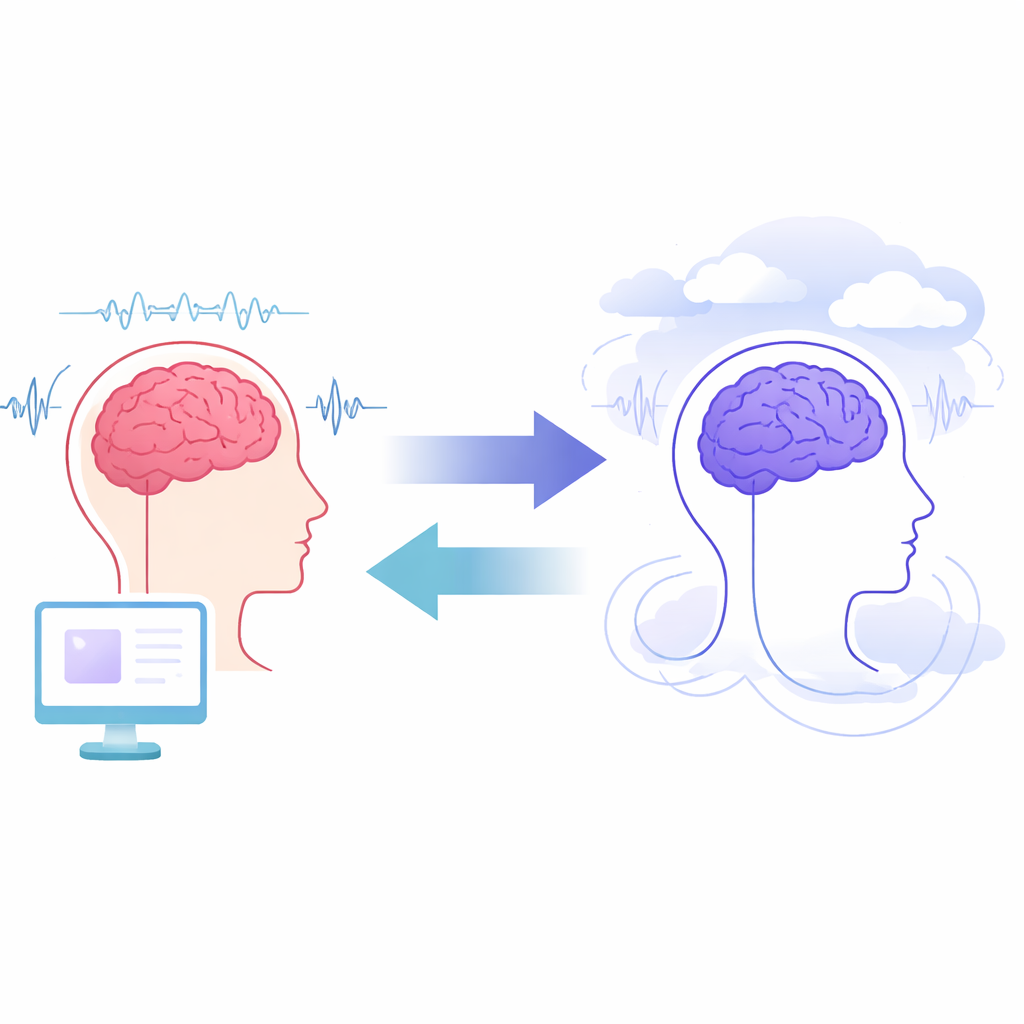
Everyone knows the feeling: one moment you are focused on a task, the next your thoughts drift to weekend plans or an old memory. This study asks what happens in the brain as it flips between such on-task focus and off-task mind wandering. Using recordings of brain activity from volunteers doing a simple button-pressing task, the researchers uncover distinct temporal “signatures” that separate focused from wandering thoughts, and show how slower, background brain rhythms quietly shape our moment-to-moment mental life.
Listening to the brain’s internal rhythms
The team recorded electrical activity from the scalp (EEG) while people repeatedly pressed keys in response to a visual cue. After short blocks of trials, a probe asked whether their attention just before the question had been on the task or off the task. Instead of looking only at brief responses to each cue, the scientists treated the EEG as a continuously changing signal and analyzed its dynamics over two time windows: longer 17-second blocks and shorter 3-second trials. They focused on four measures that capture different aspects of how the signal unfolds over time: how strongly it correlates with its own past, how rich or compressible its patterns are, and how much power lies in slower versus faster brain rhythms.
Slow versus fast patterns of thought
When people reported off-task thoughts, their brain activity showed a reliable shift toward slower dynamics. On these trials, slow frequencies carried relatively more power, while faster rhythms were less prominent. At the same time, the signal remained correlated with itself for a longer period, indicating that the brain was integrating information over extended stretches of time rather than rapidly resetting. Behaviorally, mind wandering went hand in hand with slower and more variable reaction times. Together, these findings paint off-task thought as a “slower and longer” mode of operation, in contrast to the “faster and shorter” patterns seen when attention is anchored to the task.
Patterns that repeat versus patterns that surprise
The study also examined how diverse or repetitive the ongoing brain patterns were. Using a compression-based measure, the authors found that during off-task states, the signal was more regular and easier to compress, both over long blocks and, especially, within the short trials just before a probe. On-task states, by contrast, showed slightly higher moment-to-moment complexity, suggesting a richer variety of neural activity patterns when we closely track an external task. Interestingly, off-task periods combined greater variability over longer stretches of time with simpler patterns in the immediate moment, hinting that the mind may wander by revisiting similar internal themes rather than constantly inventing new ones.
Background and foreground layers of mental time
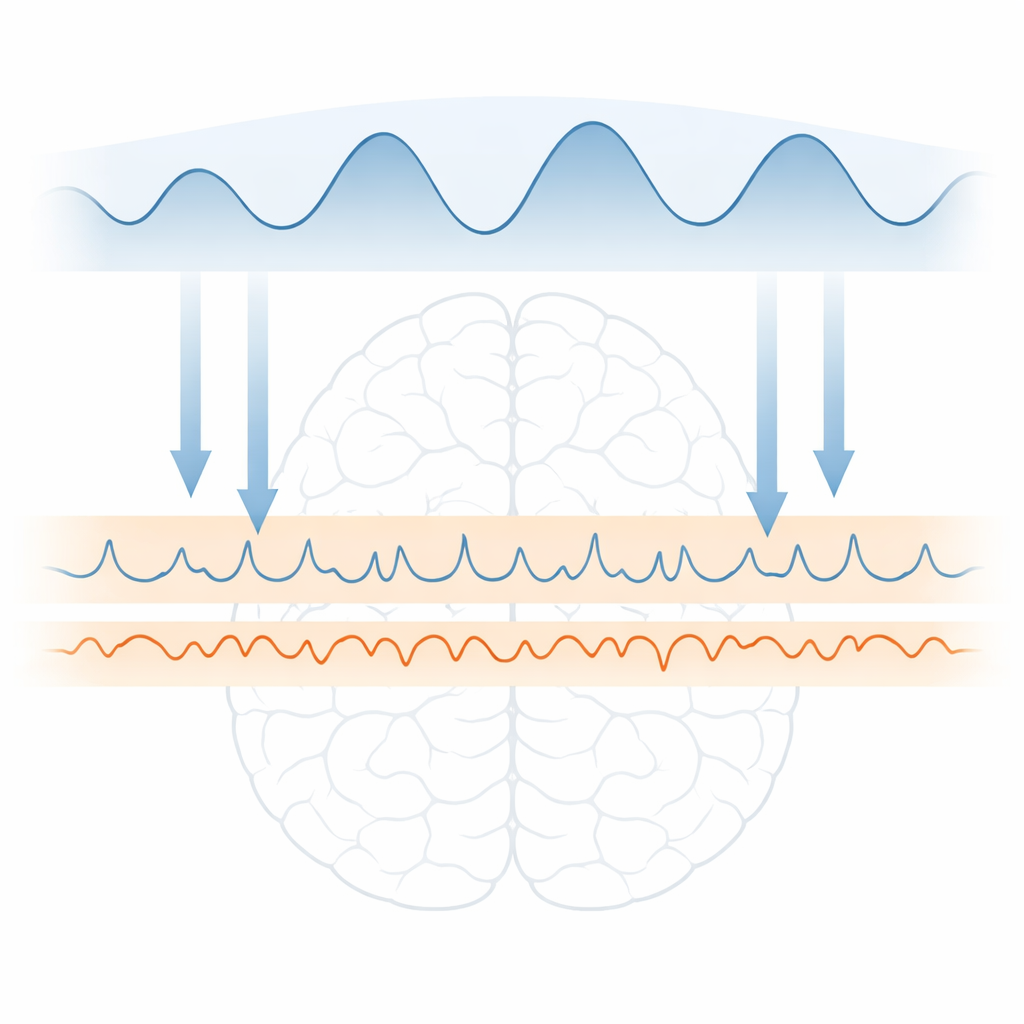
A key innovation of the work is the idea that brain dynamics form a temporal hierarchy. Measures computed over longer 17-second windows acted like a slowly changing background, while measures from the brief 3-second windows served as a rapidly updating foreground. Using statistical modeling, the researchers found that background dynamics strongly influenced foreground dynamics, but not the other way around. This influence was tighter when people were on task: long-timescale activity and short-timescale patterns moved in lockstep. During mind wandering, the link between background and foreground weakened, as if the slower, internal rhythms were less constrained by the fast demands of the task and more free to drift.
What this means for everyday thinking
To a non-specialist, the main message is that the brain does not simply switch thoughts on and off; instead, it runs on layered time scales that gently steer whether we stay engaged with the outside world or sink into inner reverie. Focused thoughts are supported by faster, more flexible brain patterns that remain tightly coupled to a slower background. Off-task thoughts ride on slower, more persistent rhythms and simpler repeating patterns, with looser coupling between long and short timescales. In this way, the tempo and organization of the brain’s own activity help determine when we concentrate and when our minds will inevitably wander.
Citation: Long, Z., Fu, X., Chen, Q. et al. Temporal signatures of thought—neurodynamics distinguish on- and off-task thoughts. Commun Biol 9, 437 (2026). https://doi.org/10.1038/s42003-026-09715-7
Keywords: mind wandering, attention, EEG, brain dynamics, intrinsic timescales