Clear Sky Science · en
Divergence at the IRX gene cluster underlies extreme trophic polymorphism in a cichlid fish (Herichthys minckleyi)
A Tale of Two Tooth Types in One Fish
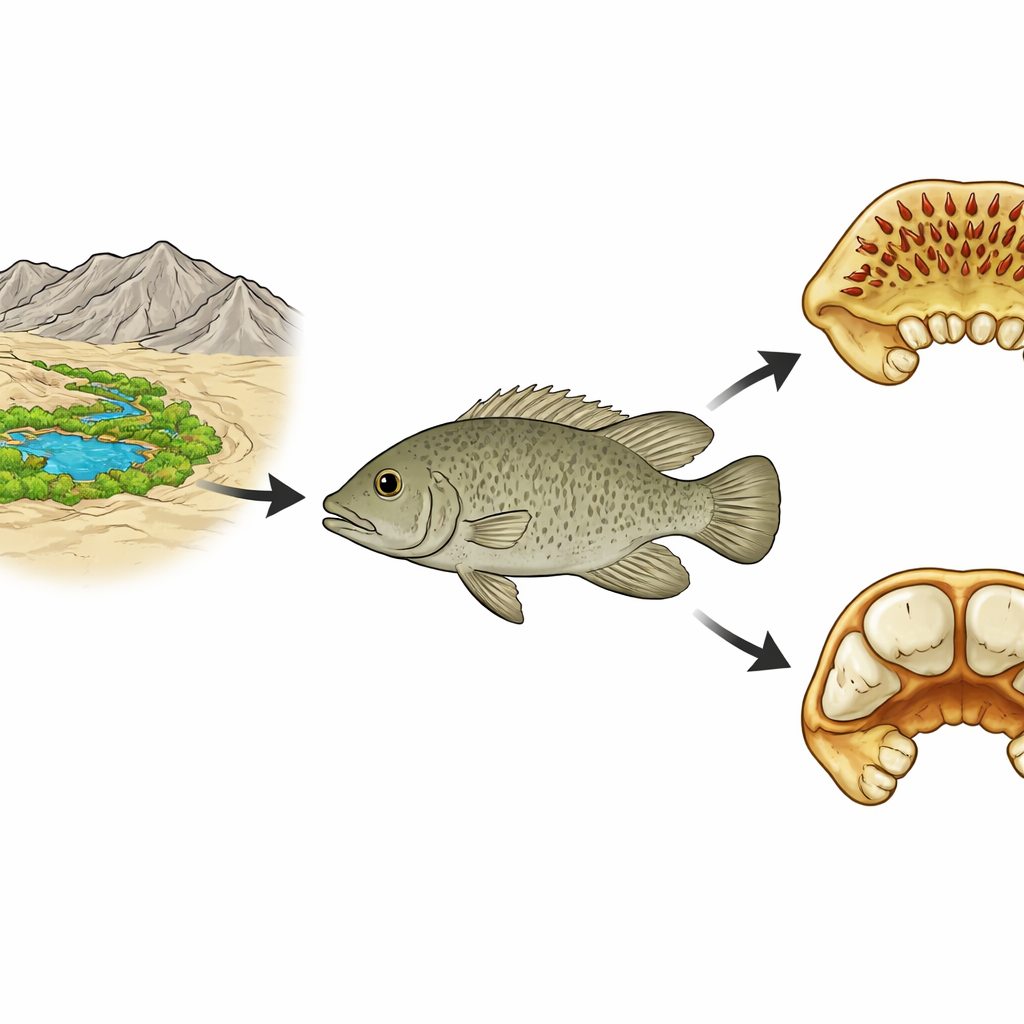
In a desert valley in northern Mexico lives a small fish that breaks some big evolutionary rules. The cichlid Herichthys minckleyi comes in two striking mouth varieties: one with tiny needle-like teeth for shredding plants, and one with big molar-like teeth for crushing snails. This dramatic difference, found within a single species living in the same pools, gives biologists a rare living snapshot of how major evolutionary changes in feeding and lifestyle can arise—and even how such change might begin the formation of entirely new species.
A Desert Oasis as a Natural Evolution Lab
Herichthys minckleyi is found only in Cuatro Ciénegas, a small valley of spring-fed pools surrounded by the Chihuahuan Desert. In each pool, both tooth types—called papilliform (fine, pointed teeth) and molariform (large, rounded teeth)—live side by side and freely interbreed. The two forms eat different foods and use their specialized pharyngeal jaws, a second set of “throat jaws” common to cichlids, to process their meals: plant material for the papilliforms, hard-shelled snails for the molariforms. When the researchers compared tooth size variation within this single species to that across more than 30 related cichlid species in Central America, they found something remarkable: the range of tooth sizes in H. minckleyi alone rivals that seen across an entire adaptive radiation of many species.
Not Two Species, and Not Just Environment
Because the two forms look and feed so differently, it might be tempting to call them separate species. Yet decades of genetic work, now extended with full-genome sequencing, show that the two morphs are almost indistinguishable across most of their DNA. Within each pool, fish cluster genetically by location, not by tooth type. This means there is no genome-wide split between morphs, no strong barrier to mating, and no sign that they are on the verge of becoming fully separate species. At the same time, the clear, bimodal tooth-size differences are hard to explain as simple environmental plasticity—changes caused only by diet or use—suggesting that something in the genome must be acting like a switch.
Pinpointing a Single Genomic Switch
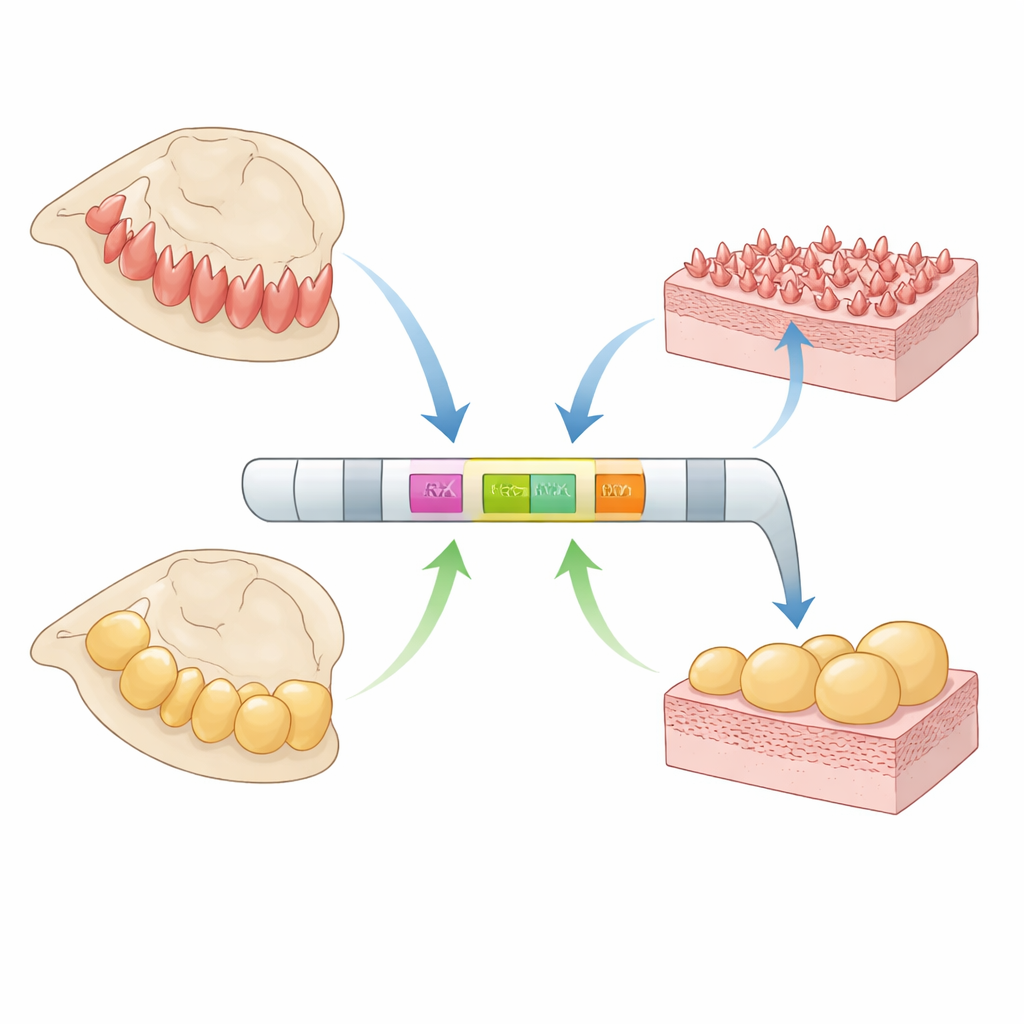
To find that switch, the team combined several powerful genomic approaches. They first built a high-quality reference genome from a close relative, Herichthys cyanoguttatus, then crossed it with H. minckleyi to map DNA regions linked to tooth size. This mapping highlighted a few genomic regions, with one on chromosome 11 standing out. Next, they resequenced whole genomes from dozens of wild H. minckleyi whose tooth areas had been carefully measured. A genome-wide association scan revealed a single, sharp peak of genetic differences between the two morphs, again on chromosome 11. The key variants sit in a short, noncoding stretch of DNA between two genes, IRX1a and IRX2a, part of a small, ancient gene cluster known to help shape tooth development in other vertebrates. In papilliform fish this region is consistently homozygous for one version; in molariform fish it is enriched for a mixed, heterozygous combination that behaves much like a classic on–off genetic switch for jaw type.
Hybridization: Present, but Not the Culprit
The valley is not completely isolated from the outside world. H. cyanoguttatus has recently entered Cuatro Ciénegas, probably via human-made canals, and there is evidence that its DNA has mixed into some local populations. In many famous fish radiations, such hybridization has helped spark bursts of new forms. Here, however, detailed tests of gene flow along chromosome 11 show little sign that DNA from H. cyanoguttatus contributed to the tooth-size switch. While the two species can hybridize and their offspring show a range of tooth sizes, these hybrids do not recreate the extreme, two-peaked pattern seen in natural H. minckleyi. Instead, the data point to changes that arose within the valley’s own cichlids, at a single genomic site with outsized effects.
Big Evolutionary Leaps from Tiny DNA Changes
To a non-specialist, the message of this work is that evolution does not always proceed by countless tiny steps spread widely across the genome. In H. minckleyi, a dramatic shift in what and how individuals eat—mirroring differences usually seen among multiple species—can be traced mainly to a small regulatory region in one gene cluster that controls tooth formation. This single genomic change helps produce two very different ways of making a living within one species, expanding ecological diversity without erecting strong reproductive barriers. The study shows how localized, genetically simple changes can generate macroevolution-sized differences in form and function, offering a window into how major bursts of diversity in the fossil record and in modern radiations might sometimes arise almost overnight.
Citation: Hulsey, C.D., Franchini, P., Masonick, P. et al. Divergence at the IRX gene cluster underlies extreme trophic polymorphism in a cichlid fish (Herichthys minckleyi). Commun Biol 9, 508 (2026). https://doi.org/10.1038/s42003-026-09689-6
Keywords: cichlid fish, trophic polymorphism, tooth evolution, adaptive radiation, genetic switch