Clear Sky Science · en
Achieving more human brain-like vision via human EEG representational alignment
Why this research matters
Modern artificial intelligence can recognize objects in photos with near-human accuracy, yet it still does not “see” the world the way our brains do. This study introduces a new way to tune computer vision systems using brain signals recorded from volunteers, moving AI a step closer to human-like visual understanding. By directly shaping a vision model with human brain activity, the work hints at future AI that is not only powerful, but also organized more like our own minds.
Teaching machines with brain waves
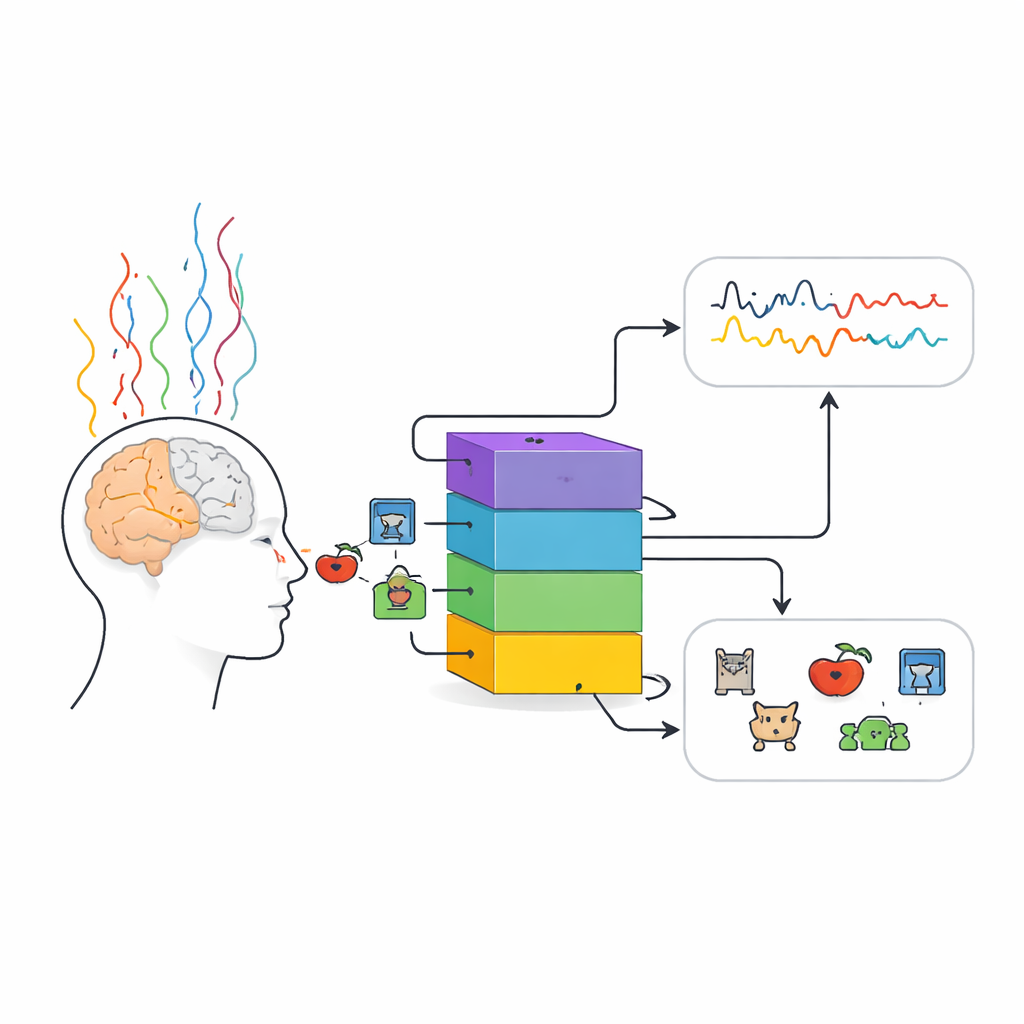
The authors focus on a simple but bold idea: instead of just training vision models on images and labels, why not also show them how the human brain responds to those images? They use electroencephalography (EEG), which measures tiny voltage changes on the scalp as people view pictures. EEG is noninvasive, relatively inexpensive, and can be collected rapidly over many trials. From ten volunteers, the team used a large open dataset in which each person viewed tens of thousands of natural object images while their EEG signals were recorded within the first two-tenths of a second after each picture appeared.
Building a brain-aligned vision network
Starting from an existing deep vision model called CORnet-S, the researchers added an extra “image-to-brain” module. When an image enters the network, the model now performs two tasks at once: it guesses what object is present and it tries to predict the EEG pattern that a real human showed for that same image. To do this, signals from several internal layers of the network are funneled into the EEG module, which learns to generate a short time series matching the human data. During training, the model is rewarded both for correct object recognition and for producing EEG-like activity, nudging its internal features to resemble those in the human visual system.
Closer to brain activity across methods
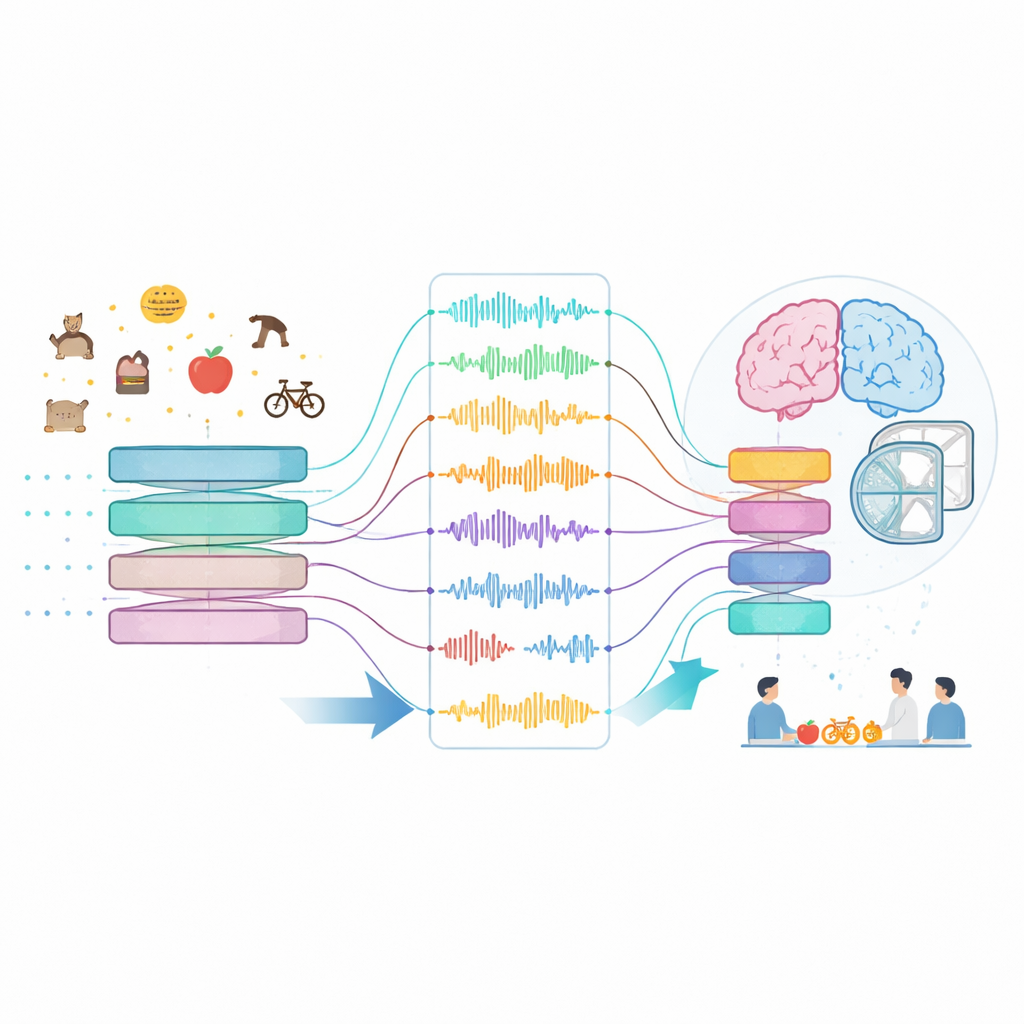
After training ten such “ReAlnets” (one per subject), the team asked whether these models had actually become more brain-like. They compared the pattern of relationships among images inside the model to the pattern seen in human EEG, using a technique called representational similarity analysis. Across all main layers and time points between 50 and 200 milliseconds, ReAlnets were consistently more similar to human EEG than the original CORnet-S and other standard models, with peak gains of up to about 6% and relative improvements as high as 40%. Importantly, the boost held even for new object categories never used during training, showing that the alignment generalizes beyond the training set.
Reaching into brain scans and behavior
A key question is whether the models merely learned idiosyncrasies of EEG, or captured something more general about human vision. To test this, the authors turned to a separate brain imaging dataset, where different volunteers viewed natural images, abstract shapes, and letters inside an MRI scanner. Even though ReAlnets had never seen this data, their internal patterns more closely matched signals from several visual brain regions than the original model did. Moreover, the degree of improvement for EEG and for MRI was strongly correlated across models, suggesting that a shared core representation was strengthened. The researchers also evaluated how often models and humans made similar mistakes in demanding object recognition tasks. Here too, ReAlnets aligned better with human behavior than the baseline models.
Personalized and general brain-like vision
Because each ReAlnet was tuned to one person’s EEG, the authors could probe individual differences. They found that personalized models diverged from each other more in deeper layers, echoing how differences across people grow from early to higher visual brain areas. Yet each person’s model still generalized to other people’s EEG better than the unaligned baseline did, showing that it captured both shared and subject-specific structure. The team also extended their framework to a different architecture, ResNet18, and again saw improved alignment with EEG, MRI, and (to a lesser extent) behavior, suggesting that the approach is flexible rather than tied to a single model design.
What this means for everyday understanding
To a non-specialist, the take-home message is that it is now possible to tune vision algorithms directly using noninvasive recordings from the human brain. The resulting ReAlnets do not just recognize objects; they organize information in ways that more closely mirror our own visual pathways, across electrical brain signals, MRI scans, and even patterns of mistakes in recognition tasks. While the improvements are modest and many technical challenges remain, this work offers a concrete step toward AI systems whose internal workings are shaped by the human brain itself, potentially leading to more robust, interpretable, and person-specific technologies in the future.
Citation: Lu, Z., Wang, Y. & Golomb, J.D. Achieving more human brain-like vision via human EEG representational alignment. Commun Biol 9, 463 (2026). https://doi.org/10.1038/s42003-026-09685-w
Keywords: brain-aligned AI, EEG vision, object recognition, computational neuroscience, human-like perception