Clear Sky Science · en
Measuring hierarchical structure across hominid percussive tool-use sequences
Why cracking nuts can crack a big mystery
When a chimpanzee cracks a nut or a human shapes a stone tool, they are not just moving their hands at random. Each action is part of a larger pattern, a bit like steps in a dance or words in a sentence. This study asks a deep question with a simple starting point: can we measure the hidden structure inside such everyday actions, and what does that reveal about how human thinking evolved from our great-ape relatives?
From simple chains to layered plans
Scientists have long suspected that the way we string actions together—whether in speech, tool use, or other skills—relies on a “structure within structure,” where small action units are grouped into larger chunks and sub-plans. Human language is the classic example: sounds form syllables, which form words, which form phrases and sentences. Many researchers have proposed that tool use, in both humans and great apes, may rest on a similar kind of layered organization. But until now there has been no standard way to detect and measure this invisible hierarchy in natural behavior, leaving debates about similarities between language and action largely speculative.
A new way to see hidden patterns in action
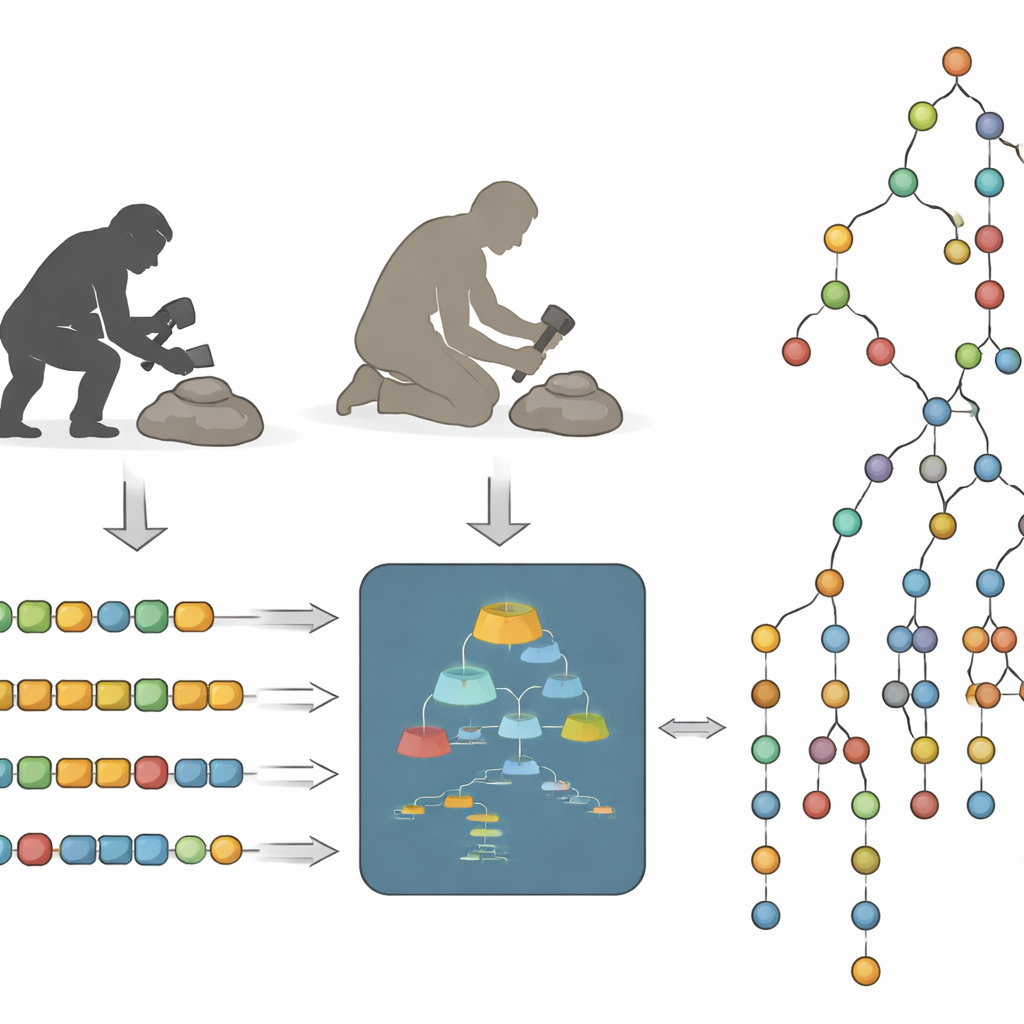
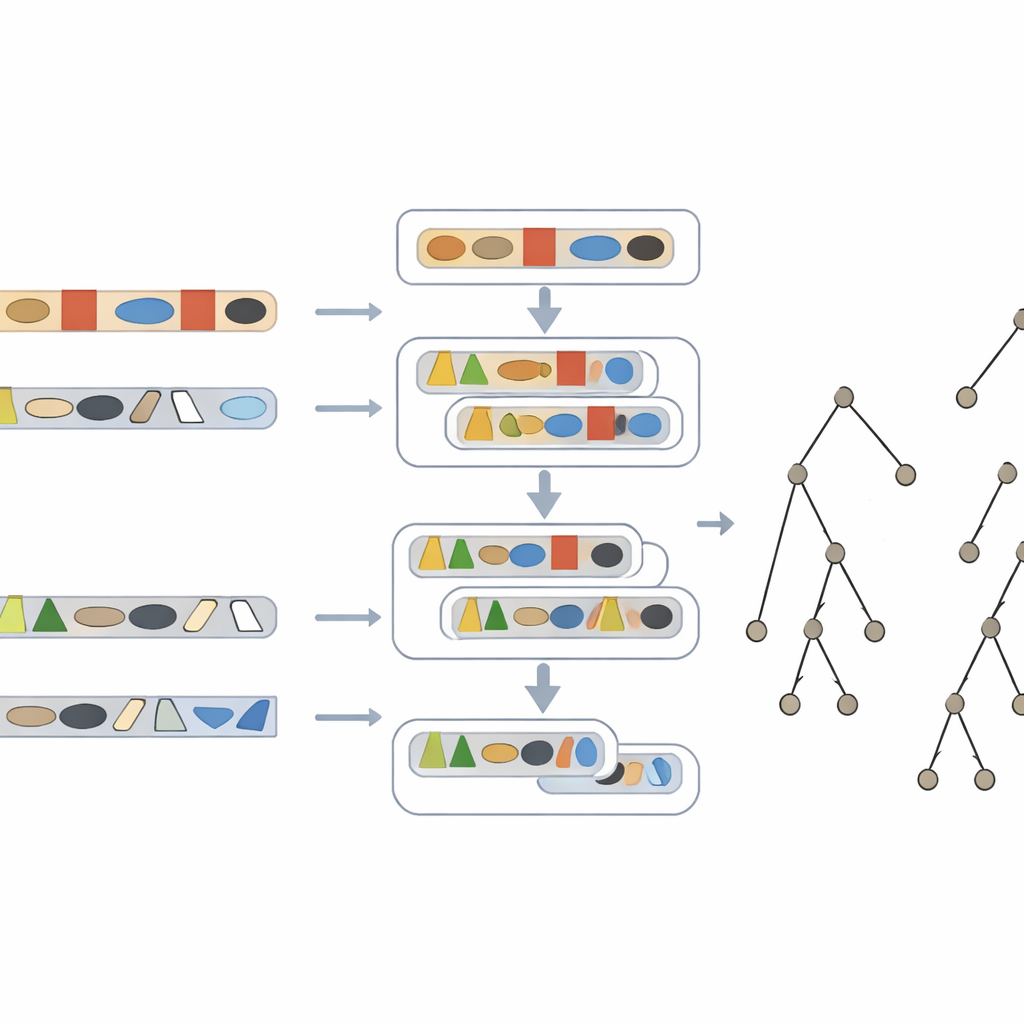
The authors introduce an analysis pipeline that turns streams of behavior into measurable "hierarchical complexity." They begin with videos of real percussive tool use: wild chimpanzees cracking nuts on anvils, and expert human stone knappers shaping Oldowan and Acheulean tools. Each distinct movement—such as picking up a nut, striking it, shifting grip, or removing a shell—is coded as a symbol in a long sequence. These sequences are then fed into a compression algorithm called Sequitur, which finds repeated subsequences ("chunks") and shows how they can nest inside one another. From the resulting rule book, the pipeline calculates several properties: how many chunks exist, how long they are, how many levels are stacked on top of each other, and how evenly branching is distributed in the resulting tree-like structures.
Outsmarting random noise and simple habits
To show that real tool use is more than repetition or simple habits, the researchers compared chimpanzee sequences to two kinds of synthetic controls. One was fully random, created by shuffling actions while keeping overall frequencies the same. The other was generated by a Markov model, which captures how likely each action is to follow the previous one but has no memory of longer-range relationships. If chimpanzee behavior were only a matter of local associations—"after this, usually do that"—then the Markov sequences should match the real ones in complexity. Instead, the chimpanzee nut-cracking sequences consistently produced longer phrases, more complex tree structures, and a richer variety of unique structural patterns than either random or Markov controls. About 30 percent of the structural "rules" in real behavior could not be reproduced by the Markov model, pointing to genuine hierarchical organization that goes beyond simple chaining.
Where chimpanzees and early humans diverge
The same method was then applied to human stone-tool-making sequences, which archaeologists already regard as strongly structured. Here, the researchers compared chimpanzee behavior with Oldowan and Acheulean tool production, two classic stages in human technological evolution. Human sequences showed greater hierarchical depth, longer recurring phrases, and higher structural diversity than chimpanzee nut-cracking, especially in the more advanced Acheulean tradition. At the same time, there was some overlap: not all human sequences were vastly more complex, and chimpanzee actions did show nontrivial layering. This pattern supports a picture of gradual evolutionary change, in which humans elaborated on capacities already present in great apes rather than inventing hierarchical planning from scratch.
What this means for minds and evolution
For a lay observer, the headline is that both chimpanzees and humans organize their tool-use actions in nested patterns, but humans take this nesting further. The new pipeline does not read minds; it identifies statistical signatures of hierarchy in what bodies do, not the exact thoughts behind them. Even so, it offers a powerful, general way to compare the "grammar" of behavior across species, tasks, and domains—from nut-cracking and stone knapping to gestures or birdsong. By showing that wild chimpanzee tool use has measurable hierarchical structure that surpasses what simple habits can explain, and that human tool use pushes this complexity further, the study provides a concrete, data-driven bridge between everyday actions and big questions about the evolution of language, culture, and the brain.
Citation: Taylor, D., Petersen, T., Crockford, C. et al. Measuring hierarchical structure across hominid percussive tool-use sequences. Commun Biol 9, 457 (2026). https://doi.org/10.1038/s42003-026-09633-8
Keywords: chimpanzee tool use, hierarchical behavior, stone tool making, cognitive evolution, behavioral sequences