Clear Sky Science · en
Controlling the human connectome with spatially diffuse input signals
Why this matters for everyday brains
Our brains are constantly shifting through patterns of activity, even when we sit quietly with our eyes closed. Doctors and engineers now try to gently push these patterns—using tools like magnetic pulses or weak electrical currents—to treat depression, epilepsy, and other conditions. But most models assume that a push to one tiny spot in the brain affects only that spot, which is not how real brains or real medical devices work. This paper asks a simple question with big implications: if we respect the brain’s geography and the way signals naturally spread through neighboring tissue, can we guide brain activity more efficiently and more in tune with biology?
Seeing brain activity as states and journeys
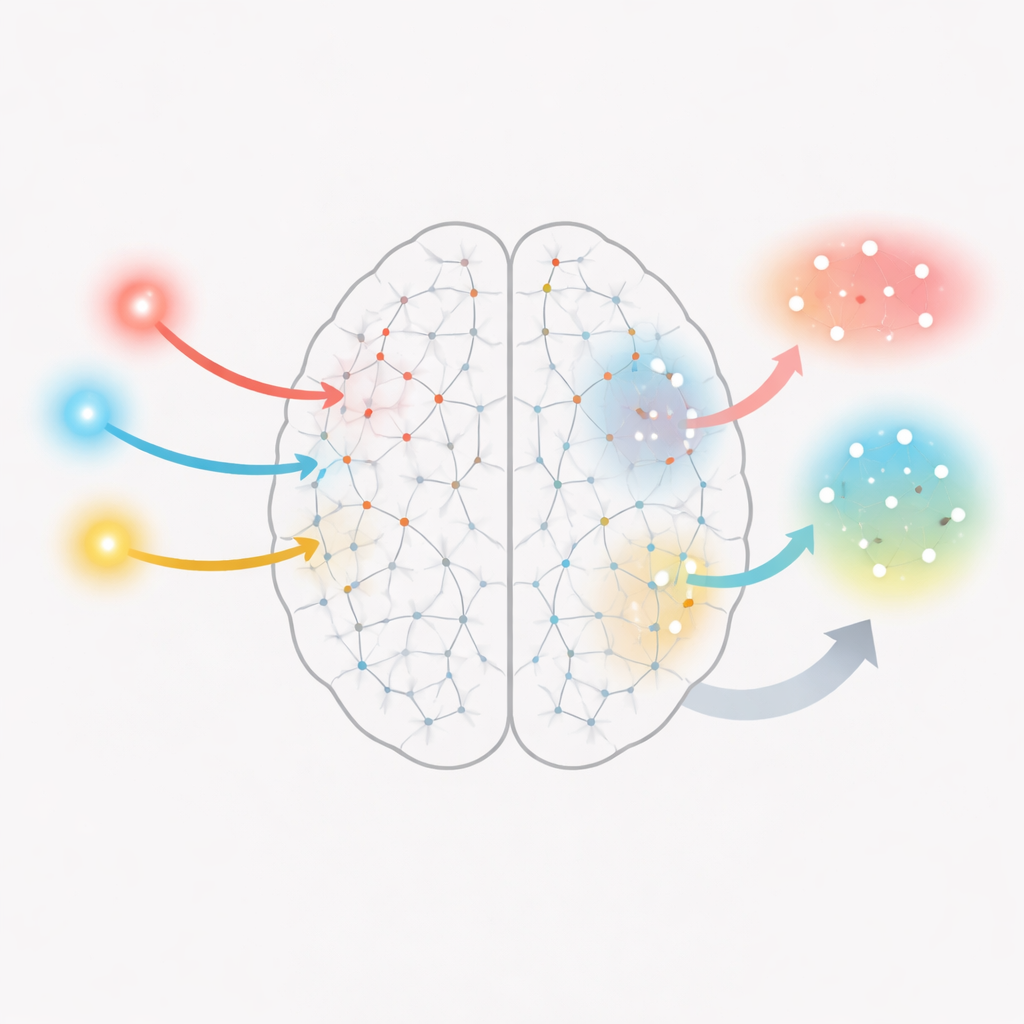
The authors start by treating the brain like a citywide power grid whose lights flicker in different neighborhoods over time. Each whole-brain pattern of activity—captured using functional MRI—is treated as a “brain state.” As activity rises and falls across hundreds of regions, the brain traces out a path through this landscape of states. Using data from dozens of healthy adults, the team identified eleven recurring states, each resembling familiar large-scale systems such as sensory networks, attention systems, and the so‑called default mode network that dominates during daydreaming. Moving from one state to another—say, from an externally focused state to an inwardly focused one—is like steering the brain along a route through this high‑dimensional space.
From idealized pushes to realistic nudges
To study how best to steer these routes, the researchers used a mathematical framework called network control theory. In its usual form, this framework assumes you can inject a precise, independent input into each brain region, as if every town in a country had its own dedicated power plant with zero spillover. That is convenient for equations but unrealistic for real stimulation methods, which always influence nearby tissue too. The authors replace this “pinpoint” view with a “splash” model: when they center an input on one region, neighboring regions also feel it, with the strength of the effect fading smoothly with distance. This simple change builds the physical layout of the cortex directly into the control model, acknowledging that adjacent areas are anatomically and functionally tied together.
Gentler, smarter routes between brain states
When they compared the traditional pinpoint model to their new spatially diffuse approach across all possible transitions between the eleven brain states, a clear pattern emerged. Over a broad and realistic range of how far signals spread, the diffuse strategy required substantially less “energy”—the total size of the control signals over space and time—to reach the same target state. In other words, by letting inputs naturally spill into neighboring regions, the model finds easier routes that work with the brain’s built‑in wiring and similarity between nearby regions. These more realistic inputs also produce slightly different paths through state space and different patterns of effort across regions, highlighting that where and how we stimulate the brain can meaningfully reshape its trajectories, not just their endpoints.
Doing more with fewer control knobs
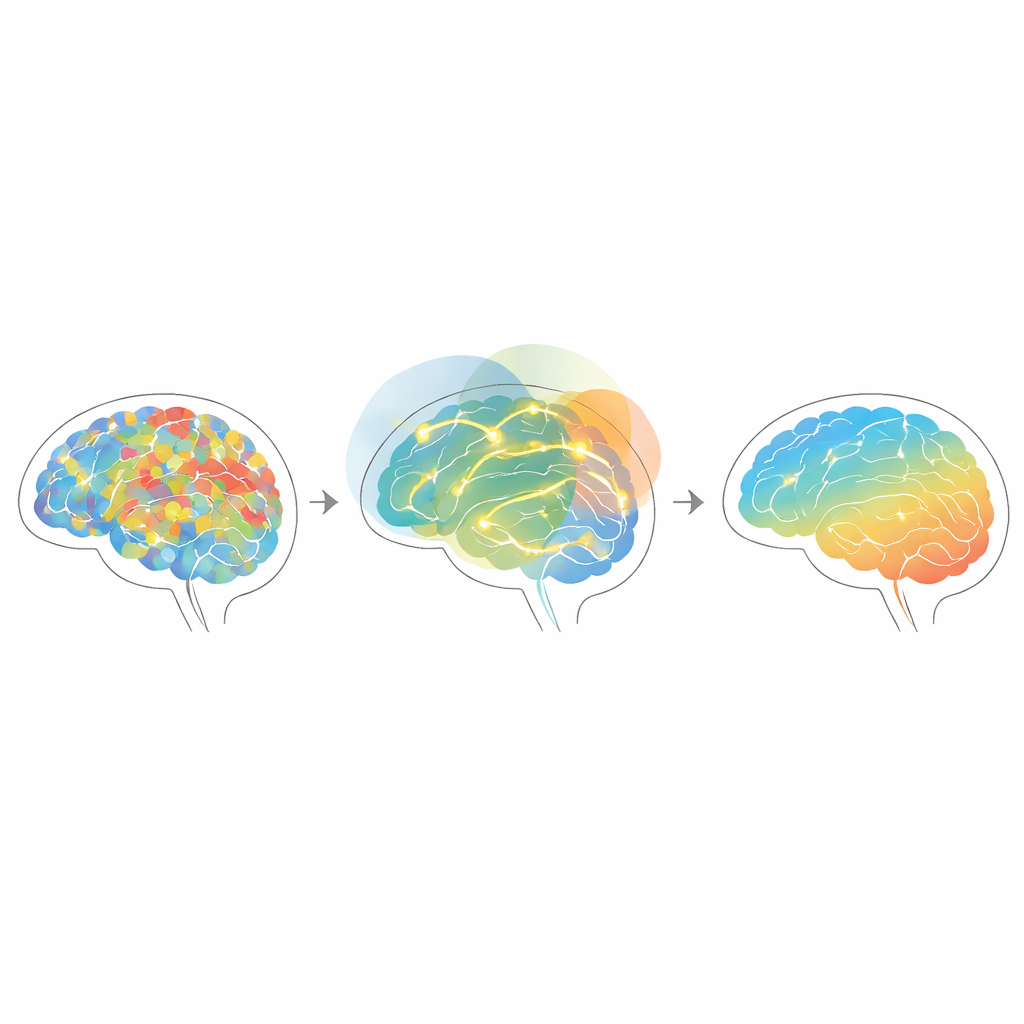
The study also tackles an important practical issue: real devices cannot deliver thousands of perfectly independent signals across the cortex. Inspecting their solutions, the authors notice that many regions receive highly similar time‑courses of input. They compress these into a much smaller set of “prototype” control signals and assign each prototype to multiple regions. Remarkably, even when they reduce the number of independent inputs by factors of tens, the brain still comes very close to the desired target states while using far less overall energy. The spatially diffuse model is especially compressible, achieving good control with fewer distinct inputs than the traditional approach. This suggests that, in principle, a limited number of well‑chosen stimulation patterns could orchestrate widespread, coordinated changes in brain activity.
Anchoring theory in real biology
Finally, the researchers compare their control‑derived input maps to many independent brain maps built from other types of data: metabolism, neurotransmitter receptor density, myelin content, developmental gradients, and patterns of cognitive function. The strongest control maps align with known axes that separate basic sensory areas from higher‑order association regions, with gradients of functional connectivity, and with specific chemical systems such as dopamine and acetylcholine. These links imply that the “easiest” ways to steer the brain are not arbitrary mathematical constructs; they echo deep organizational principles of the cortex and its chemistry.
What this means for guiding the brain
For a non‑specialist, the core message is intuitive: the brain is easier to nudge when we push it in ways that respect its natural geography and chemistry. Models that allow signals to spread across nearby regions not only better match how stimulation technologies actually work, they also show that we can move between meaningful brain states using less effort and fewer independent control points. In the long run, these insights could help design more efficient and targeted brain stimulation protocols—ones that rely on a handful of carefully placed and timed nudges to coax the whole network into healthier patterns of activity, rather than fighting against the brain’s own structure.
Citation: Betzel, R., Puxeddu, M.G., Seguin, C. et al. Controlling the human connectome with spatially diffuse input signals. Commun Biol 9, 501 (2026). https://doi.org/10.1038/s42003-026-09560-8
Keywords: brain stimulation, connectome, network control, brain states, neuroimaging