Clear Sky Science · en
Spatial distribution of isoprenoid enzymes and MpABCG1 transporter influences sesquiterpene accumulation in Marchantia polymorpha oil bodies
Why tiny plants and their hidden droplets matter
On the forest floor, the liverwort Marchantia polymorpha looks like a simple green mat. Yet inside some of its cells sit microscopic droplets called oil bodies that are packed with aromatic chemicals. These compounds help the plant fend off hungry insects and microbes, and many relatives of these molecules are valuable for medicines, fragrances, and crop protection. This study asks a deceptively simple question: where in these cells are the molecules made, and how do they end up stored in the oil bodies?

Hidden chemical factories inside special cells
Marchantia does not spread protective chemicals evenly across all its tissues. Instead, it concentrates a group of 15‑carbon molecules called sesquiterpenes inside the oil bodies of a special cell type. The researchers used genetic constructs that light up under a microscope whenever particular enzymes are present, allowing them to see both which cells turn these genes on and where inside each cell the corresponding proteins sit. They focused on the two main routes plants use to build terpenes from simple carbon building blocks and on the enzymes that assemble the final linear precursors used to make sesquiterpenes, diterpenes, and triterpenes.
Mapping the cell’s internal assembly lines
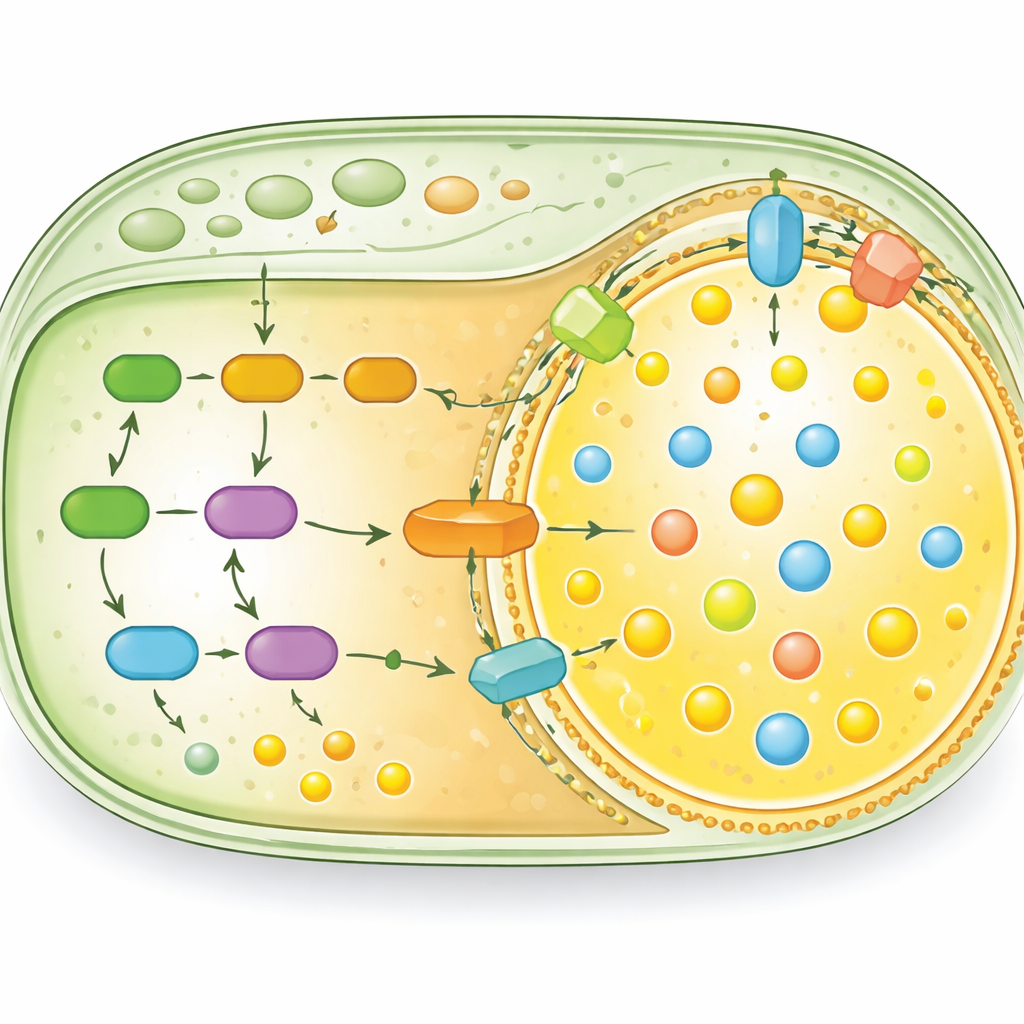
The fluorescent reporters revealed a clear division of labor inside oil body cells. Enzymes belonging to one pathway, which is typically associated with molecules used in photosynthesis and scent, clustered in green, chloroplast‑like compartments. There they likely produce precursors for compounds such as diterpenes. A second pathway, better known for supplying building blocks for sterols and many sesquiterpenes, appeared in the surrounding cell fluid and in thin membrane networks that form the cell’s internal transport system. The key enzyme that makes the direct precursor to sesquiterpenes was strongly and specifically present in oil body cells, emphasizing that these cells are the main sites where the defensive chemicals are built.
Testing the oil body as a mini storage tank
The team then asked whether they could repurpose these oil bodies to stockpile valuable foreign chemicals that the plant does not normally make. They introduced genes from other species that produce taxadiene, an early step toward the anti‑cancer drug Taxol, and β‑amyrin, a starting point for sweet and medicinal compounds from licorice. When these new enzymes were active across the whole plant, Marchantia produced measurable amounts of both target products. When the same enzymes were restricted to oil body cells, the plant still made the compounds, but yields were substantially lower. Boosting upstream enzymes in the supply pathways, a common engineering trick to increase output, did not significantly raise production in these specialized cells.
A transport gatekeeper for defensive oils
Because simple overproduction failed to fill the oil bodies, the researchers turned their attention to a membrane protein called MpABCG1, previously seen sitting on the oil body surface. When they increased the amount of this transporter together with certain precursor‑making enzymes, levels of several native sesquiterpenes inside the plant rose two- to threefold. In striking contrast, when they used gene editing to disrupt MpABCG1, the usual suite of sesquiterpenes almost disappeared, while other lipid‑like molecules and sterols stayed unchanged. The oil bodies in these mutant plants were smaller but still present, suggesting that the transporter specifically affects the buildup of sesquiterpenes rather than the existence of the compartment itself.
What this means for future green chemistry
By combining live imaging, metabolic engineering, and gene editing, the study paints a detailed picture of how a simple land plant organizes its internal chemistry. Oil body cells emerge as dedicated factories where distinct enzyme pathways feed precursors into defensive sesquiterpenes, and the MpABCG1 transporter acts as an essential gatekeeper for getting these products into storage. For non‑specialists, the key takeaway is that simply adding more pathway enzymes is not enough to turn Marchantia into a high‑yield biofactory. Successful design of plants that manufacture useful compounds in safe cellular “vaults” will also require carefully positioning enzymes and transporters so that molecules end up in the right place at the right time.
Citation: Forestier, E.C.F., Asprilla, P., Bonter, I. et al. Spatial distribution of isoprenoid enzymes and MpABCG1 transporter influences sesquiterpene accumulation in Marchantia polymorpha oil bodies. Commun Biol 9, 521 (2026). https://doi.org/10.1038/s42003-025-09508-4
Keywords: terpenes, plant oil bodies, metabolic engineering, ABC transporters, Marchantia polymorpha