Clear Sky Science · en
Reactive oxygen species-producing genes regulate mosquito midgut bacteria colonization, transcriptomic changes and cell repair
Why mosquito gut repair matters
Mosquitoes are best known as carriers of diseases like malaria and dengue, but inside their guts unfolds a microscopic drama that helps decide whether dangerous germs survive or die. This study looks at how two closely related enzymes in the mosquito intestine manage both harmful invaders and friendly resident bacteria, and how they trigger cell repair when the gut is damaged. Understanding these inner defenses could point to new ways to make mosquitoes less capable of spreading disease.
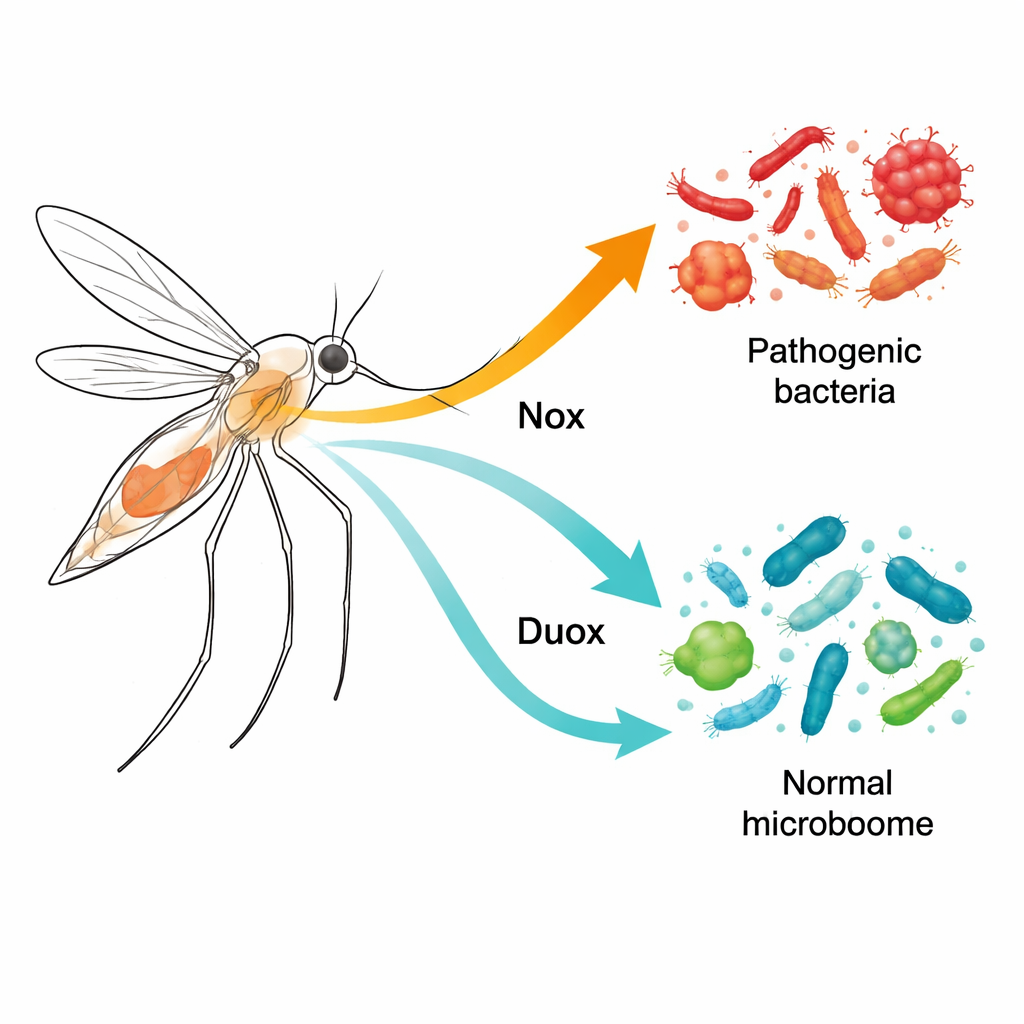
Two similar tools with very different jobs
The researchers focused on a stretch of the mosquito’s digestive tract called the midgut, the first place blood-borne and food-borne microbes arrive. Midgut cells can produce reactive oxygen species (ROS)—highly reactive molecules that help kill microbes—using two enzymes known as Nox and Duox. On paper they look similar, and both respond to stress signals inside cells. But it has been unclear whether they truly share the same tasks: Are they equally important for killing infectious bacteria, managing the normal microbiome, and helping damaged gut tissue heal?
Putting Nox and Duox to the test
To tease apart their roles, the team temporarily switched off either the Nox gene or the Duox gene in Aedes aegypti mosquitoes using RNA interference, and compared these insects with a control group. They then fed all three groups with large amounts of a gut-pathogenic bacterium called Erwinia carotovora 15 (ECC15) and counted how well the mosquitoes cleared the infection over time. Only mosquitoes with working Nox were able to almost completely eliminate ECC15 from their midguts within four days. When Nox was silenced, bacterial counts stayed high; when Duox was silenced, the bacteria declined but not as efficiently as in controls. Despite these differences, all infected mosquitoes survived at roughly similar rates, suggesting that Nox’s main impact is on gut-level control rather than immediate survival.
Keeping everyday gut bacteria in balance
The mosquito midgut is not empty in the absence of infection; it hosts a community of resident bacteria. The scientists examined how turning off Nox or Duox, without adding ECC15, altered this microbiome. Overall bacterial numbers did not change dramatically, but the mix of species did. In control and Duox-silenced mosquitoes, a few common genera such as Serratia and Enterobacter tended to dominate at later time points. In contrast, when Nox was silenced, a broader variety of low-abundance species expanded, and the community became more diverse. This suggests that Nox normally acts as a quiet gatekeeper, restraining rare bacterial types and helping one or a few main species stay in control, while Duox has a much smaller say in this balancing act.
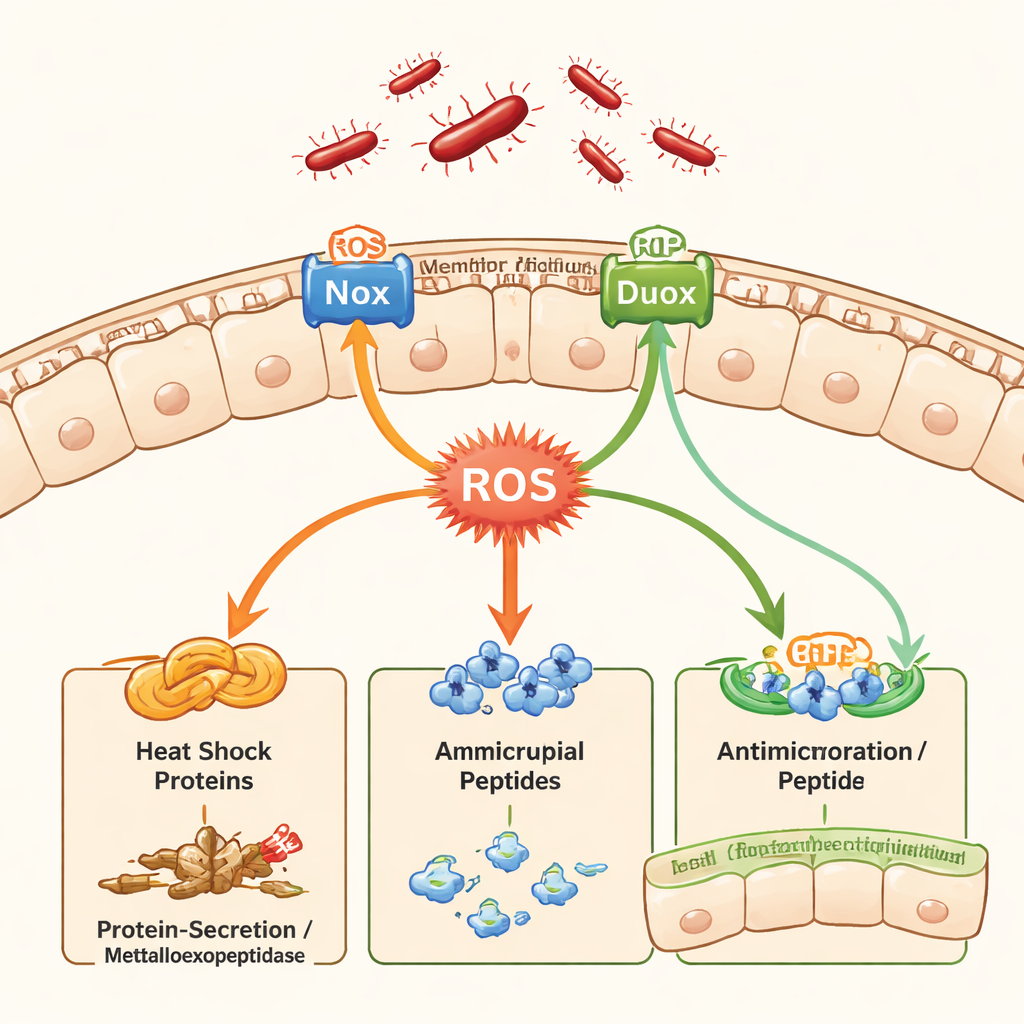
From stress signals to gut repair
The team then looked inside midgut cells at the level of gene activity. After ECC15 infection, mosquitoes with intact Nox showed large shifts in the activity of hundreds of genes tied to stress responses, protein handling, immunity and DNA repair. Silencing Duox blunted these changes somewhat; silencing Nox weakened them the most. In particular, genes for antimicrobial peptides—the mosquito’s natural antibiotics—were strongly induced in normal mosquitoes, less so without Duox, and least of all without Nox. Markers of cell division and repair, and genes that remodel the cell’s internal skeleton, also depended heavily on Nox. Microscopy confirmed this pattern: ECC15 infection triggered bursts of new cell growth in the midgut of control and Duox-silenced insects, but this regenerative response was largely absent when Nox was disabled. At the same time, Duox appeared more closely linked to a different set of proteins, metalloexopeptidases, which are involved in processing secreted proteins and helping maintain tissue barriers.
What this means for stopping disease
Altogether, the findings portray Nox as the central conductor of a stress-and-repair orchestra in the mosquito midgut. When pathogens arrive, Nox-driven ROS help kill invaders, fine-tune which resident bacteria thrive, switch on immune genes, and spur the gut lining to renew itself. Duox contributes to defense and barrier maintenance, but it is not the main coordinator. For a lay reader, the take-home message is that not all “similar” enzymes in a mosquito’s gut are equal: one, Nox, sits at the crossroads of immunity, microbiome control, and tissue repair. Targeting this pathway—or its partners such as heat shock proteins—could be a promising strategy to tip the balance against disease-causing microbes inside mosquitoes before they ever reach a human host.
Citation: Song, B., Zeb, J. & Sparagano, O.A. Reactive oxygen species-producing genes regulate mosquito midgut bacteria colonization, transcriptomic changes and cell repair. Commun Biol 9, 322 (2026). https://doi.org/10.1038/s42003-025-09024-5
Keywords: mosquito immunity, reactive oxygen species, gut microbiome, cell regeneration, vector-borne disease