Clear Sky Science · en
Mixed-valence Co0/IIOx clusters on silicalite-1 facilitate propane dehydrogenation to propene
Turning Everyday Gas into a Valuable Building Block
Propene is a quiet workhorse of modern life, forming the backbone of plastics, solvents and many everyday materials. Today it is mostly made as a by-product of breaking down crude oil, an energy-hungry and increasingly strained route. This article explores a new type of cobalt-based catalyst that can more cleanly and efficiently turn propane—abundant in shale gas—into propene, potentially lowering costs and environmental impact.
Why Propene Production Needs a Rethink
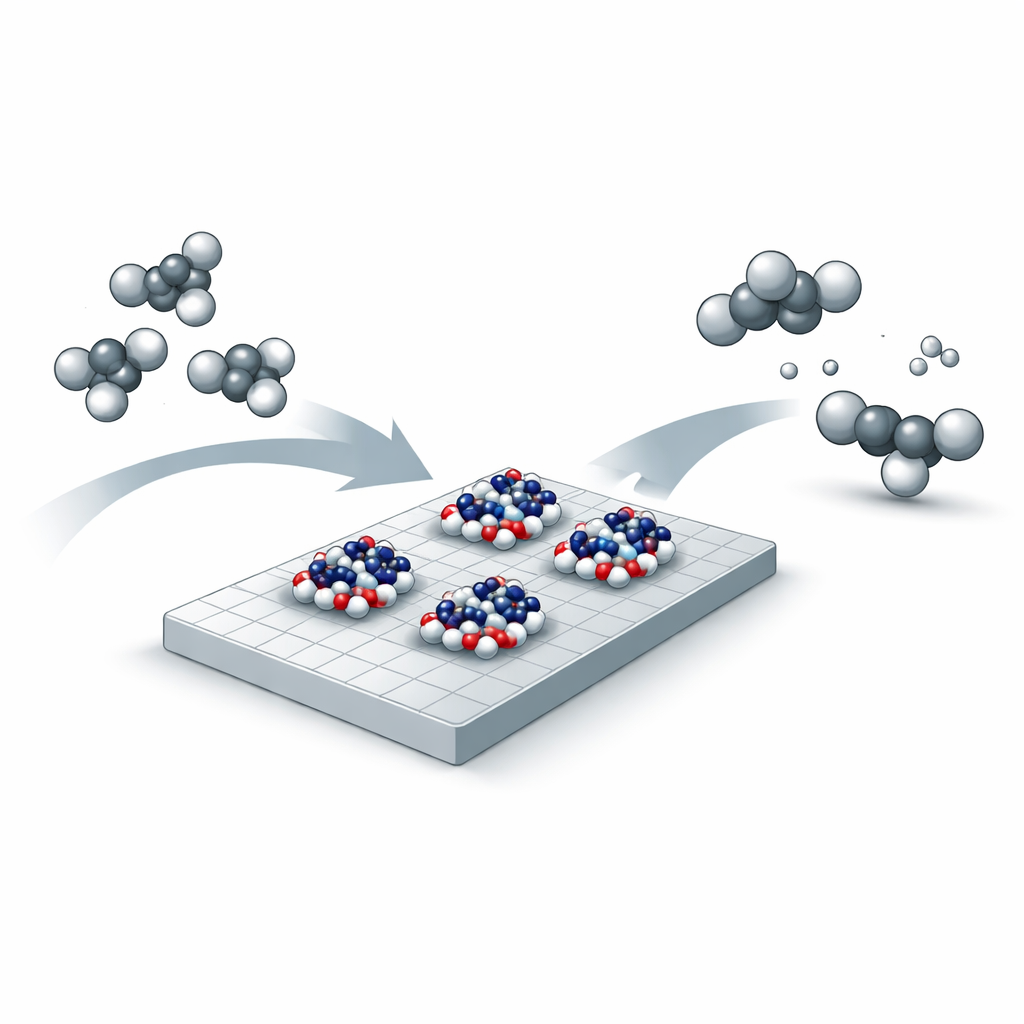
As demand for plastics and chemicals grows, industry needs more propene than traditional oil-refining routes can easily supply. An attractive alternative is to start directly from propane, a simple component of natural and shale gas, and remove hydrogen to make propene. Existing commercial technologies rely on platinum or chromium catalysts. Platinum is expensive and requires chlorine-containing treatments for upkeep, while chromium in its high-oxidation forms raises toxicity concerns. Many researchers have tried to replace these systems with catalysts based on cheaper metal oxides, but most alternatives lose activity too quickly or waste propane by forming unwanted by-products.
Building a Better Catalyst on a Tailored Surface
The authors designed a new catalyst by anchoring tiny clusters of cobalt and oxygen onto a porous silica material called silicalite-1. This support is riddled with special “defect” sites—silanol groups, a particular type of surface hydroxyl—that act like anchor points for cobalt. Using a carefully controlled deposition method, they created subnanometre cobalt oxide clusters in which a few metallic cobalt atoms sit on top of cobalt ions bound through oxygen atoms to the silicalite-1 framework. By comparing different supports, cobalt loadings and preparation methods, they showed that both the presence of these silanol defects and the precise way cobalt is introduced are critical to forming the highly active mixed-valence clusters.
How the Tiny Clusters Do the Heavy Lifting
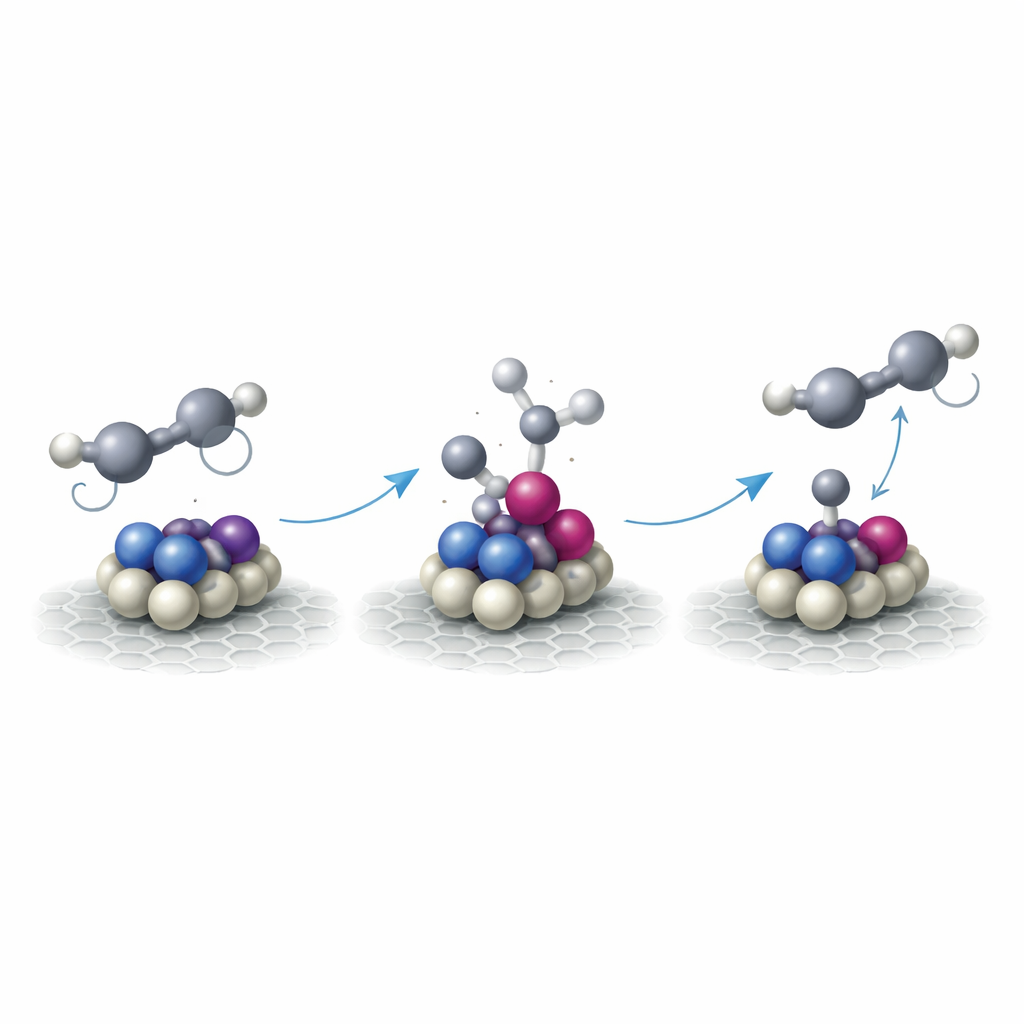
To see what actually happens during the reaction, the team combined high-resolution microscopy, X-ray techniques and computer simulations. Imaging revealed ultrasmall cobalt-oxide clusters roughly three-quarters of a nanometre across on the silicalite-1 surface. Under hydrogen and propane at reaction temperatures around 500 °C, part of the cobalt within these clusters is reduced to metallic form, but remains intimately connected to oxidized cobalt through oxygen bridges. Experiments that pulsed propane over either oxidized or pre-reduced catalysts showed that propene and hydrogen form only once the clusters are partially reduced. Detailed simulations indicate that the metallic cobalt atoms lower the barrier for breaking the carbon–hydrogen bonds in propane, while the oxidized cobalt network helps recombine surface hydrogen atoms into hydrogen gas. The slowest step is the pairing of hydrogen atoms, which governs the overall reaction rate.
Performance that Matters in the Real World
In practical tests, the best-performing catalyst, containing just 1.1 weight percent cobalt on silicalite-1, produced propene at high rates while operating close to the thermodynamic limits of the reaction. It maintained propene selectivity above about 90–98% even at high propane conversion and propene concentrations, conditions where side reactions and carbon deposits usually become problematic. When compared head-to-head with commercial-like platinum–tin and potassium–chromium catalysts, the cobalt system matched or exceeded their productivity and showed much better stability over dozens of on–off reaction and regeneration cycles. A preliminary economic analysis suggests that, if operated under optimized conditions, this cobalt-based route could deliver propene at costs comparable to established chromium technology but without the same environmental burden.
What This Means for Future Clean Chemical Production
In simple terms, the study shows that carefully engineered, mixed-valence cobalt clusters on a tailored silica support can turn propane into propene efficiently, selectively and durably. By tuning the balance between metallic and oxidized cobalt within clusters smaller than a nanometre, the researchers created active sites that break hydrogen from propane without tearing the molecule apart into unwanted fragments. This strategy not only offers a promising path toward cleaner and cheaper propene production, but also provides a blueprint for designing other metal-oxide catalysts that change their state under working conditions to deliver superior performance.
Citation: Zhang, Q., Li, Y., Tian, X. et al. Mixed-valence Co0/IIOx clusters on silicalite-1 facilitate propane dehydrogenation to propene. Nat Catal 9, 269–280 (2026). https://doi.org/10.1038/s41929-026-01488-w
Keywords: propane dehydrogenation, cobalt catalyst, propene production, zeolite support, mixed-valence clusters