Clear Sky Science · en
Electrochemical imaging of thermochemical catalysis
Why this matters for cleaner chemistry
Chemical factories and fuel refineries rely on solid metal catalysts to speed up vital reactions, from making plastics to cleaning exhaust. Yet even a polished metal surface is a patchwork of tiny crystalline "grains," each behaving a bit differently. This paper shows how to take a high‑resolution "activity map" of such a surface while it is working, revealing how these grains cooperate, compete and sometimes poison one another. The insights could help design smarter catalysts that waste less energy and make fewer by‑products.
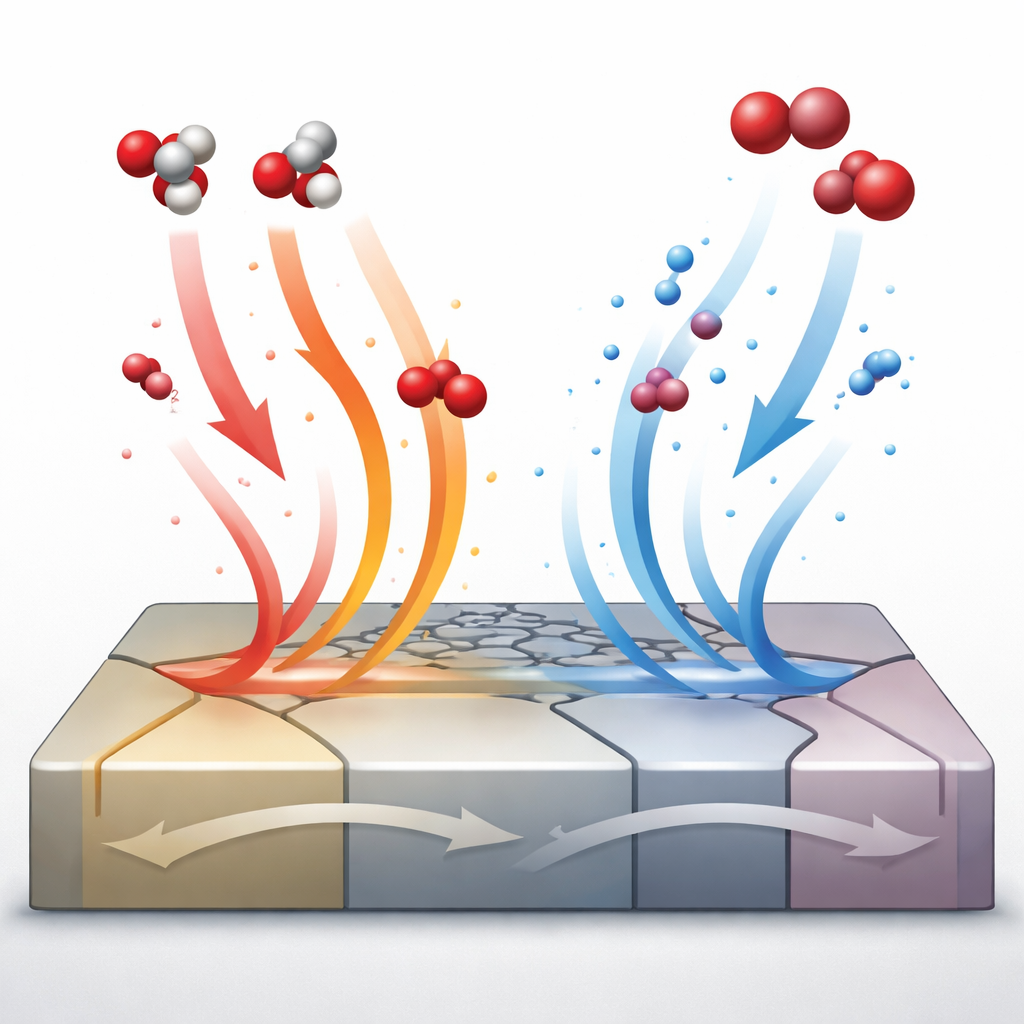
Seeing reactions one tiny patch at a time
The researchers focus on a well‑known reaction: the aerobic oxidation of formic acid on platinum. In simple terms, this overall transformation can be broken into two linked steps, one that strips electrons from formic acid and one that feeds those electrons to oxygen gas. Instead of treating the platinum as a uniform slab, the team uses a technique called scanning electrochemical cell microscopy (SECCM) to probe thousands of microscopic spots across a single metal foil. A fine pipette brings down a tiny droplet of electrolyte that briefly touches one spot, measures the current flowing from a chosen reaction and then hops to the next location, gradually building a detailed picture of how fast each region works.
Different patches, different jobs
By combining SECCM with an electron‑based method that identifies how each grain in the platinum is oriented, the team shows that some grains are much better at one half of the overall reaction than the other. Certain surface orientations excel at reducing oxygen, while others are more active for burning formic acid. When the authors overlay the current–voltage behavior of the two half‑reactions, they can predict the so‑called mixed potential—a balance point where the two steps would exactly counter each other—and the corresponding overall rate, grain by grain. This analysis reveals that no single grain type is "best" at everything; instead, the most effective overall behavior emerges from how grains with complementary strengths are electrically linked.
Cooperative currents across the surface
The study goes beyond predictions by measuring what actually happens when both formic acid and oxygen are present together. Under these realistic conditions, each spot on the surface settles to a mixed potential where the net current is zero, even though both half‑reactions are running underneath. By fitting the data around this balance point, the authors infer the true local reaction rate at each spot. They find that small differences in preferred potential between neighboring grains are enough to drive lateral electron currents across the surface. In effect, regions that are naturally better at the oxygen step behave like tiny cathodes, while regions that favor formic acid oxidation act like tiny anodes, forming countless microscopic short‑circuited cells that boost the overall reaction.
When reactants talk to each other
A surprising result is that the two halves of the reaction are not completely independent. Comparing measurements with and without the partner reactant shows that the presence of formic acid strongly slows the oxygen reduction step, while oxygen slightly speeds up formic acid oxidation on most grains. The authors attribute this "chemical cross‑talk" to carbon monoxide species that build up on the surface and block active sites. These poisons are generated more readily when both reactants are present, shifting the balance point of the reaction and reducing the rate of oxygen use. The extent of this effect varies from grain to grain and becomes worse at slower operating conditions, when the surface has more time to accumulate blocking species.
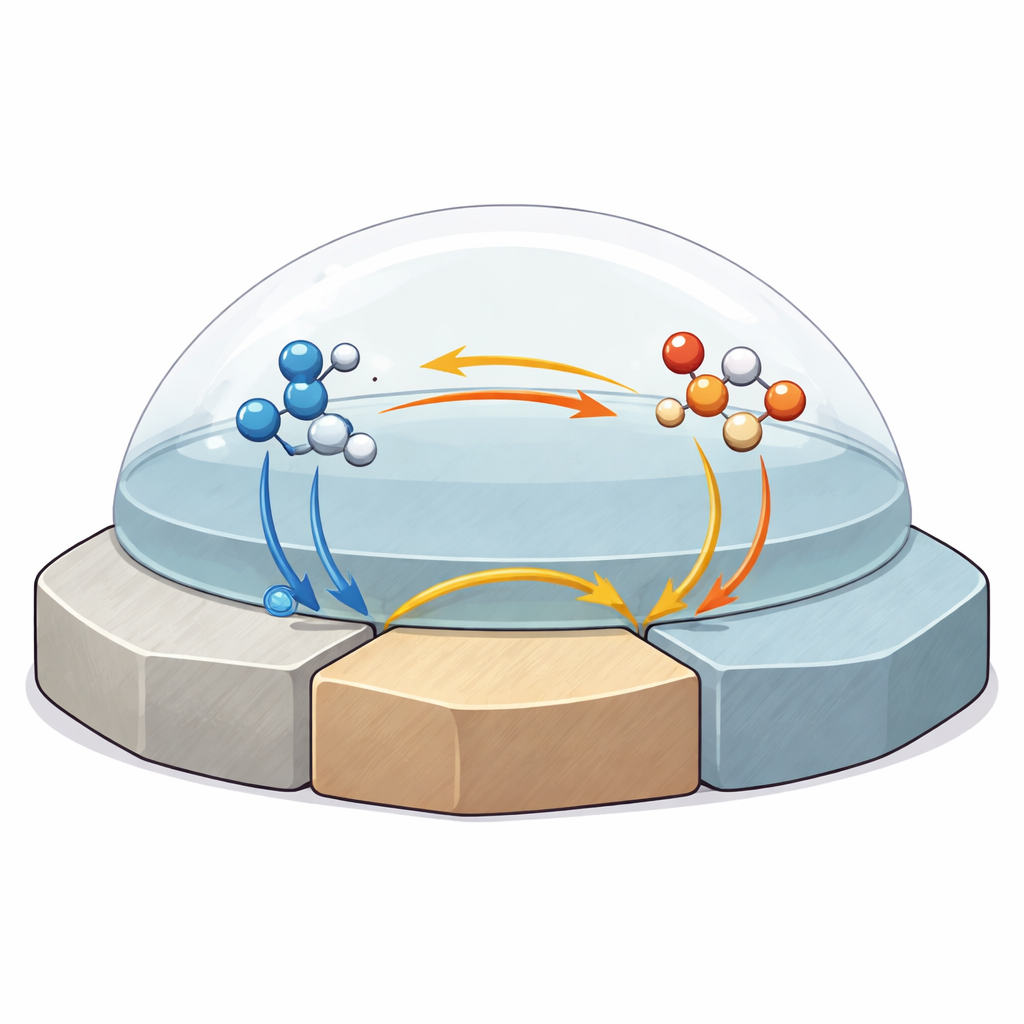
What this means for future catalysts
For non‑specialists, the key message is that metal catalysts should be thought of less as flat, uniform plates and more as intricate electrical networks of tiny regions that share charges and influence each other chemically. By imaging how fast and how cleanly each patch works, and how poisons spread and are removed, this approach offers a powerful new way to diagnose and improve catalysts used in energy and manufacturing. It suggests that the highest performance may come not from a single "perfect" surface, but from deliberately combining different kinds of active sites and possibly even separating certain steps in space to avoid harmful cross‑talk. Such understanding is essential for building the next generation of cleaner, more efficient chemical processes.
Citation: Xu, X., Howland, W.C., Martín-Yerga, D. et al. Electrochemical imaging of thermochemical catalysis. Nat Catal 9, 307–318 (2026). https://doi.org/10.1038/s41929-026-01486-y
Keywords: thermochemical catalysis, electrochemical imaging, platinum catalysts, formic acid oxidation, oxygen reduction