Clear Sky Science · en
Radiofrequency cascade readout of coupled spin qubits
Why faster quantum measurements matter
Quantum computers promise to solve certain problems far beyond the reach of today’s machines, but only if we can build chips that host and monitor millions of fragile quantum bits, or qubits. Silicon spin qubits—tiny magnets made from single electrons trapped in a silicon transistor structure—are especially attractive because they can be manufactured in the same factories that make modern computer processors. A major bottleneck, however, is how to read out the state of each qubit quickly and reliably without filling the chip with bulky sensors. This paper introduces a new way to boost the sensitivity of a compact readout method, potentially clearing a path toward dense, scalable quantum processors built in standard silicon technology.
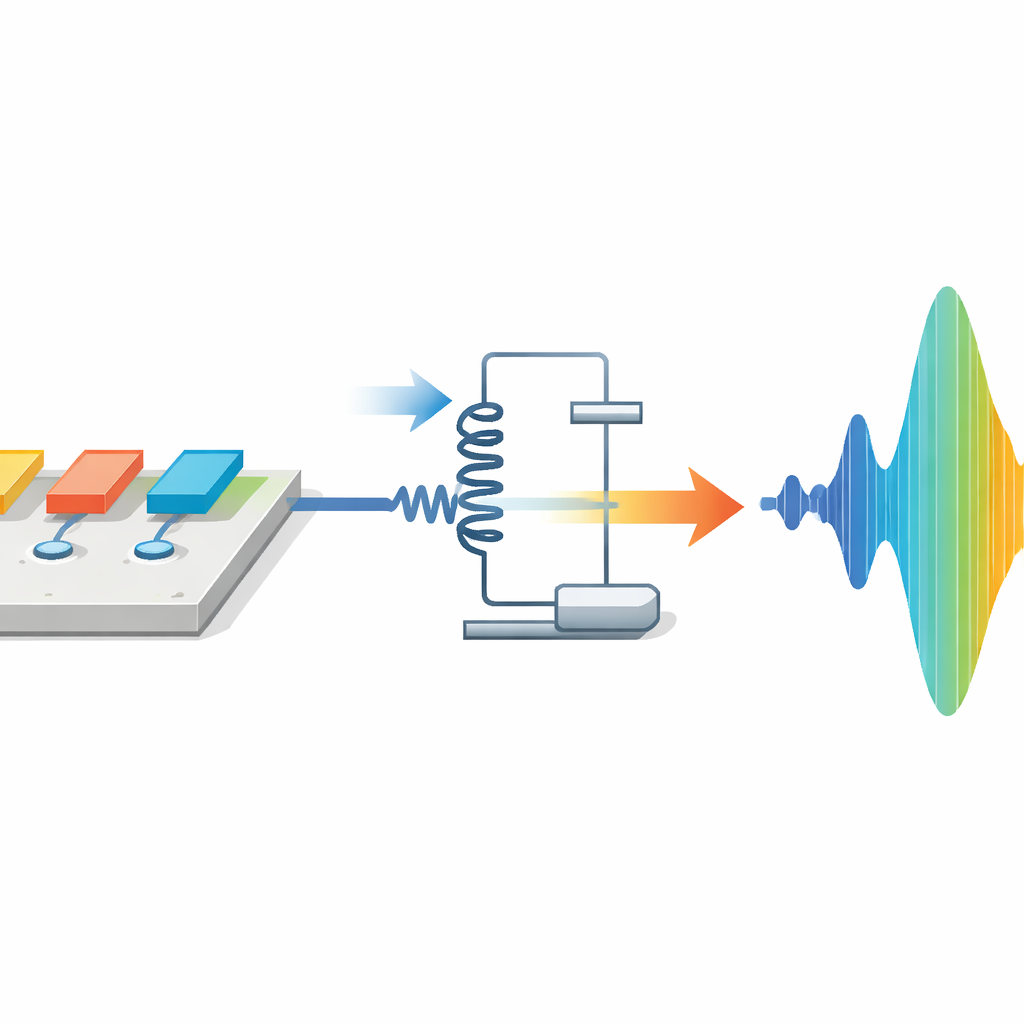
A new way to listen to tiny electron magnets
Most silicon spin qubits are hosted in “quantum dots,” small puddles of electrons defined by metal gates on top of a silicon chip. To find out whether two spins are aligned or opposed, researchers typically convert the spin information into a difference in electric charge and detect it with a neighboring charge sensor. That sensor works well but consumes valuable area and wiring. An alternative, called dispersive readout, couples the quantum dots directly to a radiofrequency (rf) resonant circuit and infers the spin state from tiny changes in how the circuit reflects an incoming rf signal. In planar silicon devices this in situ method has so far been too insensitive for practical use. The authors tackle this limitation by adding a third quantum dot that acts as an on-chip amplifier, creating what they call an rf electron cascade.
Turning a weak signal into a strong cascade
In their device, two quantum dots hold the two-electron spin qubit, while a nearby multi-electron dot is connected to an electron reservoir. The multi-electron dot is strongly coupled electrically—but not directly by tunneling—to one of the qubit dots. When the rf drive makes charge slosh back and forth between the qubit dots, that motion shifts the energy of the multi-electron dot just enough to trigger an additional electron tunnelling in and out of the reservoir in a synchronized, “cascaded” fashion. Instead of sensing only the small polarization charge inside the qubit pair, the resonant circuit now also senses the larger charge flow associated with the reservoir. This effectively amplifies the readout signal by more than 35 decibels, allowing the team to distinguish charge configurations in only 7.6 microseconds—over two orders of magnitude faster than earlier planar silicon dispersive readout experiments.
Reading spins and controlling their dance
With this enhanced signal, the researchers demonstrate spin readout using a well-known effect called Pauli spin blockade: certain spin pairings allow charge to move between the dots, while others do not. By tracking how the rf response changes with magnetic field and time, they separate the singlet and triplet states of the two electrons and measure how quickly one relaxes into the other. They then go beyond passive readout and use carefully shaped voltage pulses to control the exchange interaction between the spins, which governs how strongly they influence each other. This control lets them drive coherent oscillations between different two-spin configurations over a wide range of interaction strengths, an essential ingredient for two-qubit quantum logic gates.
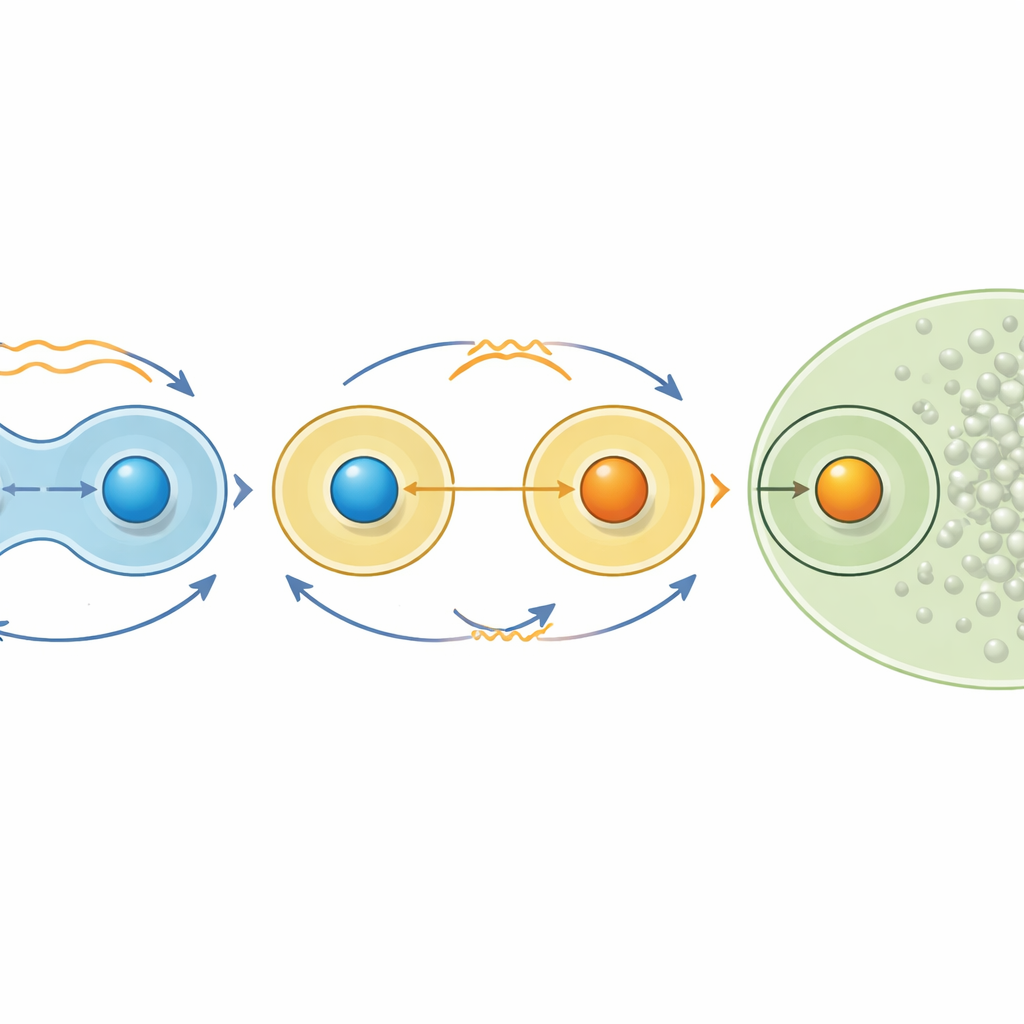
Keeping quantum information coherent
The team examines how noise in the device—both electrical fluctuations in the gates and tiny magnetic fields from naturally occurring silicon nuclei—limits the stability of the spin states. They extract characteristic times over which the oscillations decay and show that, even in natural silicon, the coherence time and charge noise are comparable to the best reported values for similar industrially fabricated devices. By applying an echo-style pulse sequence, which flips the spins halfway through their evolution to refocus slow drifts, they extend the effective coherence time by roughly an order of magnitude. In the regime where the exchange interaction dominates over magnetic differences between the dots, they achieve a qubit quality factor above 10, corresponding to a prospective two-qubit gate fidelity nearing 98%.
Toward large silicon quantum chips
Finally, the authors sketch how the rf electron-cascade concept could be scaled up. In their vision, data qubits are coupled to nearby “ancilla” dots, which in turn link into chains of cascaded dots feeding a distant reservoir and shared resonant circuit. By driving different chains at distinct rf frequencies, many qubits spread across a two-dimensional array could be read out simultaneously without shuttling electrons or dedicating a separate sensor to each qubit. Combined with the demonstrated exchange-based control and the compatibility with 300-millimeter silicon manufacturing, this work suggests a practical route to denser, more efficient silicon quantum processors, where fast, high-gain readout is built directly into the fabric of the chip.
Citation: Chittock-Wood, J.F., Leon, R.C.C., Fogarty, M.A. et al. Radiofrequency cascade readout of coupled spin qubits. Nat Electron 9, 314–323 (2026). https://doi.org/10.1038/s41928-026-01582-8
Keywords: silicon spin qubits, quantum dot readout, radiofrequency sensing, exchange-based two-qubit gates, quantum computing hardware