Clear Sky Science · en
A crossbar chip for benchmarking semiconductor spin qubits
Why packing quantum bits matters
Today’s experimental quantum computers use only a tiny fraction of the millions of quantum bits, or qubits, that will eventually be needed for useful machines. Before engineers can build such large processors, they must learn how reliably they can manufacture and control qubits across an entire chip, not just a few lucky spots. This paper introduces a specialized chip that acts as a test platform for hundreds of semiconductor spin qubits at once, helping researchers understand how well these fragile building blocks behave at the extreme conditions where quantum computers operate.
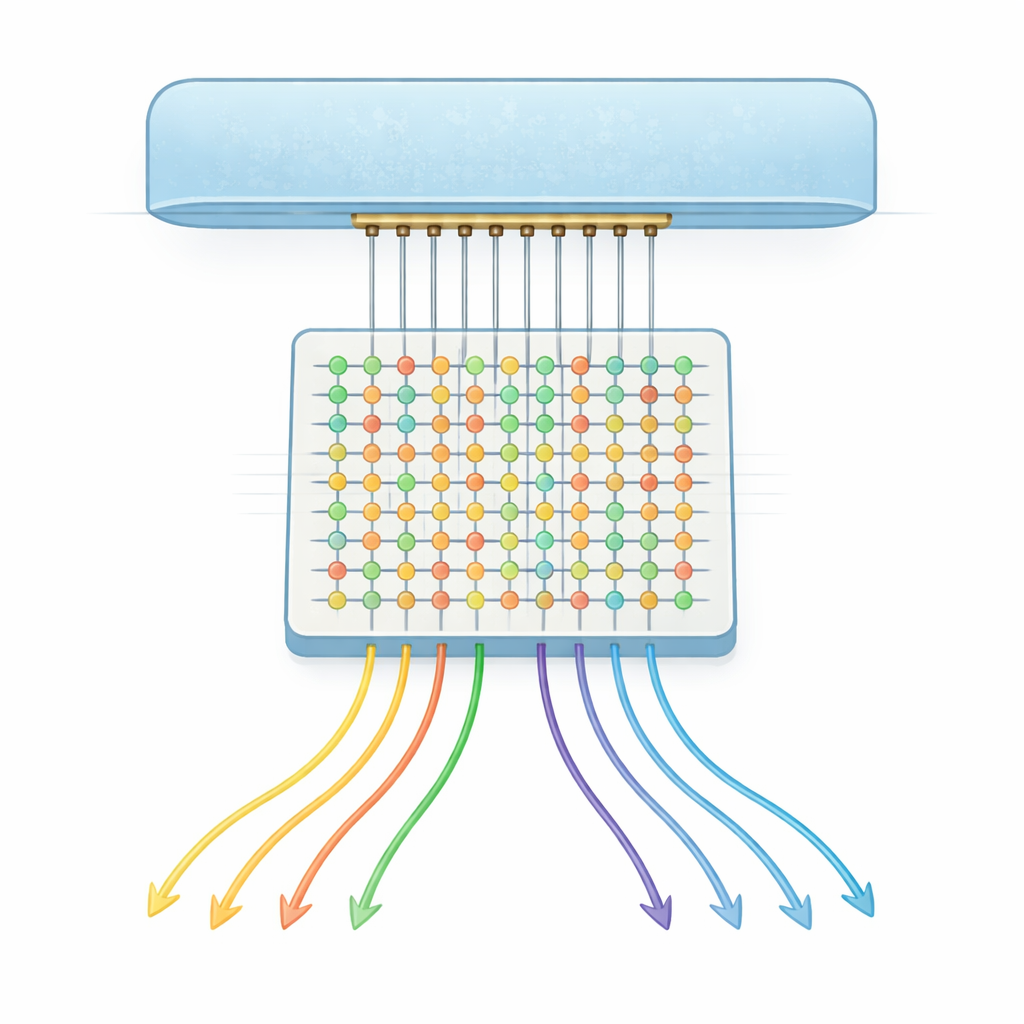
A quilt of tiny test cells
The heart of the work is a carefully designed “crossbar” chip patterned in a thin germanium layer grown on silicon. Instead of wiring every qubit individually, the authors divide the chip into tiny repeating tiles, each containing a double quantum dot used as a qubit plus a nearby charge sensor. These tiles are arranged in a 23-by-23 grid. Clever sharing of control lines—similar in spirit to the way rows and columns are addressed in computer memory—means that a chip with the potential to host 1,058 individual spin qubits needs only 53 external connections. This sublinear growth of wiring with qubit number is crucial if future quantum processors are to fit inside cramped cryogenic refrigerators.
Turning on single charges, one tile at a time
To see whether this architecture works in practice, the team cools the chip to a fraction of a degree above absolute zero and applies radio-frequency signals to the shared sensor line. By adjusting just two gate voltages, they can select one tile out of the dense array and observe a characteristic pattern of peaks that confirms they are sensing that specific tile and no others. In 38 of 40 tested tiles, the charge sensors show the expected behavior, demonstrating reliable addressability across the grid. In a second step, the researchers tune one quantum dot in each tile down to the regime where it holds only a few positively charged holes, and in most tiles they are able to reach the very last hole—exactly the operating point needed for spin-qubit experiments.
How uniform are these tiny devices?
With dozens of dots tuned in a similar way, the chip becomes a statistical laboratory. The team measures how strongly each gate on a tile influences the local quantum dot, how much voltage is needed to add each extra hole, and how these values vary from place to place. They find that dots closest to certain gates respond more strongly, as intended, and that the voltages required to reach the first few holes vary by only a few percent across the device. This gives a concrete target for how precisely control pulses must be matched if many qubits are to be driven in parallel. They also probe the ever-present electrical “charge noise” that jostles the energy levels of the dots, by watching fluctuations at both the sensor and the qubit itself. Across the array, the noise follows a familiar slow 1/f spectrum and varies by more than a factor of ten from the quietest to the noisiest tiles, yet the average levels are in line with expectations for this material stack.
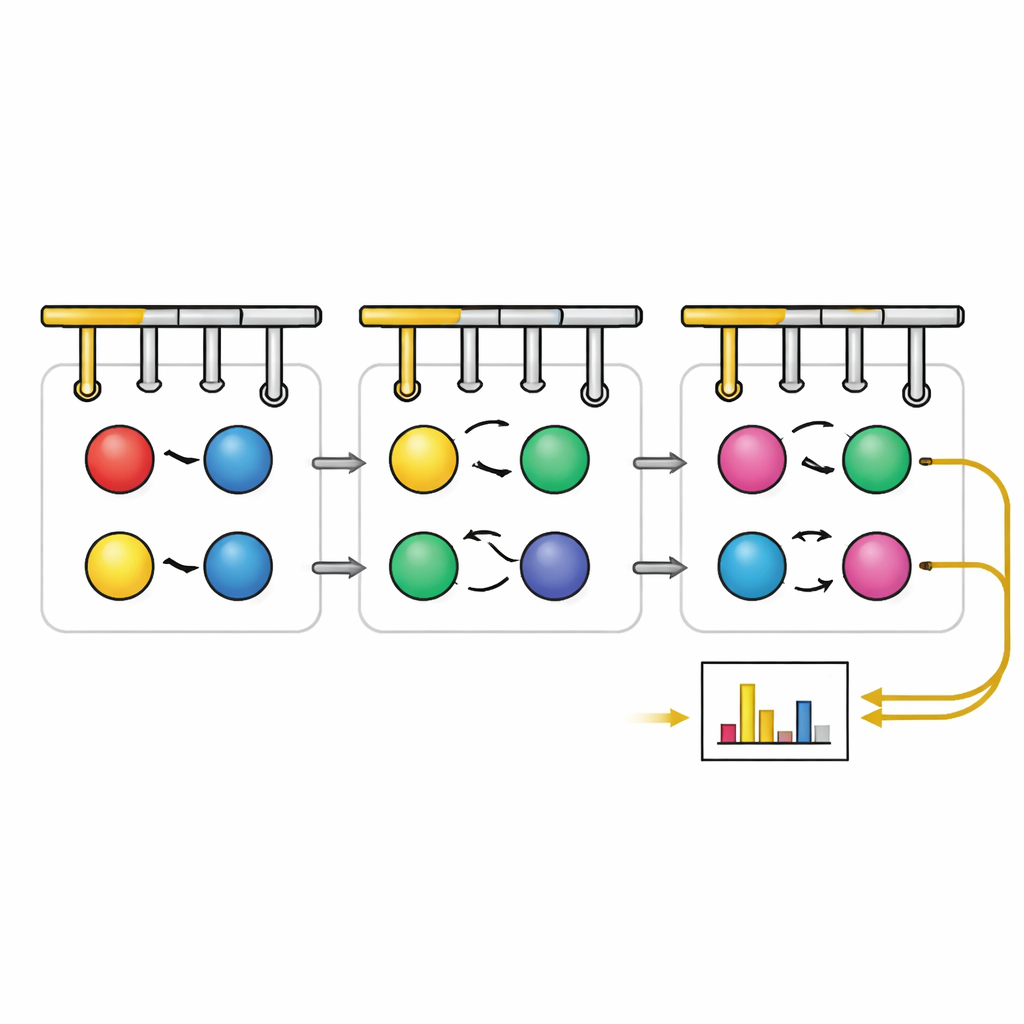
Zooming in on working spin qubits
To show that the platform can host fully functional qubits, the authors study a second chip where the barrier between two dots within a single tile works as intended. There they realize two standard types of spin qubits: a singlet–triplet qubit encoded in a pair of spins, and two single-spin qubits driven electrically. By pulsing the local gates and applying microwave signals, they observe clear patterns of spin oscillations and measure how long the spins retain their quantum phase. The extracted coherence times, of a few to more than ten microseconds, are comparable to the best values previously reported for germanium hole spins, confirming that squeezing many tiles together does not fundamentally degrade qubit quality.
What this means for future quantum chips
Instead of being a quantum computer in its own right, this crossbar chip is a high-throughput test bed. It allows researchers to benchmark yield, device uniformity, charge noise and qubit coherence across hundreds of nearly identical cells in a single cool down. This kind of statistical feedback can guide improvements in materials and fabrication, and it meshes naturally with automated tuning and machine-learning tools that will be needed to operate large arrays. The authors argue that their QARPET platform, or variations of it adapted to other semiconductor systems, can help bridge the gap between today’s few-qubit demonstrations and tomorrow’s industrial-scale spin-based quantum processors.
Citation: Tosato, A., Elsayed, A., Poggiali, F. et al. A crossbar chip for benchmarking semiconductor spin qubits. Nat Electron 9, 324–333 (2026). https://doi.org/10.1038/s41928-026-01569-5
Keywords: spin qubits, quantum dots, crossbar arrays, germanium semiconductors, quantum benchmarking