Clear Sky Science · en
Fully autonomous tuning of a spin qubit
Letting quantum chips tune themselves
Future quantum computers may contain millions of tiny quantum bits, or qubits, packed onto semiconductor chips. Today, getting even a handful of these qubits to work properly requires weeks of painstaking adjustment by expert researchers, turning dozens of electronic “knobs” by hand. This article describes a system that hands that job over to the machine itself: an automated procedure that can wake up a cold, silent quantum chip and guide it all the way to a functioning qubit without human intervention.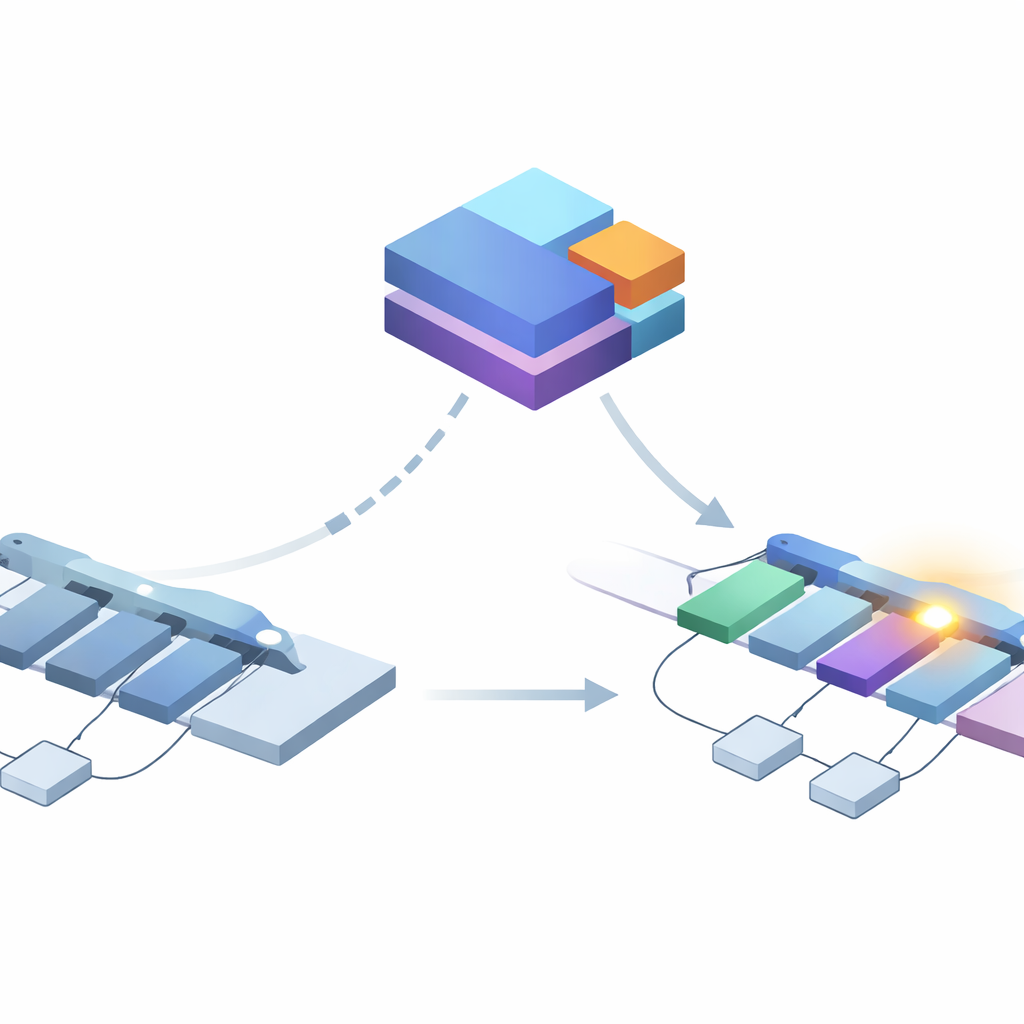
Why tuning quantum chips is so hard
Semiconductor spin qubits are promising building blocks for quantum computers because they can, in principle, be manufactured with techniques similar to those used for everyday computer chips. Each qubit lives in a tiny region of a nanowire or transistor, defined and controlled by voltages on many gate electrodes. To make a reliable qubit, the gates must be adjusted so that just the right amount of electric charge sits in just the right places, the barriers between regions are neither too high nor too low, and the qubit can be read out and controlled by microwave pulses. All of these conditions depend delicately on several voltages and magnetic fields at once, so the space of possible settings is enormous—like searching for a single grain of sand in a house-sized pile. That complexity is what currently limits experimental quantum chips to only a few qubits per device, even though fabrication could support vastly more.
A step-by-step robotic operator
The authors build a four-stage “digital operator” that takes over this search. It starts from a device with all gate voltages set to zero and uses measurements of the tiny electrical currents flowing through the nanowire as feedback. In the first stage, the system learns where current starts and stops as it sweeps combinations of barrier gate voltages, and uses a statistical model to outline a region where a double quantum dot—a pair of neighboring charge puddles—can form. In the second stage, it focuses on that region and reshapes the barriers so that certain current patterns, called bias triangles, become sharp and well-separated, signaling that the energy levels inside the device are suitable for isolating spin states.
Teaching the machine what to look for
To recognize promising patterns without a human in the loop, the algorithm draws on several branches of modern data science. Neural networks, trained on thousands of earlier measurements and simulations, can tell whether a current image corresponds to a well-formed double dot, whether it suffers from disruptive charge jumps, or whether it shows the hallmark of “spin blockade,” a condition needed to turn spin information into an easily measured current signal. Other computer vision routines automatically find and follow geometric features in the data, such as the edges and tips of the bias triangles. Bayesian optimization, a strategy for efficient trial-and-error search, proposes new voltage settings that are most likely to improve a chosen score—for example, a measure related to how cleanly different spin states are separated in energy.
From raw device to working qubit
Once the algorithm has found a transition that shows spin blockade, it enters the final stage: searching not just over gate voltages, but also over microwave frequency, magnetic field, and pulse length to locate conditions where the spin responds coherently. It looks for a peak in the leakage current as the magnetic field is swept, using an entropy-based score to single out traces where a clear feature stands out from the background. When a likely candidate is found, the system automatically performs more detailed measurements, including patterns of oscillations known as Rabi chevrons, to confirm that it has genuine, controllable qubit behavior. In tests on a germanium–silicon nanowire device, the procedure successfully reached clear Rabi oscillations—firm evidence of a working qubit—in 10 out of 13 runs, typically within about a day and a half of fully automated operation.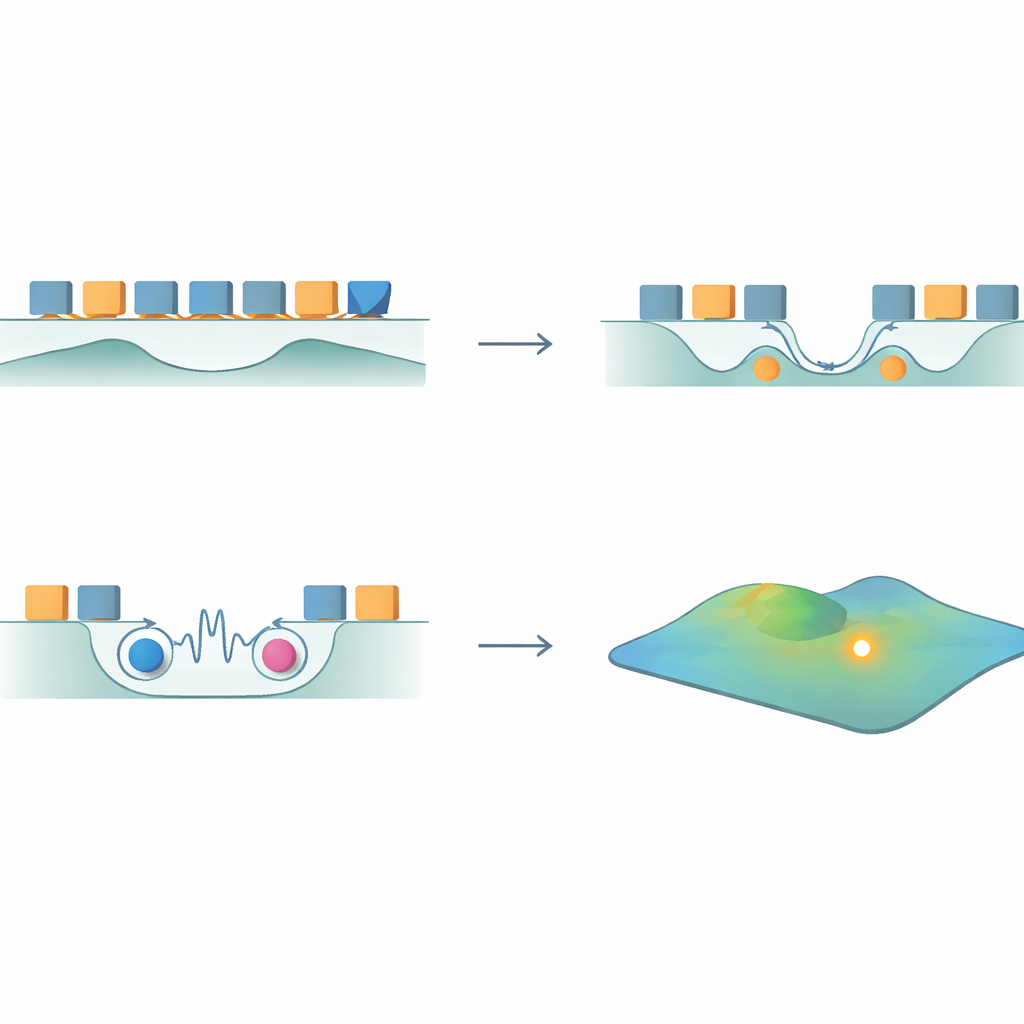
Opening the door to large quantum processors
For a layperson, the key message is that this work shows how the most tedious and expertise-heavy part of operating quantum chips can be delegated to smart software. Instead of researchers manually hunting through a vast space of settings, an automated pipeline uses pattern recognition and guided exploration to find tiny “sweet spots” that would otherwise remain hidden. Because the method is modular and relies on general measurement patterns rather than device-specific tricks, it should transfer to other quantum chip designs and can be extended to characterize how qubit quality varies across a wafer. As quantum processors grow from dozens to thousands or millions of qubits, such hands-free tuning and self-optimization will be essential for turning laboratory prototypes into practical quantum technologies.
Citation: Schuff, J., Carballido, M.J., Kotzagiannidis, M. et al. Fully autonomous tuning of a spin qubit. Nat Electron 9, 304–313 (2026). https://doi.org/10.1038/s41928-025-01562-4
Keywords: spin qubits, quantum device automation, machine learning, semiconductor quantum computing, nanowire quantum dots