Clear Sky Science · en
Microbial upcycling of plastic waste to levodopa
From plastic trash to useful medicine
Most of us see empty plastic bottles as throwaway junk, but they are also packed with carbon that took millions of years to form and minutes for us to discard. This study explores a way to turn that wasted carbon into levodopa, a key drug used to treat the symptoms of Parkinson’s disease, by teaching microbes to “eat” certain plastics and rebuild them into medicine under gentle, water-based conditions.
Why plastic waste is a missed resource
Modern chemicals and medicines largely start from oil and gas, which are burned, processed and often end up as products that are simply dumped or burned again at the end of their lives. That means a one-way trip from underground fossil carbon to landfills, oceans and the atmosphere. Nature, in contrast, recycles carbon over and over through living systems. The researchers behind this work ask whether we can copy nature’s approach by using living microbes to reclaim the carbon locked in plastic waste and plug it back into a circular economy instead of continually drilling for more fossil fuels.
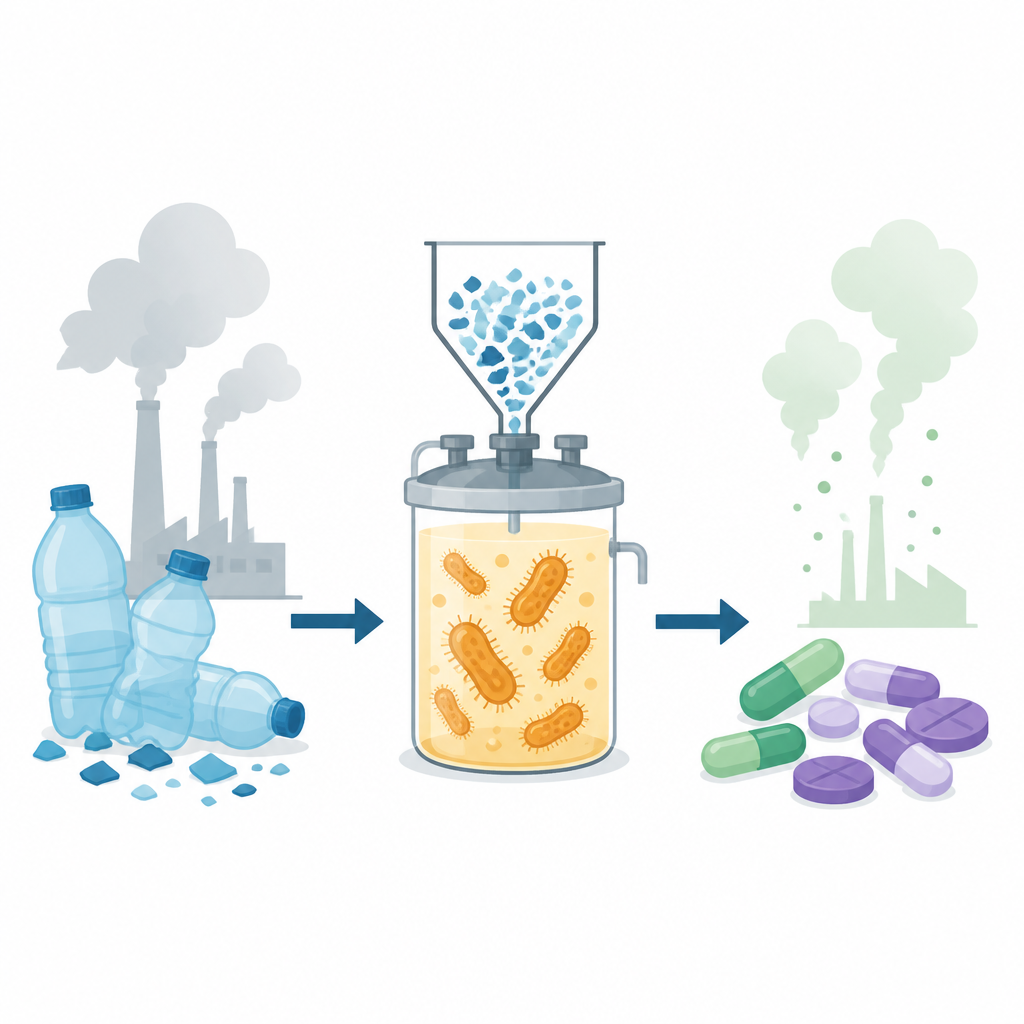
Teaching bacteria to remake plastic into drug ingredients
The team focused on a common plastic called PET, widely used in drinks bottles and shiny stamping foils for packaging. When PET is broken down, it yields a small carbon ring called terephthalic acid. The scientists designed a new biological pathway in laboratory strains of the bacterium Escherichia coli so that, step by step, this ring is reshaped into levodopa. Seven genes from different microbes were combined so that the plastic-derived building block first becomes an intermediate called protocatechuate, then another called catechol, and finally levodopa. To help the plastic fragment get into the bacterial cells in the first place, they also added a transporter protein that acts like a gate in the cell membrane, making uptake efficient at neutral pH.
Solving roadblocks inside living factories
Turning plastic into medicine inside a cell is not as simple as lining up reactions. The team discovered that one intermediate compound strongly slowed down the final step, blocking levodopa production. Careful experiments and computer models showed that this intermediate competes with the true starting material for the same active site in the key enzyme that builds levodopa. To get around this, the scientists split the full pathway between two cooperating E. coli strains. The first strain converts the plastic-derived material to catechol and releases it into the surrounding liquid. The second strain is then added later to turn catechol into levodopa under conditions tuned for high yield. This “two-strain relay” design prevents the troublesome intermediate from piling up in the same cell that performs the final step.
Using real plastic waste and capturing carbon
After fine-tuning the reactions, the researchers showed that their system can handle plastic from the real world, not just pure laboratory chemicals. They broke down industrial stamping foils and a single discarded drinks bottle to release terephthalic acid, then fed this mixture directly to the two-strain process. The microbial factories produced grams per liter of levodopa and the team could isolate solid product equivalent to several medical doses. To probe how climate friendly the approach could become, they also connected the process to green microalgae. Carbon dioxide released in one of the reaction steps was transferred into a culture of the alga Chlamydomonas, which used the gas to grow, hinting at ways to balance emissions in future designs.
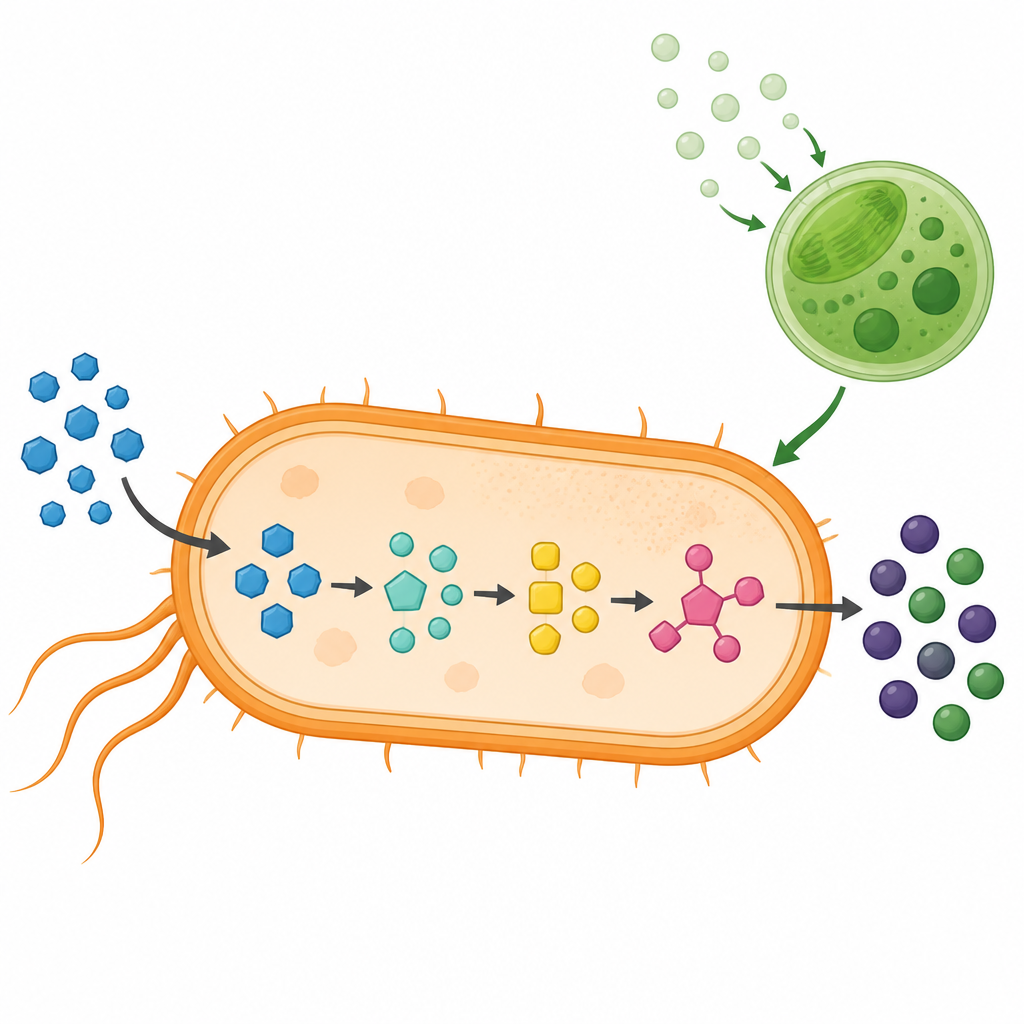
What this means for people and the planet
The work does not claim to solve the global plastic crisis, because medicine volumes are tiny compared with the mountain of plastic waste we generate every year. Instead, it offers a vivid example of how biology can rescue carbon from the waste stream and turn it into something of high value for human health. By preserving the aromatic core of the plastic building block all the way into levodopa, the process avoids bringing in fresh fossil carbon. With further engineering, safety checks and scale-up, similar strategies could help supply important drugs and other complex molecules using yesterday’s packaging as tomorrow’s raw material.
Citation: Royer, B., Era, Y., Valenzuela-Ortega, M. et al. Microbial upcycling of plastic waste to levodopa. Nat Sustain 9, 706–713 (2026). https://doi.org/10.1038/s41893-026-01785-z
Keywords: plastic upcycling, microbial biotechnology, levodopa, PET recycling, circular bioeconomy