Clear Sky Science · en
Randomized trial of electronic health record implemented AI risk prediction in kidney transplant care
Why this study matters for patients and families
For people living with a donated kidney, knowing what comes next if the transplant fails is a deeply personal and often frightening question. Doctors hope that artificial intelligence (AI) tools can spot rising risk early and spark honest talks about future care. This study tested whether adding an AI risk calculator into hospital computer systems actually changes what patients experience in the clinic.

The promise of smart risk prediction
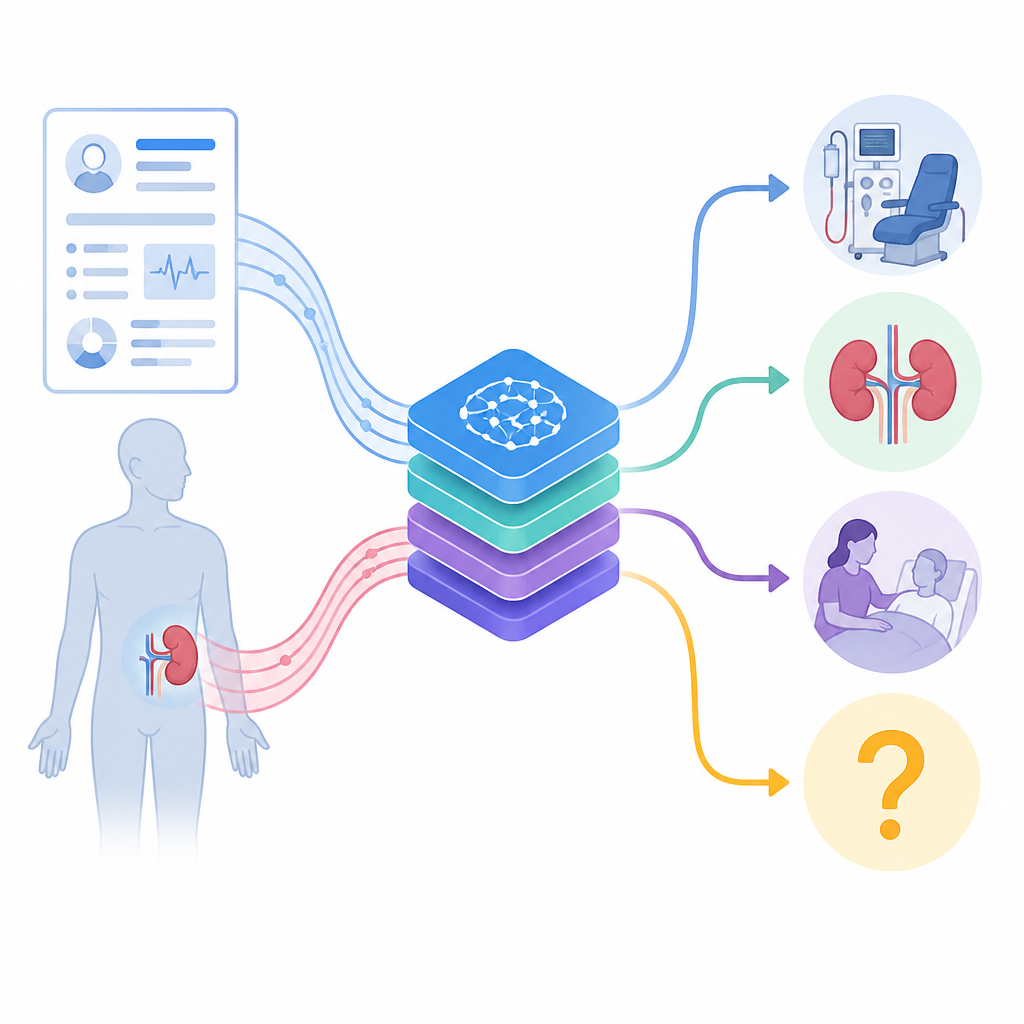
Kidney transplantation can free people from dialysis, but over half of transplanted kidneys eventually stop working. As kidney function declines, patients may need to choose between starting hemodialysis, using home-based peritoneal dialysis, seeking another transplant, or focusing on comfort care. These choices depend heavily on personal values and goals. Researchers built a computer model that scans routine medical data, such as lab results and past transplant history, to estimate the chance that a transplanted kidney will fail within a year. The hope was that showing this risk in the electronic health record would gently prompt doctors to talk with patients about options before a crisis hits.
Testing AI in real clinic visits
The PRIMA-AI trial enrolled 76 adults with transplanted kidneys whose kidney function was already quite low. Half received usual care. For the other half, their doctors could see the AI risk estimate inside the electronic health record during regular follow up visits. The main question was simple and patient centered: over the next 12 months, would more patients in the AI group report that they had a clear conversation with their transplant doctor about what treatments they could choose if their kidney failed?
What actually happened in the study
After a year, the share of patients who remembered such a conversation was almost identical in both groups: about four in ten. The AI tool did not raise this number. It also did not change medical results such as how many people lost their kidney, how dialysis was started, or how often emergency dialysis was needed. Surveys that measure shared decision making, the quality of the doctor patient relationship, and emotional distress all showed no meaningful differences between those whose doctors had access to the AI tool and those who did not.
Why the AI tool fell short
When the researchers asked doctors afterward, most said they used the risk display only occasionally. The information sat behind an extra click in the record and did not trigger alerts, so it was easy to overlook in busy clinics. Some doctors also felt the score rarely changed what they would do, especially since many patients already had serious kidney problems based on standard lab tests. In other words, the model itself predicted risk very well, but this did not automatically lead to new conversations, different choices, or better preparation for dialysis or re transplantation.
What this means for future digital tools
This trial shows that simply adding AI risk numbers to the electronic chart is not enough to change care for transplant patients. For technology to support shared decision making, it may need to be woven more tightly into clinic routines and paired with patient friendly tools, such as question prompts or structured guides for talking about future treatment. The key lesson is that accurate prediction is only the first step; real benefit depends on how doctors and patients use that information together.
Citation: Osmanodja, B., Spencker, J.J., Ömeroğlu, Ö.E. et al. Randomized trial of electronic health record implemented AI risk prediction in kidney transplant care. npj Digit. Med. 9, 373 (2026). https://doi.org/10.1038/s41746-026-02757-5
Keywords: kidney transplant, artificial intelligence, electronic health records, shared decision making, risk prediction