Clear Sky Science · en
A review of the application of digital phenotyping in predicting peripartum depressive symptoms
Why This Matters for New Parents
Pregnancy and the first year after birth are often described as joyful, but for many women they are also marked by deep emotional struggles. Peripartum depression—a cluster of depressive symptoms during pregnancy and after delivery—affects roughly one in eight to one in four mothers worldwide. Yet most screening still happens only once or twice with paper questionnaires, meaning early warning signs are easily missed. This article reviews emerging research on “digital phenotyping,” the use of everyday technologies like smartphones, wearables, and social media to track subtle behavior changes that might signal when a new mother is at risk and could benefit from timely support.

New Clues Hidden in Daily Digital Traces
The authors examined 14 studies published between 2014 and March 2025 that followed pregnant and postpartum women in five countries. Instead of relying solely on clinic visits, these projects tapped into digital traces of daily life. Some gathered “passive” signals such as sleep duration from wearables, step counts, heart rate, or movement patterns from GPS. Others collected “active” information that women intentionally provided, including mood check-ins on an app, short diary-style text entries, social media posts, and brief phone-based surveys throughout the day. In most studies, depressive symptoms were still measured with standard questionnaires such as the Edinburgh Postnatal Depression Scale, but digital data were used to see whether warning patterns could be detected earlier or more accurately.
What Sleep, Activity, and Phone Use Can Reveal
Across studies, sleep patterns stood out as some of the most promising passive signals. Women who slept less at night or had more fragmented sleep during pregnancy tended to report higher levels of depressive symptoms, although the timing mattered. Poor sleep in early and mid-pregnancy was sometimes linked to later mood problems, while similar measures did not consistently predict symptoms after birth. Findings for physical activity were more mixed: some measures, like nighttime restlessness and disrupted daily rhythms, were tied to higher depression scores, but others—such as step counts or time spent away from home—showed little or no predictive value. Interestingly, one study found that women who later had postpartum depression wore their fitness trackers more consistently, hinting that unusually high device use itself might reflect emotional strain or hypervigilance.
Words, Posts, and Messages as Emotional Barometers
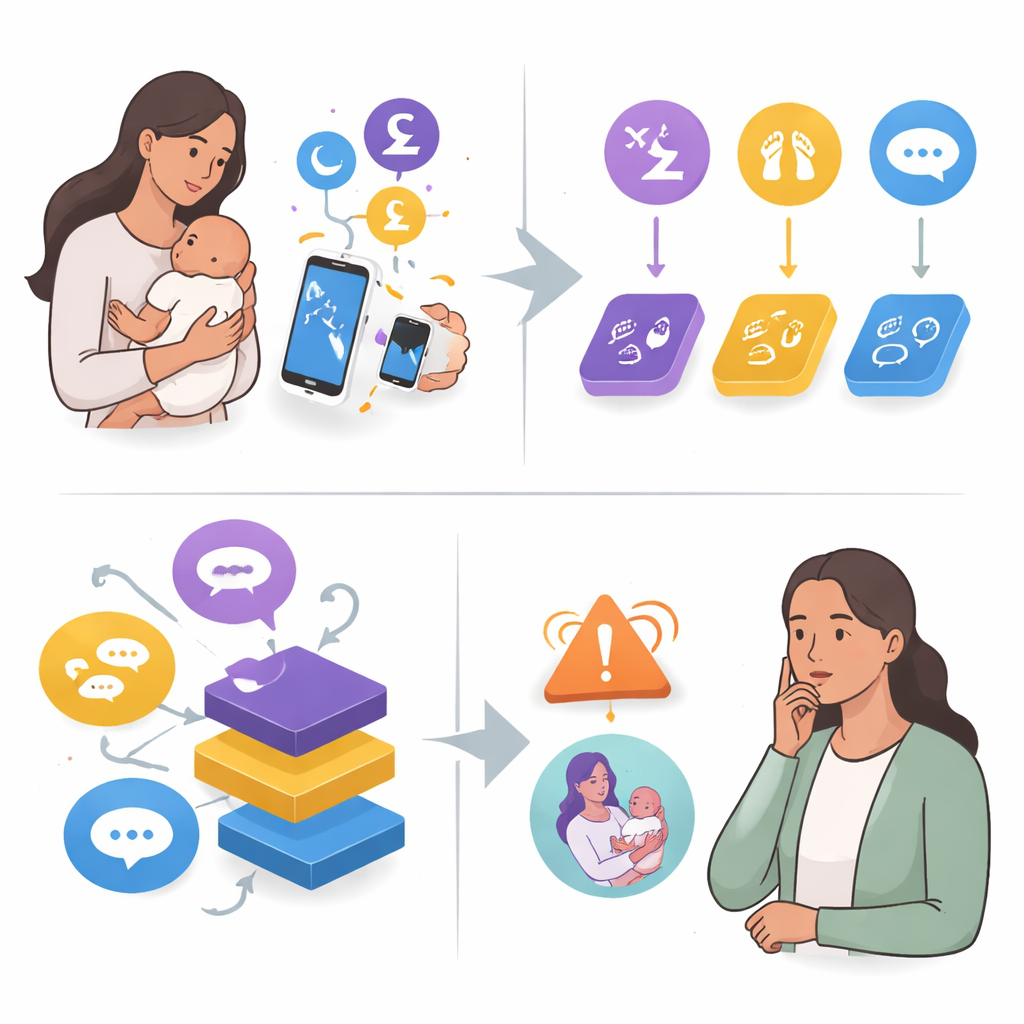
Active digital information—what women type, tap, or post—often provided rich clues about mood. Analyses of short journal entries and app-based text showed that negative emotional tone, expressions of exhaustion, and reduced positive language were linked with higher depression scores. Subtle shifts in word use, such as changes in pronouns or the appearance of mental health–related terms, helped predict who would develop symptoms within a few weeks. Social media behavior also carried signals: more frequent posting of selfies by new mothers, or signs of social withdrawal and reduced interaction with online contacts, were associated with greater depression risk. Patterns in text messaging told a similar story; women with depressive symptoms tended to send fewer and shorter messages during late pregnancy and the postpartum period. When combined with simple self-report tools like daily mood logs, these language and behavior patterns substantially improved prediction accuracy.
How Well Do the Algorithms Actually Work?
To turn raw digital traces into risk estimates, researchers used a range of statistical and machine learning methods, from classic regression to more complex models like random forests and gradient boosting. Some models that blended several types of information—such as mood logs, background characteristics, and brief in-app surveys—achieved high performance in distinguishing women with and without significant depressive symptoms. However, the review highlights major caveats. Studies varied widely in which signals they tracked, how often data were collected, and how outcomes were defined. Many had relatively small samples, did not carefully handle missing data, or relied only on internal testing rather than checking their models in independent groups of women. As a result, even the best-performing models remain closer to promising prototypes than ready-to-use clinical tools.
Balancing Promise, Privacy, and Real-World Use
The authors argue that digital phenotyping could eventually complement, but not replace, traditional care. Integrating background information, medical history, infant-related factors, and ongoing mood reports with passive data like sleep and activity may provide a fuller picture of a mother’s mental health as it changes over time. At the same time, the approach raises important questions about privacy, data security, unequal access to technology, and the risk of biased or inaccurate predictions. The review calls for standardized methods, clearer reporting, and stronger collaboration between clinicians, data scientists, and ethicists to ensure that future tools are both accurate and fair.
What This Means for Mothers and Families
In plain terms, this article concludes that our phones and wearable devices are beginning to act like early warning sensors for peripartum depression, but the science is not yet mature enough for routine use. Sleep measures and short, frequent mood or text-based check-ins appear especially promising, particularly when combined with a mother’s personal and medical history. Still, current studies are small, varied, and often methodologically weak, so their findings should be treated as early signals rather than firm answers. With better-designed research, careful attention to ethics, and strong protections for personal data, digital phenotyping could become a powerful aid to help identify struggling mothers sooner and connect them with support before symptoms deepen.
Citation: Kovacs, B.Z., Schweitzer, S., Papadopoulos, F.C. et al. A review of the application of digital phenotyping in predicting peripartum depressive symptoms. npj Digit. Med. 9, 335 (2026). https://doi.org/10.1038/s41746-026-02653-y
Keywords: peripartum depression, digital phenotyping, postpartum mental health, wearable and smartphone data, maternal mood monitoring