Clear Sky Science · en
High-sensitivity pan-cancer AI assessment of lymph node metastasis via uncertainty quantification
Why this matters for cancer care
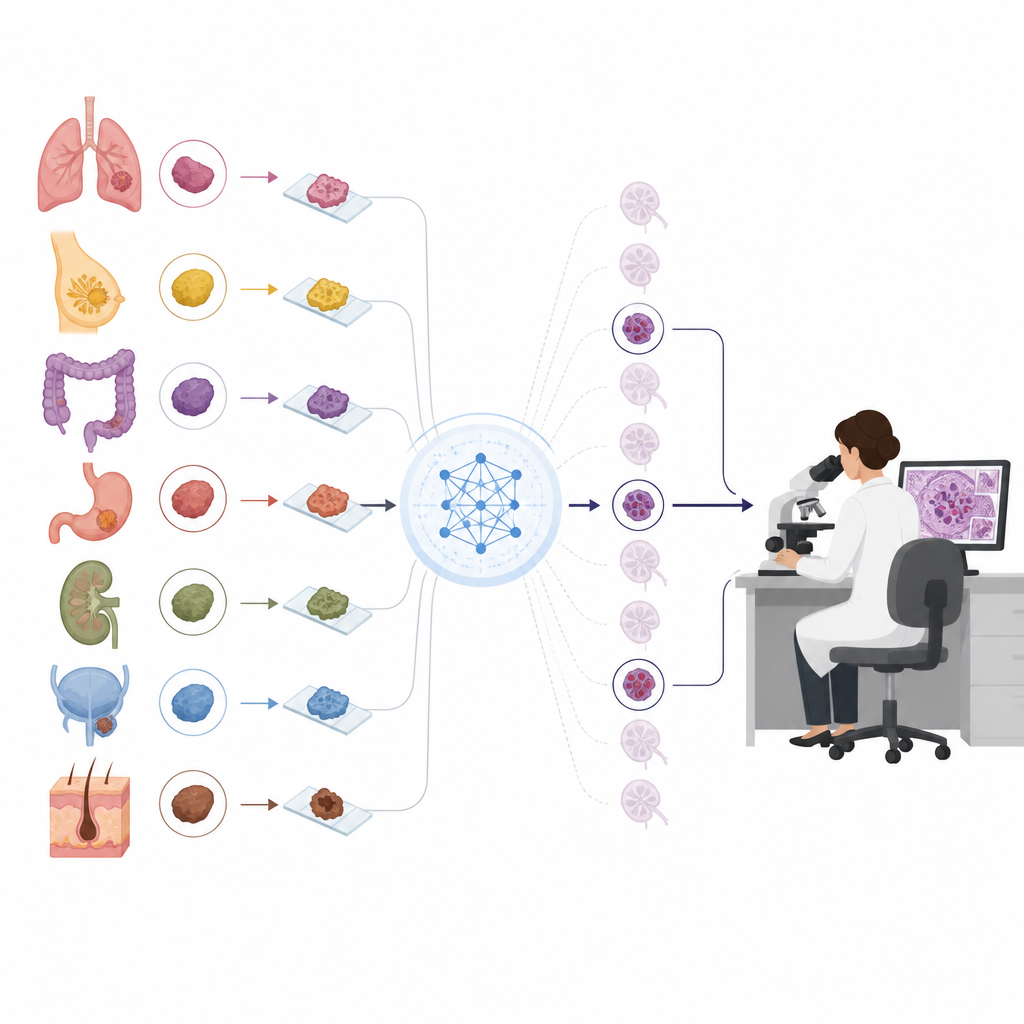
When cancer spreads, it often travels first to small immune hubs called lymph nodes. Checking these nodes under the microscope helps doctors decide how serious the disease is and what treatments to recommend. But with rising cancer cases and complex tissue patterns, pathologists face a heavy workload and the risk that rare, unusual cases slip through the cracks. This study introduces a new artificial intelligence system designed not only to spot spread of cancer across many tumor types, but also to know when it might be wrong and call for human backup.
The challenge of reading tiny warning posts
Lymph nodes act as checkpoints where cancer cells can settle and grow. Whether and how much they are involved strongly influences a patient’s outlook. Traditional staging systems mostly count how many nodes contain cancer and overlook details such as how large the deposits are or how they are arranged in the node. New research shows that these finer details matter for survival. At the same time, pathologists must now examine more lymph nodes than ever, often more than ten per surgical case, making such careful, case by case measurement very hard to deliver in daily practice.
Why usual AI tools are not enough
Computer algorithms have begun to help read digital slides, but most systems focus on one cancer type at a time and treat all input as if it were familiar. In reality, cancer in lymph nodes shows a long tail of rare shapes and growth patterns across different organs. Standard deep learning models can become extremely confident about wrong answers when they encounter such unusual images. For something as serious as missing a focus of spread, this kind of overconfident error is unacceptable. The authors argue that safe medical AI must do more than chase accuracy; it must also recognize when it is uncertain and ask for help.
A single platform for many cancers
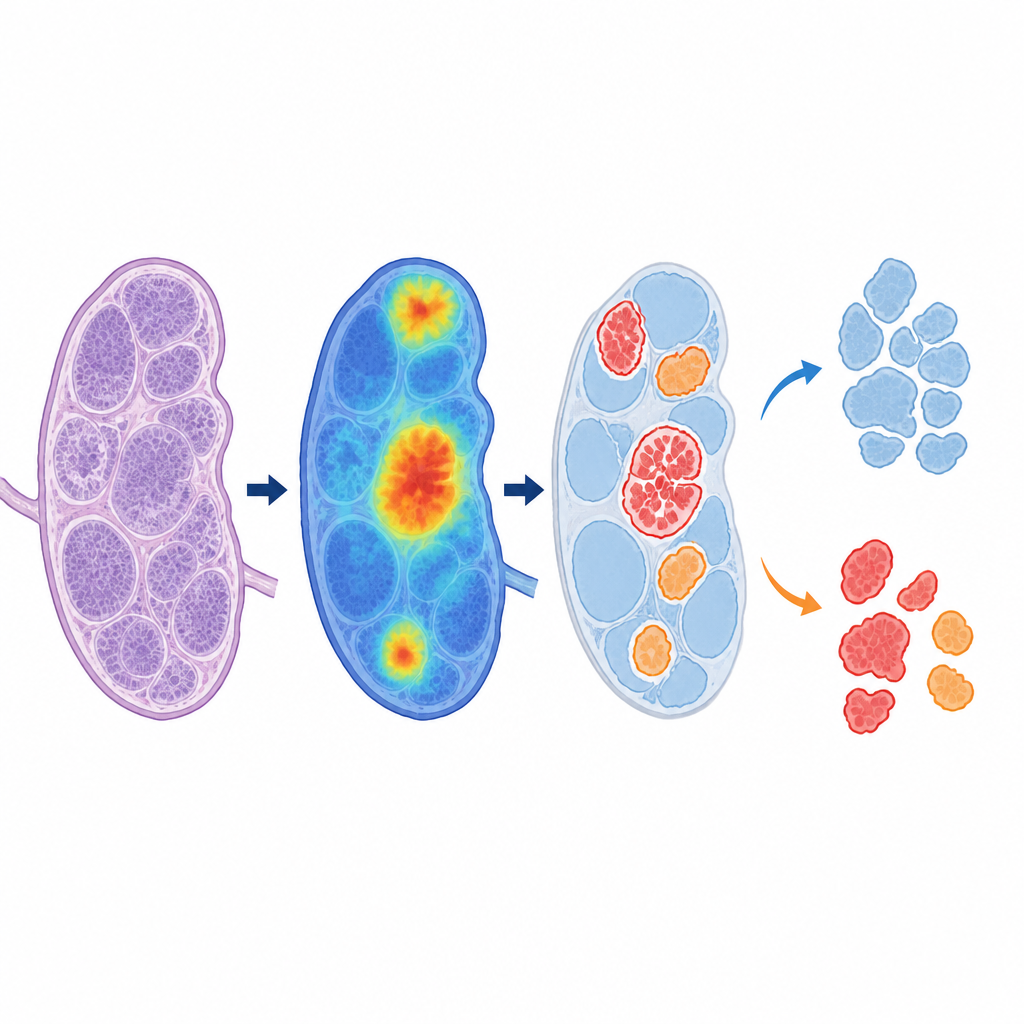
The research team built a system called UPATHLN that analyzes digital slides of lymph nodes from many different solid tumors. First, a pair of models automatically find and outline the lymph node tissue, filtering out muscle and fat. Then, a powerful image encoder, trained previously on over one hundred thousand pathology slides, examines small patches of the node at two zoom levels to capture both fine cell details and larger patterns. A dedicated classification branch estimates how likely each patch is to contain cancer, while a separate branch learns to predict how trustworthy that decision is, based on how the main model behaved during training.
Teaching the system to flag doubts
Rather than labeling every slide in advance, the team used an active learning loop. They began with existing curated datasets, ran the system on large numbers of new slides from three hospitals, and then asked pathologists to review only the areas the AI marked as most uncertain. These high uncertainty regions often contained misclassified tissue or rare patterns. After five rounds of this human in the loop process, performance improved steadily. In internal tests, the system reached a very high score for distinguishing cancer from normal tissue. More importantly, every case that the classifier alone would have missed was also flagged as uncertain, guaranteeing that such risky slides would be sent to a pathologist for review.
Safety across many organs and rare cancers
The authors then tested UPATHLN on more than sixteen thousand lymph nodes from fourteen different primary tumor sites, including seven cancer types the system had never seen during training. If one looked only at the AI’s raw yes or no outputs, some metastatic nodes would still be called negative. However, in every one of these misses, the uncertainty branch raised a warning, so that the combined process reached perfect sensitivity under the condition that flagged cases are checked by a pathologist. At the same time, about three quarters of nodes without cancer were confidently cleared, cutting the review burden substantially. For rare or very unusual cases, the system responded cautiously by flagging more regions, reflecting a bias toward safety over automation.
What this means for patients and doctors
UPATHLN shows that an AI system can safely assist pathologists across many cancer types if it is built to estimate its own uncertainty and to learn most from the hardest cases. By automatically dismissing clear cut negative lymph nodes while routing ambiguous or rare patterns to human experts, it has the potential to reduce workload and to support more detailed measurements of how much cancer is present in each node. The study does not yet prove how the tool will perform in everyday use around the world, but it outlines a path toward AI that behaves less like an infallible oracle and more like a cautious colleague that knows when to ask for a second opinion.
Citation: Wang, X., Chen, Y., Liu, X. et al. High-sensitivity pan-cancer AI assessment of lymph node metastasis via uncertainty quantification. npj Digit. Med. 9, 368 (2026). https://doi.org/10.1038/s41746-026-02564-y
Keywords: lymph node metastasis, computational pathology, medical AI safety, uncertainty quantification, pan-cancer diagnosis