Clear Sky Science · en
Randomised study of human machine collaboration for cardiotocography interpretation during labour
Why this matters for parents and babies
When a baby is being born, doctors and midwives closely watch the baby’s heartbeat to spot early signs of trouble. Reading these heartbeat traces is tricky and people often disagree, which can lead to missed warning signs or unnecessary interventions. This study asks a simple question with big consequences: can a computer “co‑pilot” help clinicians read these tracings more accurately during labour and better protect newborns from lack of oxygen?
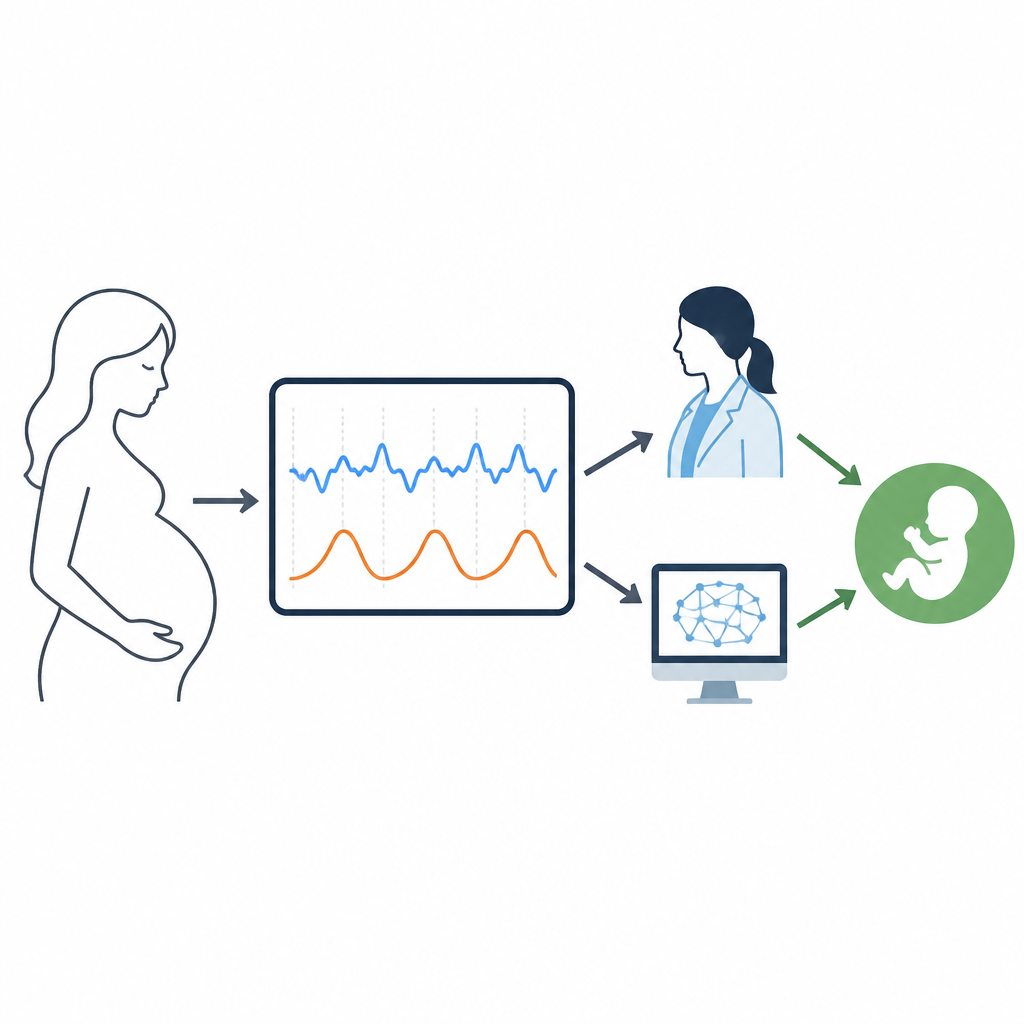
Watching the baby’s heartbeat in real time
During labour, a common tool called cardiotocography records the baby’s heart rate and the mother’s contractions. The goal is to spot when the baby may not be getting enough oxygen, which can lead to a condition called acidaemia, signalled by a low blood pH in the umbilical cord at birth. Unfortunately, the same tracing can be read very differently by different people, even when they follow the same guidelines. This variation makes it hard to rely on the test alone to prevent serious problems such as brain injury.
Adding a digital second opinion
The researchers tested a computer assistant, called computerised cardiotocography, built from a mathematical model named DeepCTG. The program looks at features in the last half hour of the heart rate tracing, such as how high or low the baseline is and how often the heart rate speeds up or slows down. It then estimates the chance that the baby will be born with a low pH (below 7.15), which signals moderate to severe lack of oxygen. This estimate is shown to clinicians along with a simplified picture of what patterns drove the computer’s judgement.
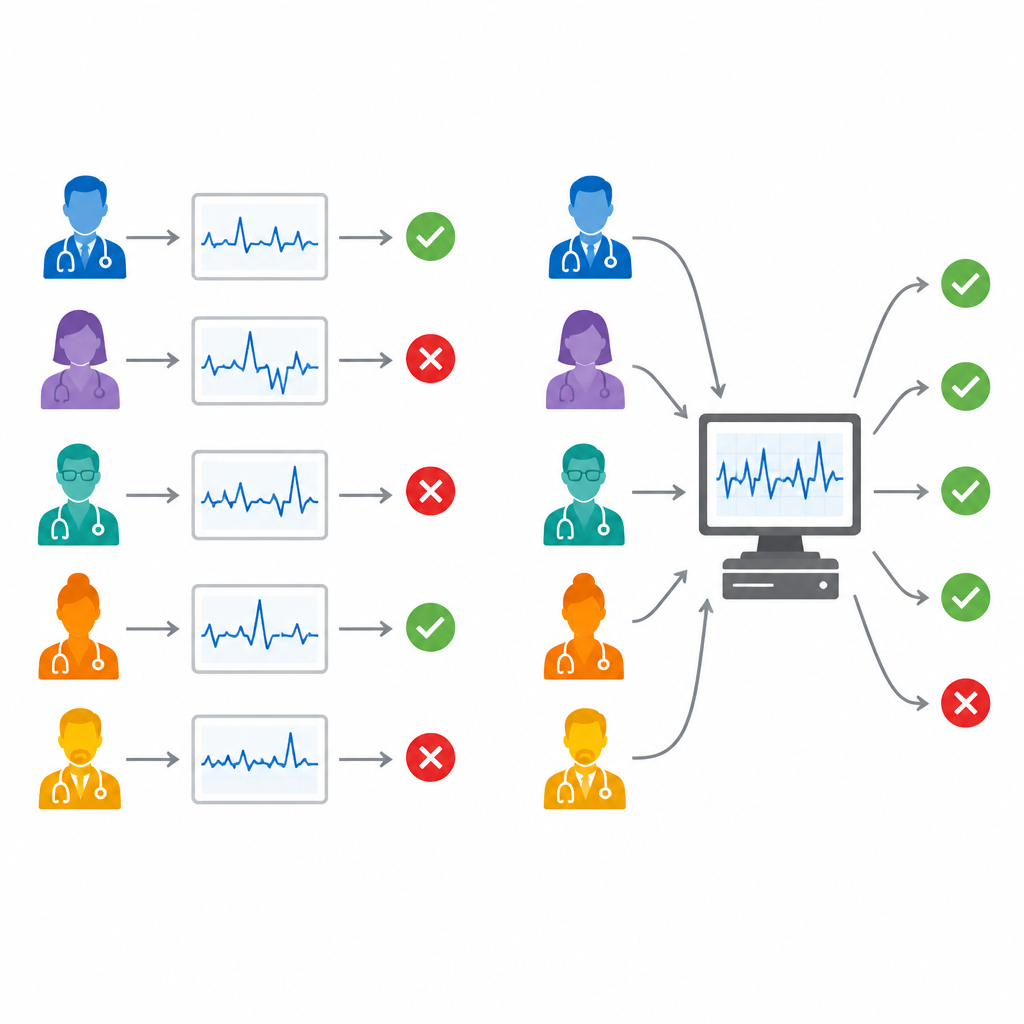
A global test of human machine teamwork
To see whether this help really improved care, 211 midwives, obstetricians and residents from 23 countries logged into a web platform and reviewed 100 real birth tracings drawn from a public database. For each case, they had to predict whether the baby’s cord blood pH would be normal or low. For about two thirds of the cases, they also saw the computer’s risk estimate and visual hints; for the remaining third, they judged the tracing on their own. In total, they made more than 8000 predictions, allowing the team to compare performance with and without the digital assistant and to see how results differed by country, job type and years of experience.
Sharper detection without more false alarms
With computer help, clinicians correctly classified outcomes in about 61 out of 100 cases, compared with 54 out of 100 without help. The biggest gain came from catching more babies who truly had low pH: sensitivity rose from roughly half to more than three fifths. At the same time, the rate of giving the all‑clear when the baby was actually fine stayed about the same, meaning the tool did not flood clinicians with extra false alarms. In situations where the computer and the human disagreed, the computer’s answer turned out to be right about two thirds of the time. The assistant also made performance more even: the spread in success rates between individuals shrank, and less experienced staff came closer to the accuracy of seasoned specialists.
What this means for future births
For parents, the takeaway is that a carefully designed computer partner can help the care team better recognise babies at risk of oxygen problems during labour, while avoiding more unnecessary interventions. For clinicians, the study suggests that using an AI tool as a transparent second opinion can boost both accuracy and agreement across teams. The work does not claim to fix all risks around birth, and it still needs to be tested in day‑to‑day hospital practice, but it points toward a future where humans and machines share the task of watching over babies in the delivery room.
Citation: Ben M’Barek, I., Ben M’Barek, B., Jauvion, G. et al. Randomised study of human machine collaboration for cardiotocography interpretation during labour. npj Digit. Med. 9, 365 (2026). https://doi.org/10.1038/s41746-026-02556-y
Keywords: fetal heart monitoring, cardiotocography, artificial intelligence, perinatal acidaemia, labour and delivery