Clear Sky Science · en
Coronary artery disease diagnosis with signal processing and machine learning of heart sound signals: a systematic review
Listening to the Heart Instead of Entering the Arteries
Coronary artery disease, in which blood vessels that feed the heart become narrowed, is one of the leading killers worldwide. Today, doctors usually confirm this disease with invasive scans that thread catheters into the heart or with costly imaging machines. This study asks a simple, appealing question: could careful analysis of ordinary heart sounds—recorded with microphones on the chest and interpreted by computers—offer a safe, fast first check for clogged heart arteries?
Why Blocked Arteries Change the Heart’s Sound
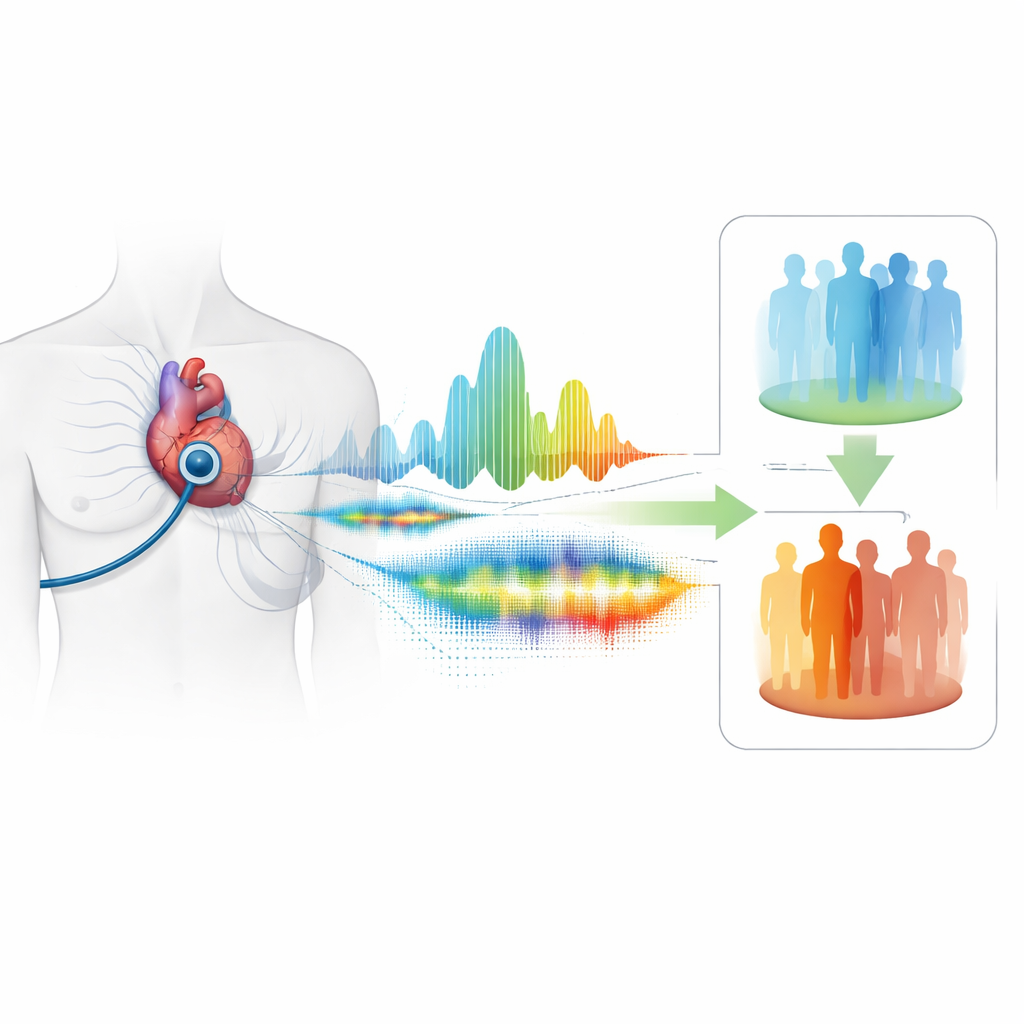
When a coronary artery is narrowed, blood is forced through a tighter opening, creating turbulent, high-speed flow. That turbulence can generate faint murmurs and extra vibrations, especially during the heart’s relaxation phase when blood normally flows more calmly. The same loss of blood supply can subtly weaken the heart’s squeeze and change the timing and strength of the main heartbeats. All of these changes slightly reshape the “music” of the heartbeat. Modern electronic stethoscopes can capture these sounds, which are then turned into digital signals for computer analysis.
How Researchers Searched the Scientific Record
The authors combed four major medical databases and screened more than a thousand publications about heart sounds and coronary disease. After removing duplicates, very small reports and papers with poor methods, they ended up with 40 studies that together included 13,814 people. Almost all of these studies confirmed the presence or absence of significant artery narrowing using standard imaging of the coronary arteries, then compared those findings with what could be learned from heart sounds. Roughly half of the studies relied on traditional signal processing—mathematical descriptions of sound energy and frequency—while the other half used machine learning, in which algorithms learn patterns directly from data.
Limits of Traditional Sound Measurements
In the older approach, scientists picked a few specific sound features that they believed might reflect narrowed arteries. Typical measures included how much sound energy appeared in certain frequency bands during the heart’s relaxation phase, or how long and how strong the main heartbeats were. These studies often looked promising in small groups of patients, sometimes reporting that they could correctly identify disease in more than 70 percent of cases. But as sample sizes grew into the hundreds or thousands, accuracy fell, often dropping below 70 percent and sometimes close to a coin flip. Many of these studies also tested their methods on the same people used to develop them, raising doubts about whether the results would hold up in new patients.
Machine Learning Learns the Heart’s Hidden Patterns
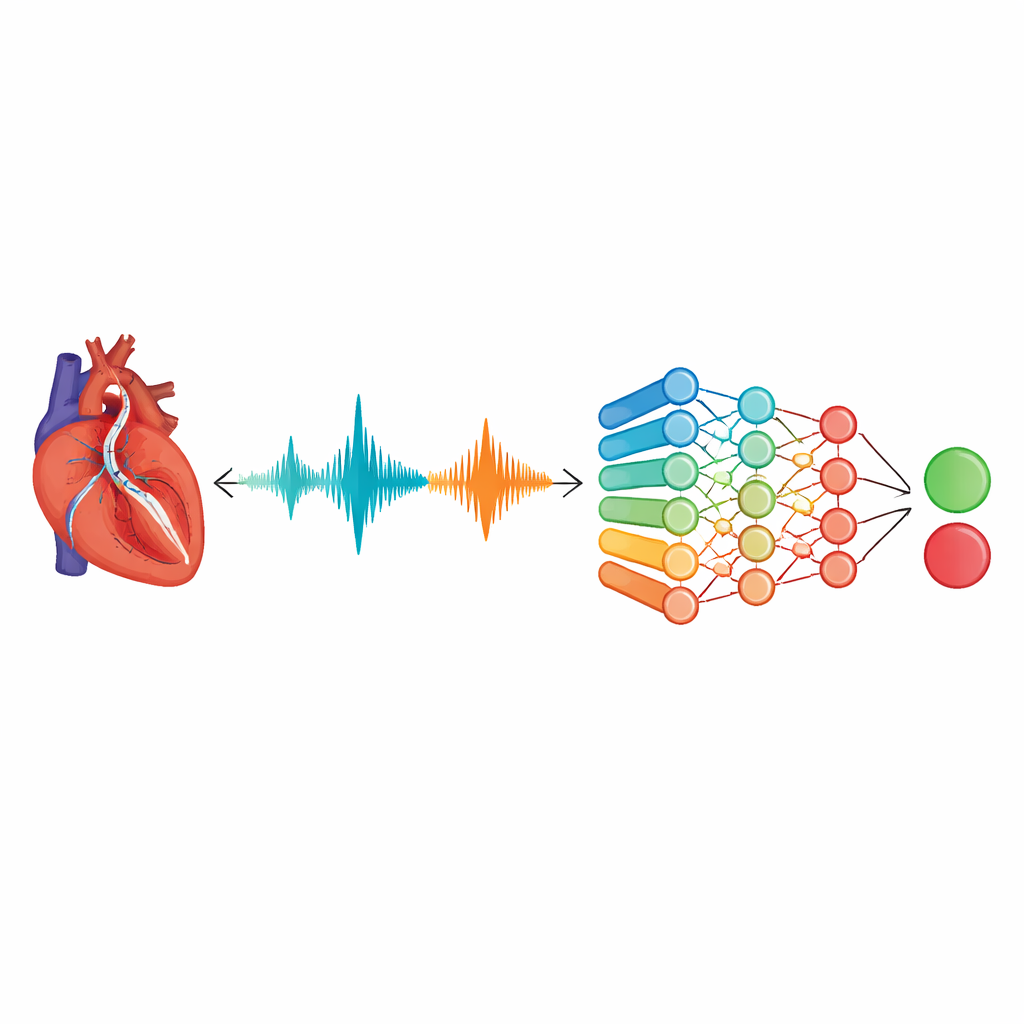
The newer studies took a different path. Instead of limiting themselves to a few hand-picked features, they allowed computer algorithms to learn richer patterns in the sound. Some combined dozens or even hundreds of traditional measurements; others fed the raw sound wave or colorful time–frequency pictures of the heartbeat into deep learning networks. Across 19 such studies, most reported sensitivity and specificity above 80 percent, meaning the systems correctly identified both diseased and healthy individuals much of the time. Importantly, most machine learning studies tested their models on heart sounds from people who were not used for training, giving more confidence that the tools could generalize. Models that listened to the entire heartbeat cycle, rather than just the quiet diastolic phase, tended to perform best—suggesting that useful clues to artery disease are sprinkled throughout the heartbeat, not confined to one moment.
What This Could Mean for Everyday Care
Taken together, the evidence suggests that machine learning applied to heart sounds has real promise as a noninvasive aid for spotting coronary artery disease, while simpler signal-processing tricks alone are probably not accurate enough. The authors caution, however, that most studies so far have been small and conducted at single hospitals, often under carefully controlled recording conditions. To move from research to everyday use—perhaps in emergency rooms, clinics, or even smartphone-based tools—larger, multicenter trials are needed. These future studies will have to show that such systems stay accurate in diverse groups of patients, remain understandable to clinicians, and fit smoothly into care pathways. If those hurdles can be cleared, listening closely to the heart with the help of artificial intelligence could someday help flag hidden artery disease long before an invasive test is needed.
Citation: Ainiwaer, A., Konings, T.J., Kadier, K. et al. Coronary artery disease diagnosis with signal processing and machine learning of heart sound signals: a systematic review. npj Digit. Med. 9, 350 (2026). https://doi.org/10.1038/s41746-026-02530-8
Keywords: coronary artery disease, heart sounds, machine learning, noninvasive diagnosis, digital stethoscope