Clear Sky Science · en
Continuous assessment of daily-living gait using self-supervised learning of wrist-worn accelerometer data
Why Your Watch Might One Day Track How Well You Walk
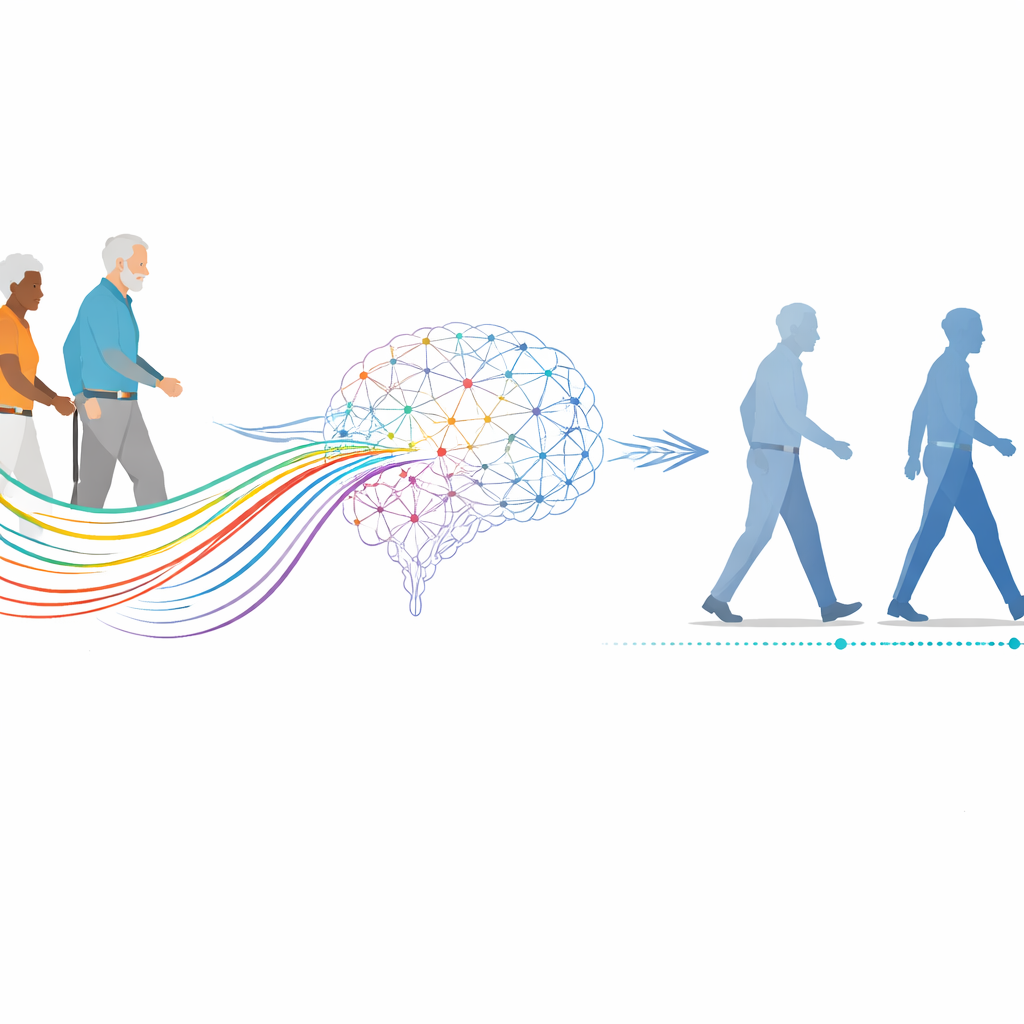
Many people already wear fitness watches that count steps or track workouts. But for older adults, how they walk—speed, rhythm, and steadiness—can reveal early signs of health problems, from frailty to dementia. This study shows that a single wrist-worn sensor, paired with an advanced artificial intelligence system called ElderNet, can turn everyday movement data into detailed measures of walking quality, potentially transforming a common gadget into a powerful health monitor.
From Simple Step Counts to Rich Walking Clues
Most wrist devices today estimate how active you are overall: how long you sit, how often you move, or how many steps you take. While useful, these summaries mix together many types of movement and miss the finer details of walking itself. Doctors and researchers care about specific walking features—such as how fast you walk, how many steps you take per minute, how long each step is, and how regular your steps are—because they are strong indicators of healthy aging and risk of disability, falls, and cognitive decline. Traditionally, these measures come from brief tests in clinics or labs, often using sensors on the lower back or special walkways. These set‑ups are accurate but inconvenient and capture only short snapshots of a person’s mobility.
Teaching a Model to Read Walking from the Wrist
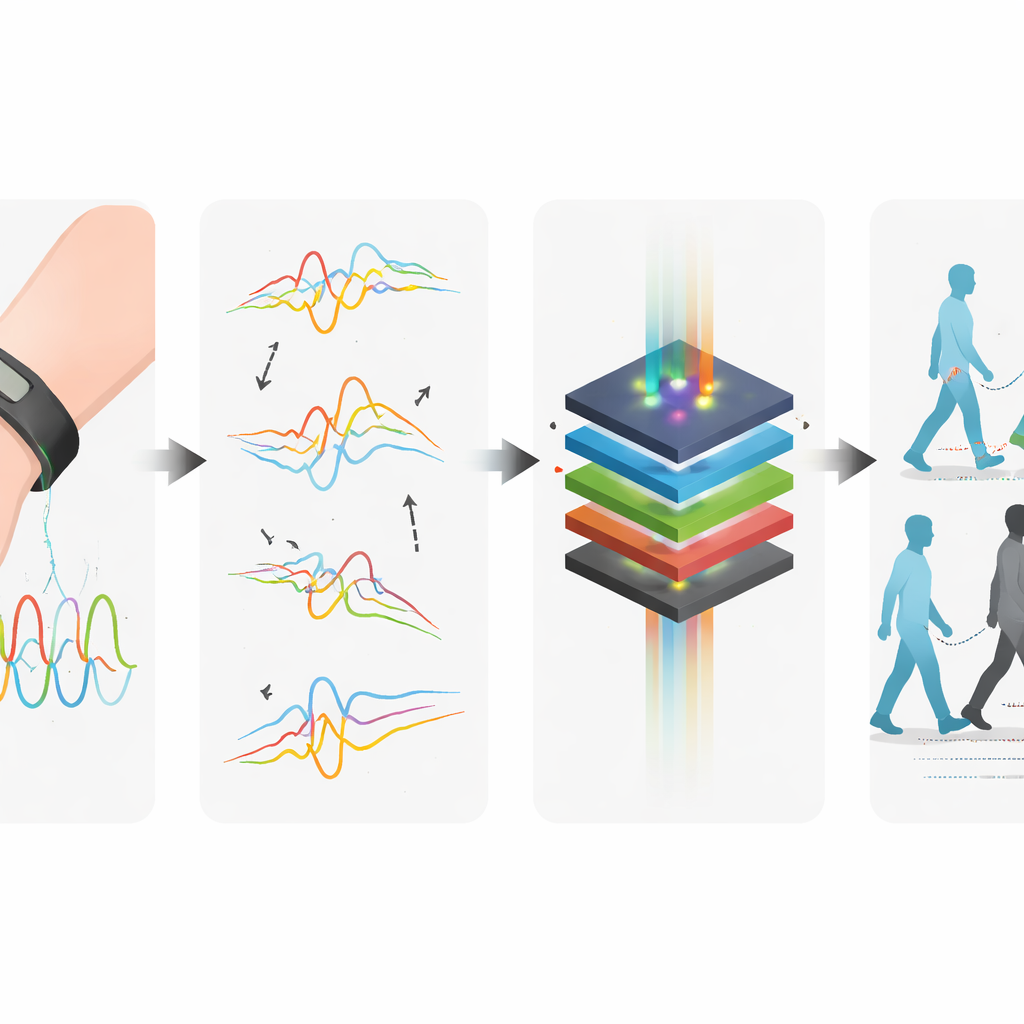
The team behind ElderNet set out to unlock full walking information from wrist sensors worn during normal daily life, even though the wrist moves in complex ways that mix arm swings with other activities. They built on a self‑supervised learning approach, where a deep neural network first teaches itself to recognize patterns in huge amounts of unlabeled wrist data from more than 100,000 people in the UK Biobank. Next, the model is further adapted using multi‑day recordings from over 800 very old adults in the Rush Memory and Aging Project, so it becomes especially tuned to the movement patterns of aging populations. Finally, the system is fine‑tuned on a smaller but carefully labeled dataset, Mobilise‑D, where participants wore both wrist sensors and a rich reference system that precisely measured their walking in real‑world settings. This step lets ElderNet learn to translate complex wrist motions into specific walking metrics for each detected walking bout.
How Well the System Measures Walking
When tested on older adults and people with conditions such as heart failure, lung disease, Parkinson’s disease, hip fracture, and multiple sclerosis, ElderNet estimated gait speed with an average error of about 8.8 centimeters per second and showed strong agreement with the gold‑standard reference system. It also outperformed a leading biomechanical method based on hand‑crafted features and a similar model trained without self‑supervised pretraining. The researchers extended ElderNet to estimate additional gait features like cadence, stride length, and step regularity; for cadence and stride length in particular, the self‑supervised version clearly beat the fully supervised baseline. Importantly, performance remained high in an independent group of younger, healthy adults, suggesting that the approach generalizes beyond the original training sample, even though it was optimized for older individuals.
Everyday Walking Tells a Different Story than Clinic Tests
To explore clinical usefulness, the authors applied ElderNet to about ten days of wrist data per person from hundreds of community‑dwelling older adults. They compared three ways of flagging who reported mobility disability: short, supervised walking tests; broad physical activity summaries from the wrist; and detailed multi‑day gait metrics estimated by ElderNet. While lab‑based walking measures and overall activity levels provided only modest discrimination, the rich, real‑world gait features did much better at separating people with and without mobility problems. Interestingly, gait patterns seen in daily life were only weakly related to those measured in brief clinical walks, suggesting that how people move in their own environments captures aspects of function that traditional tests miss.
What This Could Mean for Healthy Aging
The study shows that a common, comfortable device worn on the wrist can, with the right algorithms, provide clinic‑grade insight into how people walk in their everyday lives. ElderNet’s accuracy is on the order of changes that matter clinically for gait speed, and its multi‑day measures better identify older adults with mobility difficulties than standard tests or simple activity counts. With further validation in more diverse groups and over longer time spans, this approach could help detect subtle declines earlier, monitor disease progression or recovery, and guide more personalized interventions, all using data quietly collected from a watch‑like sensor.
Citation: Brand, Y.E., Buchman, A.S., Kluge, F. et al. Continuous assessment of daily-living gait using self-supervised learning of wrist-worn accelerometer data. npj Digit. Med. 9, 338 (2026). https://doi.org/10.1038/s41746-026-02528-2
Keywords: gait monitoring, wrist accelerometer, healthy aging, self-supervised learning, digital biomarkers