Clear Sky Science · en
Rapid and noninvasive artificial intelligence-assisted diagnostic method for oral squamous cell carcinoma
Why your breath and saliva may help spot mouth cancer
Oral cancer can steal the ability to speak, eat, and smile, and it is often found too late for the best treatment. This study shows that simple breath and saliva samples, analyzed with modern sensors and artificial intelligence, may help doctors spot this cancer earlier without painful biopsies. By reading tiny chemicals in exhaled air and tracking certain mouth germs, the researchers built a fast, noninvasive test that could change how we screen for oral cancer.
Looking for danger signs without a scalpel
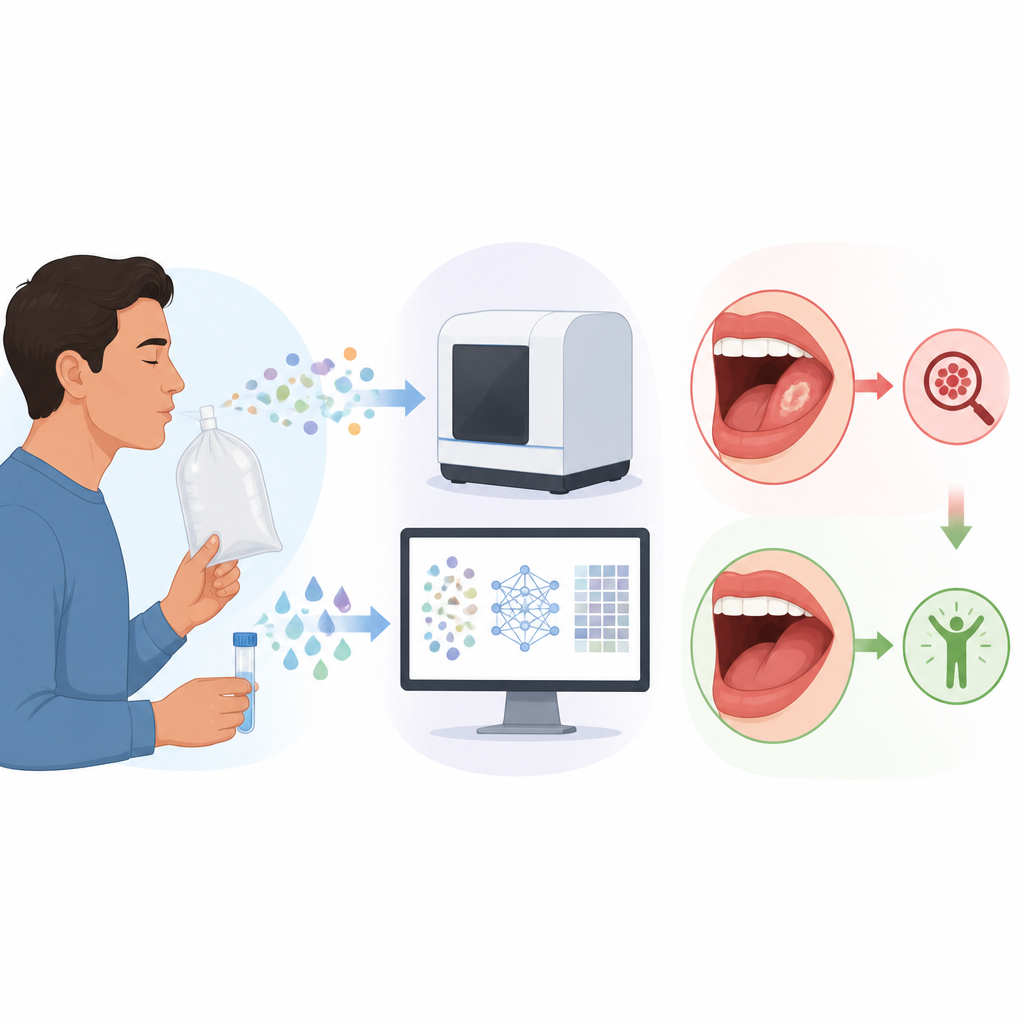
Today, oral squamous cell carcinoma is usually confirmed by cutting a small piece of tissue from a suspicious spot in the mouth and examining it under a microscope. This approach is accurate but invasive, can miss very small or hidden tumors, and is not practical as a mass screening tool. The team behind this study set out to find a gentler option. They focused on two easily collected samples: exhaled breath, which carries clouds of tiny airborne chemicals from the mouth, and saliva, which is rich in the bacteria that live there. Their goal was to see whether a computer could learn patterns in these samples that reliably separate people with oral cancer from healthy volunteers.
Reading the chemical fingerprints in breath
The researchers first built a careful system for collecting and analyzing breath. Volunteers fasted, breathed quietly to settle their airflow, then exhaled into special bags. The samples were fed into a highly sensitive device that weighs airborne molecules and can pick out hundreds of different compounds in a single breath. Using this method, they detected more than 200 distinct volatile substances and found clear differences between the breath of patients and healthy people. An artificial intelligence model was trained on these patterns and tuned through many rounds of testing. In the end, one family of models, known as gradient boosting, proved best, correctly identifying most cancer cases in both the original group and an independent group of new patients.
What the mouth microbiome reveals
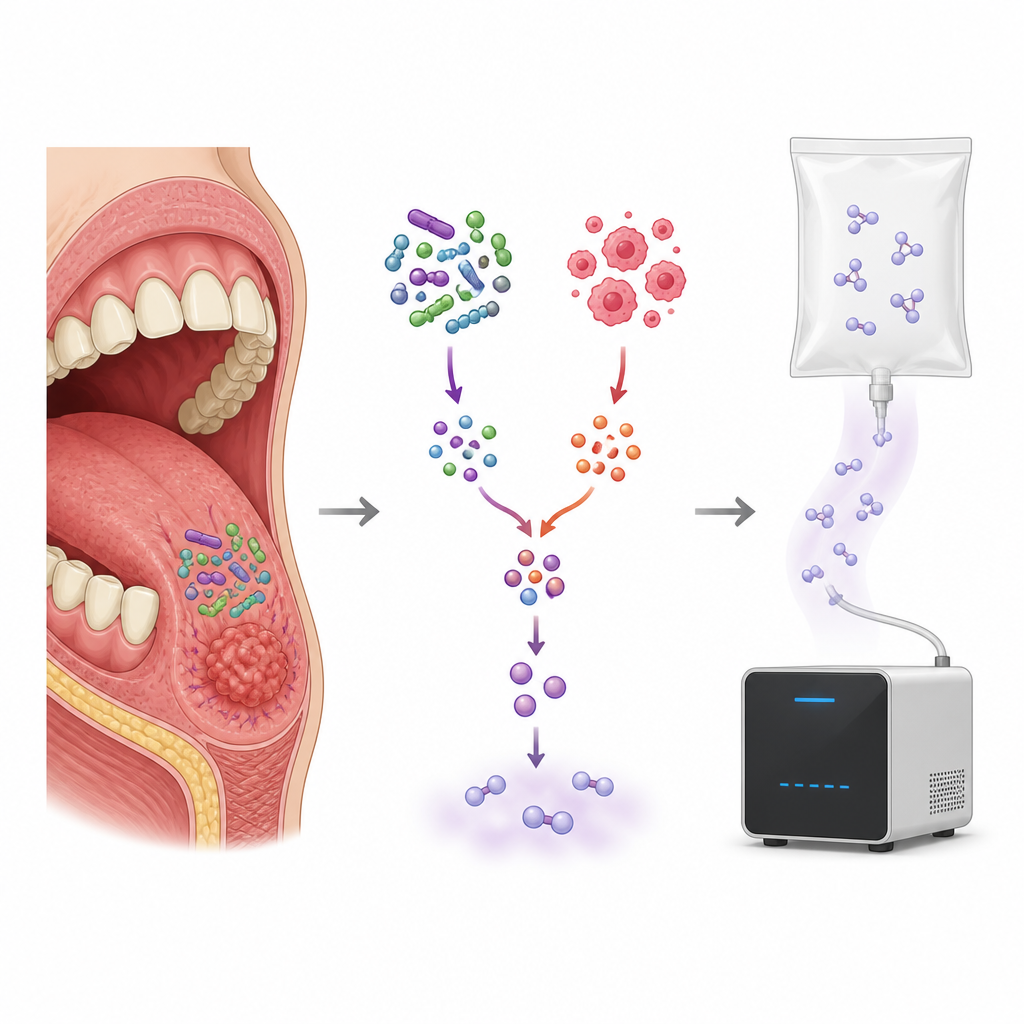
Saliva told a different but related story. By sequencing DNA from the saliva of participants, the scientists mapped which bacteria were present and in what amounts. They saw that healthy mouths tended to have richer and more balanced microbial communities, while cancer patients often showed a shift toward certain species. In particular, a microbe called Fusobacterium nucleatum, along with some of its close relatives, was more common in people with cancer. Other typical mouth bacteria became less abundant. Machine learning models that relied only on the saliva microbiome were also able to distinguish cancer from health with high accuracy, even across different tumor stages and treatment histories, suggesting that microbial shifts are a stable signal of disease.
Connecting a smelly gas to a specific germ
To understand why breath and saliva were linked, the researchers searched for specific markers that drove the computer’s decisions. One breath compound, the sulfur-containing gas methanethiol, showed a four- to fivefold higher level in cancer patients. At the same time, one subspecies of Fusobacterium nucleatum was strongly enriched in saliva. Network analyses of metabolic pathways suggested that this bacterium is equipped to turn building-block molecules into methanethiol. In lab dishes, when the microbe was grown together with oral cancer cells, methanethiol levels rose sharply even though the bacteria themselves did not multiply, supporting the idea that an interaction between tumor and germ boosts gas production that can then be detected in exhaled air.
A smart online tool for doctors and researchers
Rather than keep their methods locked away, the team combined the breath data, saliva data, and computer model into a public web platform. Clinicians or scientists can upload their own measurements of volatile breath compounds or saliva microbes and receive instant predictions about whether the pattern looks more like that of a cancer patient or a healthy person. The site also shows which features, such as methanethiol levels or the abundance of Fusobacterium nucleatum, most influenced each individual prediction, making the system more transparent and easier to trust.
What this work means for future screening
To a non-expert, the message of this study is that a quick, painless breath and saliva test may one day help catch oral cancer earlier and with less discomfort. The research does not replace biopsy as the final word in diagnosis, and it still needs to be tested in larger and more diverse populations, including people with very early or pre-cancerous changes. But it shows that the mix of chemicals we exhale and the microbes living in our mouths form a readable code of disease. By combining sensitive instruments with artificial intelligence, this work lays the groundwork for simple screening tools that could be used in dental clinics or community health centers to flag people who most need follow-up care.
Citation: Sun, Y., Hu, X., Han, J. et al. Rapid and noninvasive artificial intelligence-assisted diagnostic method for oral squamous cell carcinoma. npj Digit. Med. 9, 399 (2026). https://doi.org/10.1038/s41746-026-02527-3
Keywords: oral cancer, breath analysis, microbiome, artificial intelligence, noninvasive diagnosis