Clear Sky Science · en
Automated detection of new cerebral infarctions and prognostic implications using deep learning on serial MRI
Why tiny hidden strokes matter
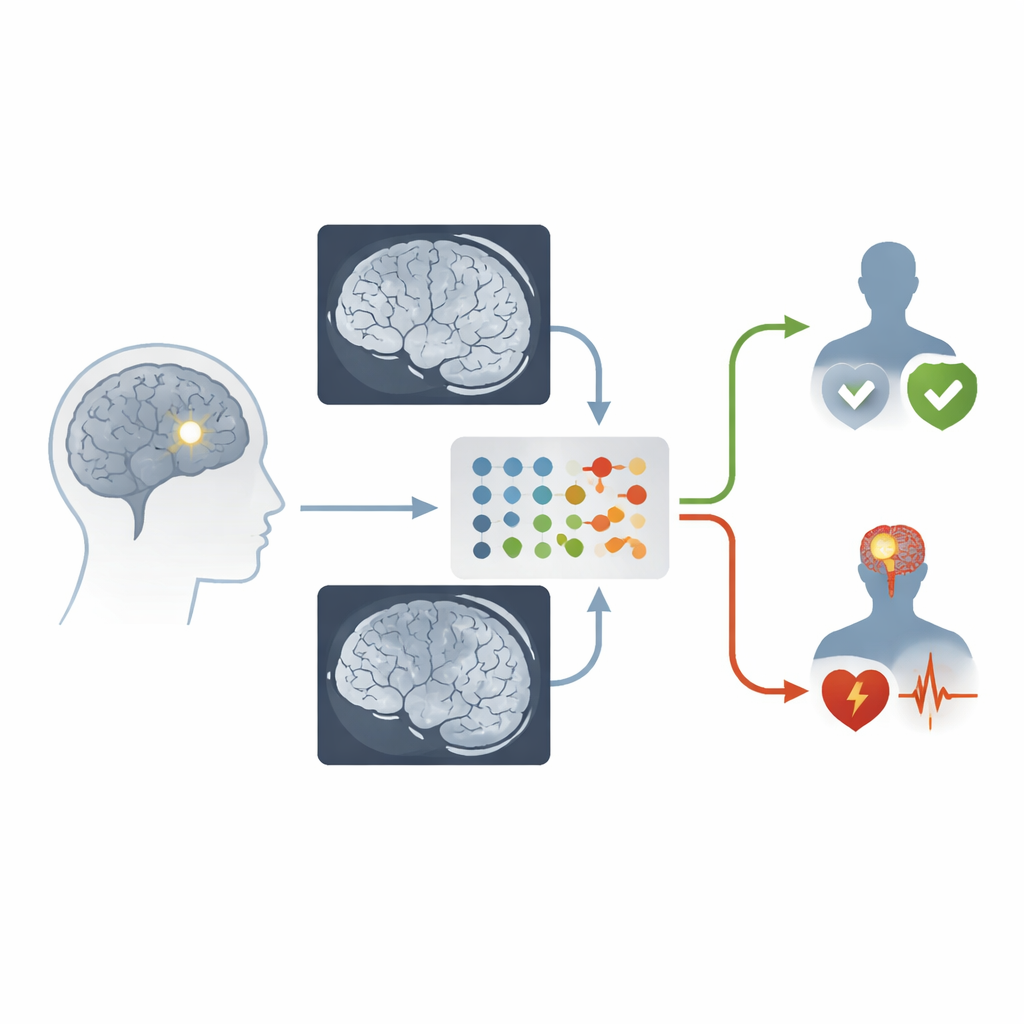
Many strokes leave clear symptoms, but others quietly scar the brain without anyone noticing. These “silent” injuries show up only on MRI scans, yet they can foreshadow serious trouble ahead. This study asks whether artificial intelligence (AI) can reliably spot these hidden brain injuries on routine scans, and whether those AI findings can warn doctors which patients are more likely to suffer a future, full-blown stroke.
Hidden damage that doctors often miss
After a stroke, doctors often order repeat MRI scans to track recovery and watch for new damage. Reading these scans is painstaking work: specialists must flip back and forth between old and new images, slice by slice, hunting for tiny new bright spots that signal fresh injury. Many of these new spots cause no obvious symptoms and are easily overlooked, especially when they are small or when the brain already shows many older changes. Yet large population studies have shown that such “silent” infarctions are common in older adults and linked to later stroke and thinking problems. The lack of a fast, consistent way to detect them has limited their use in everyday care.
Teaching a computer to compare brain scans
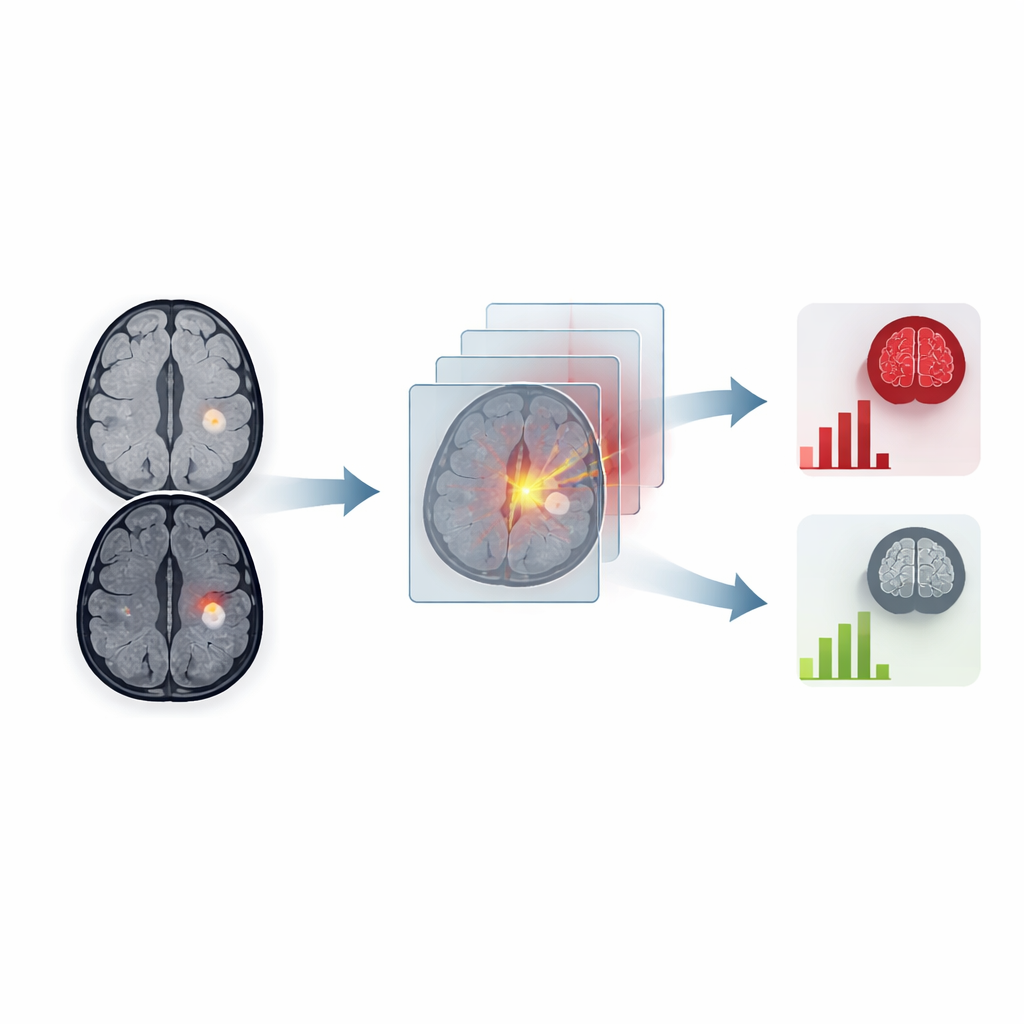
The researchers built a deep learning model—a type of AI that excels at image recognition—to mimic how a human expert compares two brain scans over time. They collected paired MRI images from more than a thousand stroke patients treated at two hospitals in South Korea. For each person, they aligned the baseline and follow-up scans and extracted matching slices of the brain. Stroke neurologists then labeled over 25,000 slice pairs as either “changed” (a new lesion appeared) or “unchanged.” Using these expert-labeled examples, the AI learned to recognize subtle differences between the two time points that signal new injury, while ignoring background noise and older scars.
How well the AI spotted new brain injuries
When tested on patients from both the original hospital and a separate hospital, the AI system performed strongly. At the level of individual image slices, it correctly distinguished new lesions from no change almost nine times out of ten. When decisions were summarized at the whole-patient level, performance remained high and similar across both hospitals, suggesting good generalizability. Heatmap visualizations showed that the AI’s attention focused on the same brain regions that human experts had marked as new infarcts, and it tended to ignore old abnormalities. This helped reassure the researchers that the model was not simply guessing but was honing in on clinically meaningful image features.
Silent findings that predict future strokes
The scientists then asked a crucial question: do the AI-detected silent lesions actually matter for patients’ futures? They followed 307 people who felt stable at the time of their follow-up scan, meaning they had no new neurological symptoms. The AI labeled about six in ten as having at least one new silent infarct. Over roughly two years of follow-up, those flagged by the AI had a much higher rate of later, symptomatic stroke than those without AI-detected lesions. Even after accounting for age, diabetes, and irregular heart rhythm, patients with AI-detected silent infarcts had nearly four times the risk of another stroke. This suggests that the computer was uncovering hidden warning signs that standard clinical evaluation alone might miss.
What this could mean for patient care
This study shows that an AI system can reliably detect new, often unnoticed brain injuries on serial MRI and that its findings carry real-world consequences for stroke risk. Rather than replacing doctors, the tool acts as a tireless assistant, scanning thousands of images and highlighting worrisome changes that deserve closer attention. If confirmed in future prospective studies, such automated detection could become a standardized imaging marker to help doctors decide who needs more aggressive prevention—such as tighter blood pressure control, different blood-thinning medications, or closer follow-up—potentially reducing the chance that a silent injury becomes a devastating stroke.
Citation: Cho, Hh., Lee, J., Bae, J. et al. Automated detection of new cerebral infarctions and prognostic implications using deep learning on serial MRI. npj Digit. Med. 9, 316 (2026). https://doi.org/10.1038/s41746-026-02511-x
Keywords: silent brain infarction, stroke risk, brain MRI, deep learning, medical imaging AI