Clear Sky Science · en
Immersive competence as a source of bias in virtual reality clinical assessment
Why Virtual Reality Exams May Not Be As Fair As They Look
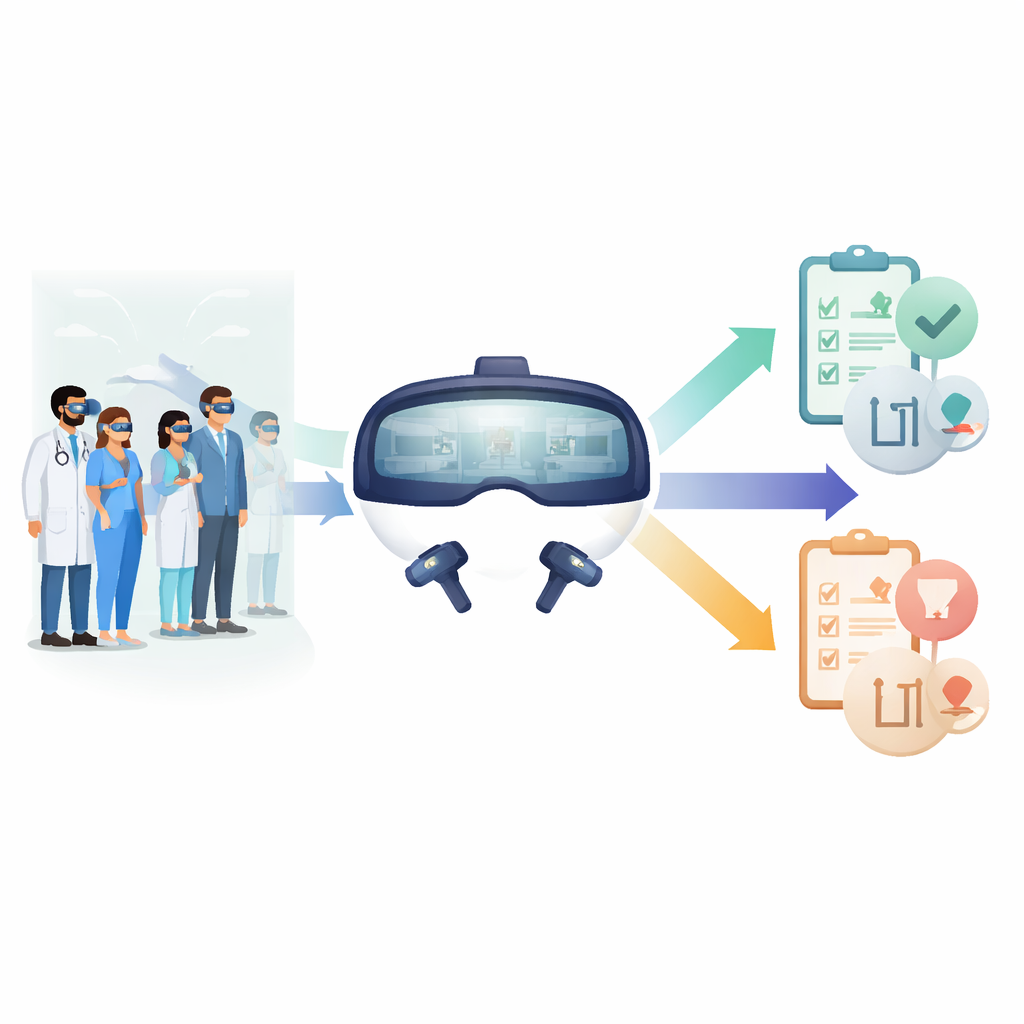
Virtual reality is rapidly entering hospitals and classrooms, promising lifelike training and testing without putting real patients at risk. But this study asks a crucial question: when people are judged inside a headset, are we really measuring their medical skills—or just how good they are at handling the technology? The researchers show that a hidden ability they call immersive competence can tilt the playing field in virtual exams, with important consequences for education and patient care.
Learning to Live Inside a Headset
Immersive competence is the practical knack for moving, grabbing, and controlling things in a virtual world. It includes using handheld controllers, understanding 3D space, and dealing with unfamiliar menus and feedback. Many VR tools assume users will simply "figure it out," but this favors people who already play video games or work with 3D software. In medicine and health care, where VR is now used to assess students and even diagnose patients, this hidden advantage can blur the line between true clinical skill and sheer tech savviness. Yet earlier reviews of VR-based exams had almost never checked for this source of bias.
A Head-to-Head Test of VR Skills and Medical Performance
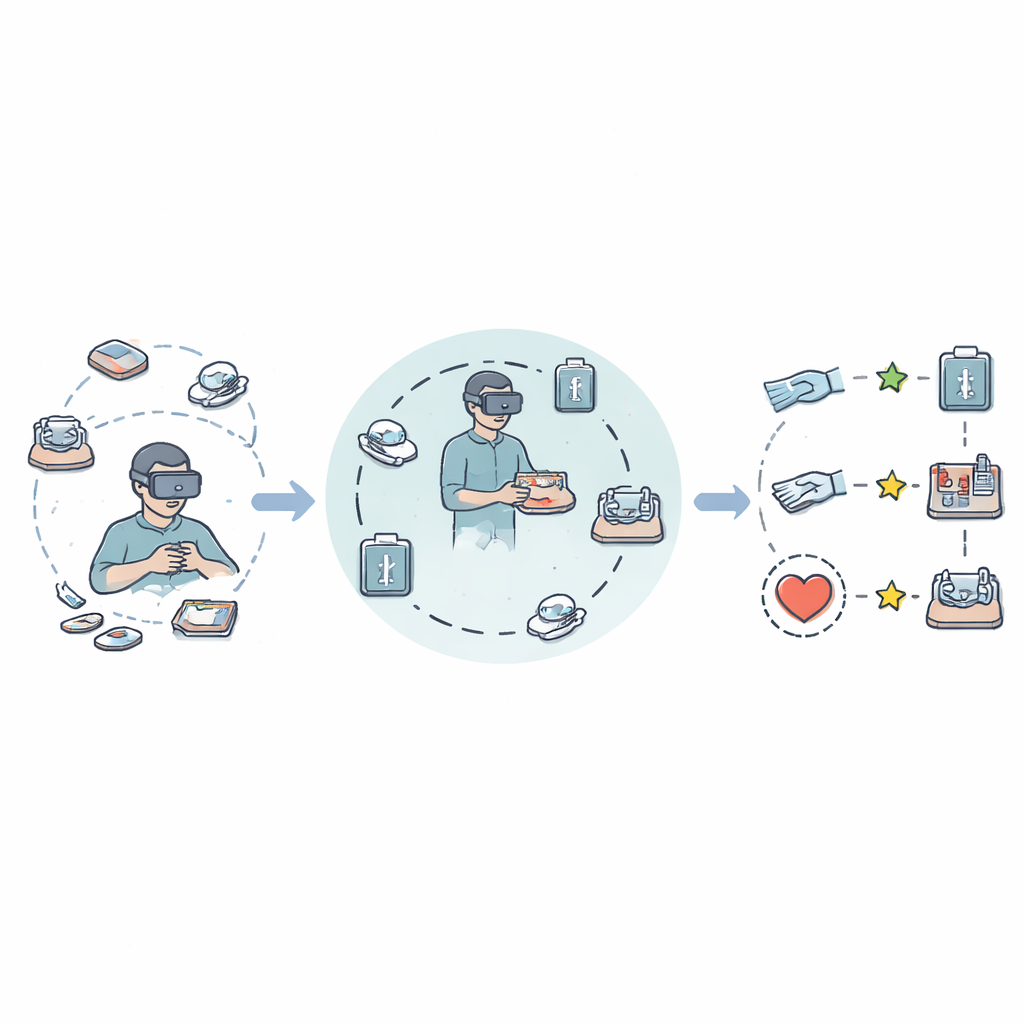
To probe this issue, the team ran a randomized controlled trial with 94 advanced medical students, of whom 88 completed the study. Students were assigned to one of three groups. One group received general VR training using abstract tasks such as grabbing floating objects or navigating around obstacles. A second group received both this general training and an extra round of practice inside the exact emergency-room simulation later used for testing. A third group only got a brief familiarization with the controls, similar to what many VR systems currently offer, before attempting the full clinical scenario: managing a virtual patient in septic shock.
How Training Changed Outcomes in the Virtual Emergency Room
The key finding was that only the students who practiced in the specific exam environment clearly outperformed the control group on the clinical checklist, with a medium-to-large advantage. General practice with abstract VR tasks alone did not meaningfully boost scores. These performance gains were closely tied to procedural efficiency: students in the combined-training group carried out both rehearsed and new medical actions more quickly and smoothly than others, especially for tasks they had not seen before. In contrast, standard written exam grades did not predict how well students handled the VR emergency, underscoring that the virtual performance measure was capturing something beyond book knowledge.
Mental Effort, Past Experience, and Hidden Inequalities
The study also tracked how much mental effort students felt they were investing, and monitored their stress responses through skin conductance. Surprisingly, those with no special training reported the lowest cognitive load during the simulation yet achieved the poorest clinical results. Students with medium levels of reported mental effort tended to perform best, suggesting that some struggle is actually productive when users are actively engaged with the task. Objective stress measures, however, did not cleanly explain performance differences. Prior experience with 3D applications was very low overall, making firm conclusions difficult, but there were hints that once basic interaction barriers were lifted through training, students with more digital experience could benefit even more—potentially widening, not narrowing, performance gaps.
Designing Fairer Virtual Worlds for Health
Beyond numbers, students reported enjoying the VR exam and generally viewed such formats as fair—provided they had enough chance to practice with the system. Those without specific training felt more distracted by clumsy controls and interface hurdles. Drawing on these results, the authors argue that immersive competence should be treated as a measurable, trainable factor that can bias outcomes if ignored. They propose three lines of defense: building more intuitive, inclusive interfaces; routinely checking performance data for signs of digital advantage; and either training users in a standardized way or statistically correcting for their VR skills when interpreting scores.
What This Means for Patients and Learners
For a lay reader, the take-home message is straightforward: when we move crucial decisions into virtual spaces—whether grading future doctors or testing a patient’s thinking and movement—we must be sure we are not simply grading how comfortable someone feels inside a headset. This study shows that short, targeted practice in the actual VR environment can significantly boost performance, but may also amplify pre-existing digital strengths if not carefully designed. Treating immersive competence as a core part of digital health equity can help ensure that VR tools become aids to fair assessment and better care, rather than new sources of hidden bias.
Citation: Schaal, J., Leutritz, T., Lindner, M. et al. Immersive competence as a source of bias in virtual reality clinical assessment. npj Digit. Med. 9, 280 (2026). https://doi.org/10.1038/s41746-026-02482-z
Keywords: virtual reality assessment, immersive competence, medical education, digital health equity, simulation training