Clear Sky Science · en
Performance of the 12-lead ECG in predicting short- and long-term risk of sudden cardiac death
Why this matters for heart patients
Sudden cardiac death strikes without warning and often affects people who already know they have heart disease. Many of these patients routinely have electrocardiograms (ECGs), simple tests that record the heart’s electrical activity. This study asked a pressing question for patients and doctors alike: can the information hidden in standard 12‑lead ECGs, combined with basic clinical data, reliably tell us who is at risk of dying suddenly, either years from now or in the near future?
Looking for warning signs in everyday heart tests
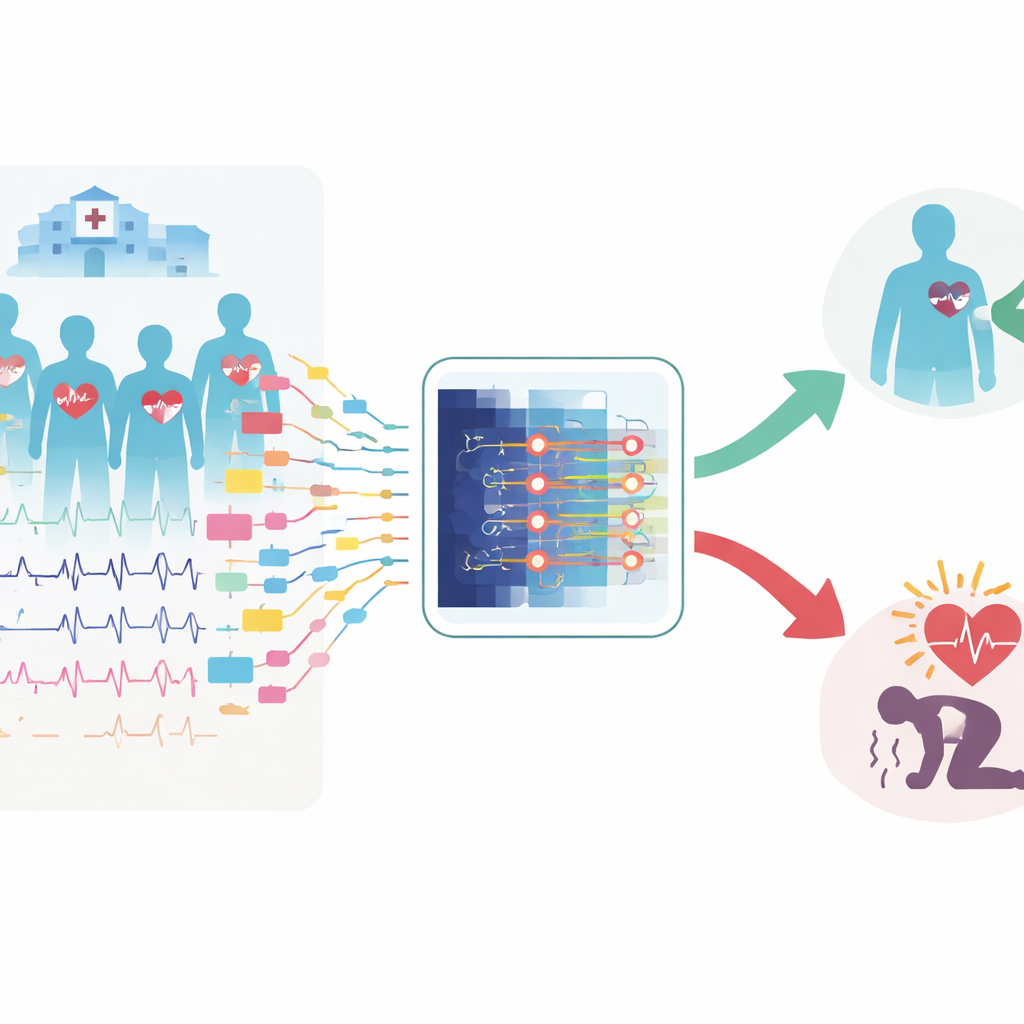
Researchers in Finland examined the medical records of 17,625 adults treated at a single heart hospital who underwent coronary angiography, an imaging test for blood vessels supplying the heart. These patients were already considered at high risk because many had coronary artery disease or an acute coronary syndrome such as a heart attack. Over a span of sixteen years, their routine ECGs were digitally stored, yielding about half a million recordings—on average 17 ECGs per person. The team also had detailed information on each patient’s health, treatments, and causes of death, and tracked them for a median of 7.5 years.
Teaching a computer to read the electrical story
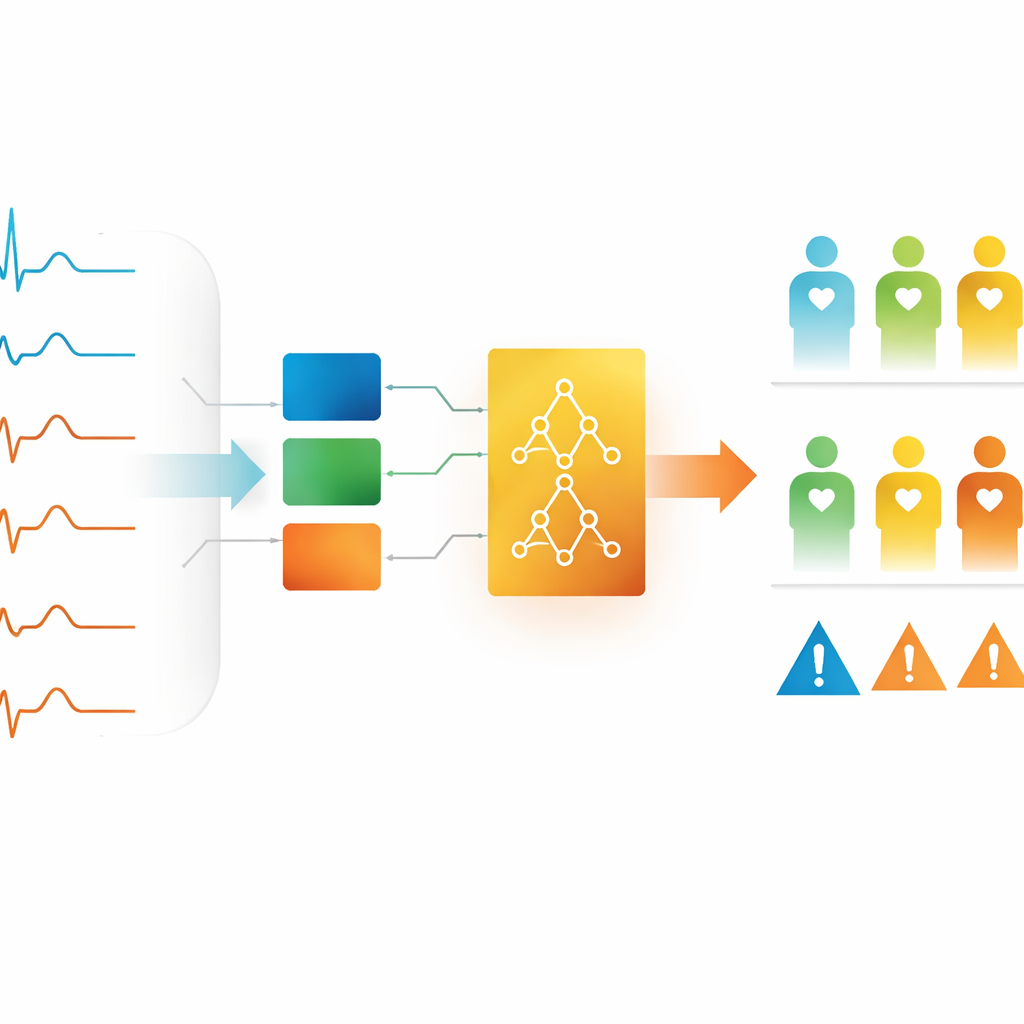
Instead of asking cardiologists to eyeball the ECGs, the researchers relied on numbers automatically extracted by widely used commercial software. These numbers described many aspects of the heart’s electrical behavior: how long each wave lasted, how strong it was in different leads, and whether rhythms like atrial fibrillation were present. Using this rich parameter set and basic clinical factors such as age, heart pumping function, and previous heart disease, they trained an advanced machine‑learning method called gradient boosting to distinguish people who later suffered sudden cardiac death or a closely related event from those who did not. They built separate models for three situations: using only the first ECG after angiography to predict long‑term risk; using the last available ECG to gauge short‑term risk; and using the last ECG plus how each ECG feature had changed over time.
How well did the models actually perform?
On paper, the models looked very strong when judged only in the data used to build them, with standard accuracy measures suggesting near‑excellent performance. But when the researchers tested them more realistically, the picture became more modest. Using a single baseline ECG alone, the model’s ability to separate future victims of sudden cardiac death from others reached an area under the curve (AUC) of about 0.68—better than chance, but far from perfect. The last ECG taken before the end of follow‑up did no better when used alone. When clinical risk factors were added, performance nudged up to AUC values around 0.70–0.71. The best short‑term results came from combining the last ECG with information on how ECG features had changed over the years, reaching an AUC of about 0.72 in the full test set. However, when the team forced a fair comparison between carefully matched patients with and without sudden death, these values fell to the mid‑0.6 range.
Real‑world limits of prediction
Because sudden cardiac death was relatively rare—even in this high‑risk group—another measure called precision‑recall gave a sobering view. The models’ ability to correctly flag patients who would actually suffer sudden cardiac death remained low, with average precision around 0.08–0.11. This was still roughly double what would be expected by chance alone but far below what would be needed to confidently decide who should receive invasive preventive treatments such as implantable defibrillators. Importantly, the study included many patients with irregular rhythms and serious coexisting illnesses, unlike earlier, more selective research. That choice made the results more representative of everyday clinical practice but also made prediction harder.
What this means for patients and doctors
In simple terms, this large study shows that ordinary 12‑lead ECGs, even when read by sophisticated computer algorithms and combined with clinical data, can only modestly predict who will die suddenly among high‑risk heart patients. The heart’s electrical signals do contain useful clues—especially when tracked over time—but they are not powerful enough by themselves to give clear‑cut answers about who needs aggressive preventive therapy. For now, doctors and patients must continue to rely on a broader picture that includes heart function, symptoms, other illnesses, and emerging tools, while research continues to search for stronger and more reliable warning signs.
Citation: Hernesniemi, J.A., Pukkila, T., Rankinen, J. et al. Performance of the 12-lead ECG in predicting short- and long-term risk of sudden cardiac death. npj Digit. Med. 9, 317 (2026). https://doi.org/10.1038/s41746-026-02456-1
Keywords: sudden cardiac death, electrocardiogram, machine learning, risk prediction, coronary artery disease