Clear Sky Science · en
Artificial intelligence–enhanced microsurgical training: a systematic review
Sharpening Tiny Skills with Smart Machines
Microsurgeons operate on blood vessels and nerves thinner than a piece of spaghetti, where the slightest tremor can mean the difference between success and harm. Training to reach that level of precision is slow, subjective, and often constrained by time, cost, and ethics. This review asks a timely question: can artificial intelligence (AI) act as a tireless digital coach, turning video and motion data from practice sessions into clear, objective guidance that helps surgeons learn delicate maneuvers faster and more safely?
Why Traditional Training Falls Short
For more than a century, surgeons have largely learned through an apprenticeship model summed up as “see one, do one, teach one.” In microsurgery, where operations are performed under a microscope on structures often less than 3 millimeters wide, this approach struggles to keep pace with modern pressures. Working hours are limited, access to expert mentors is uneven, and animal-based practice raises ethical and logistical concerns. Feedback is often informal and varies from teacher to teacher, making it hard to know whether a trainee is truly ready to operate on patients.
How Smart Systems Watch Every Move
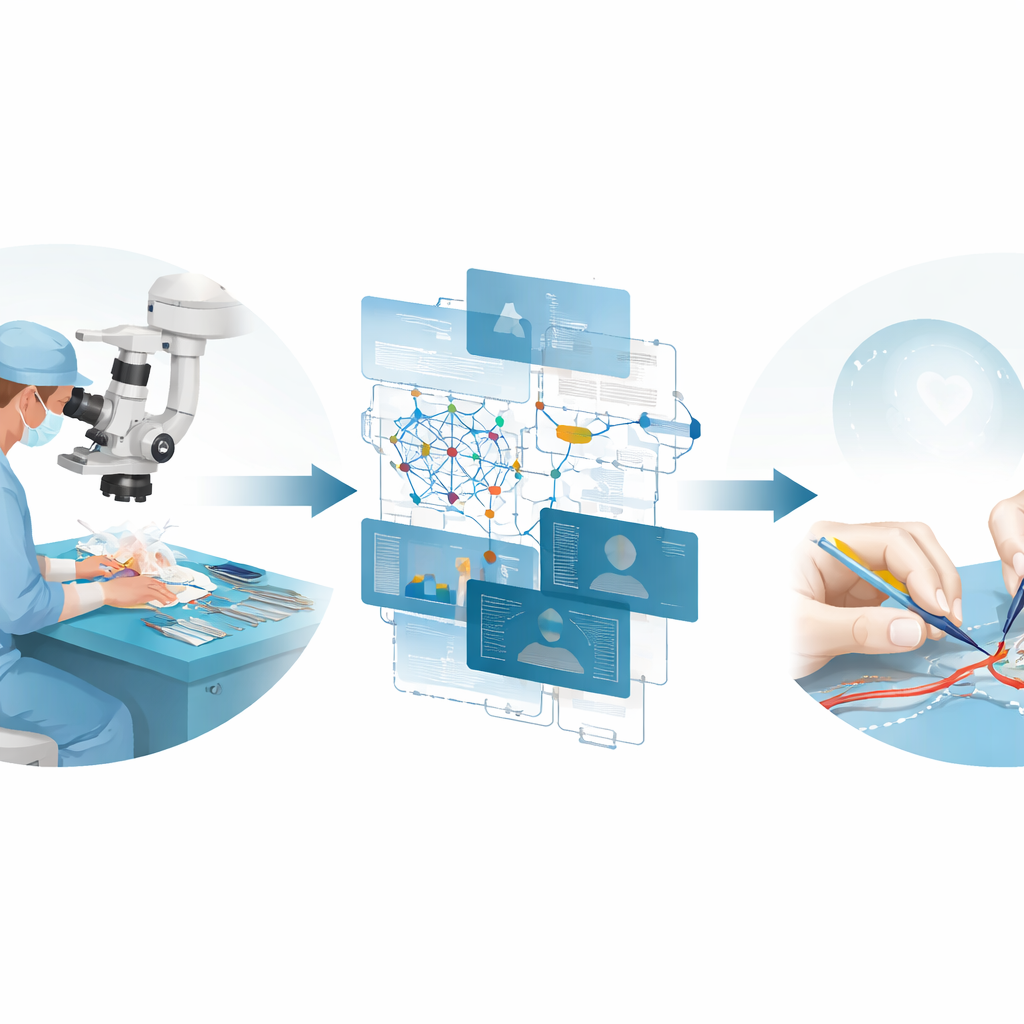
AI opens a new path by turning practice sessions into rich streams of numbers. Systems described in the 13 studies reviewed here used camera feeds, hand and tool movements, and sometimes eye-tracking to capture how trainees actually operate. Computer vision and machine learning models then followed instrument tips, mapped motion paths, and measured features such as speed, distance traveled, smoothness of movement, and tiny shaking. Some systems acted like digital examiners, scoring performance; others functioned as coaches, offering guidance during or after practice sessions. Across these studies, AI models typically reached around 80–85% accuracy in tasks such as recognizing surgical steps, tracking tools, or classifying skill level, with some exceeding 90% for well-defined tasks like outlining blood vessels.
What the Early Evidence Suggests
When AI was used alongside simulators, robotic platforms, or augmented and virtual reality systems, trainees generally showed better technical skills than with standard training alone. Their instrument paths tended to be shorter and smoother, with fewer abrupt jerks and mistakes, and their suturing became more precise. Intelligent tutoring systems and reinforcement-learning–based tools often accelerated early learning, helping novices climb the steep microsurgical learning curve more quickly. These gains, however, were usually measured in controlled practice setups, not in real operating rooms, and rarely tracked over long periods, so we do not yet know how well they translate into safer, more efficient surgery on patients.
Weak Foundations Beneath Promising Results
Beneath the encouraging surface, the evidence base is fragile. Most of the 13 studies were small, single-center projects, often with only a handful of participants, and many lacked strong comparison groups or clear plans to avoid bias. External testing—seeing whether an AI tool still works well in a different hospital or with new users—was rare. Few teams shared their code or data, making it hard for others to verify or improve their systems. Ethical questions, such as who owns trainee performance videos, how to prevent biased scoring, and how to protect privacy, were seldom addressed in depth. Taken together, these limitations mean that, while AI-assisted training looks promising, current estimates of its benefit are very uncertain.

Where This Could Go Next
The authors envision a future in which AI quietly underpins several layers of microsurgical education. Simple versions could first act as offline reviewers, analyzing recorded sessions to produce clear, standardized metrics that complement human feedback. More advanced systems might provide real-time coaching, adapt task difficulty to each learner, or combine motion and gaze data to reveal how experts think as well as how they move. Cloud-based, general-purpose models could eventually make sophisticated analysis available even to centers without in-house AI teams. To reach that point safely and fairly, the field will need larger, multi-center trials, open sharing of tools and data, attention to equity and privacy, and proof that improvements in simulated metrics truly lead to better outcomes for patients.
What This Means for Patients and Trainees
For a layperson, the takeaway is straightforward: AI has the potential to turn every microsurgical practice session into a highly detailed lesson, giving trainees faster, more objective feedback than a busy human mentor alone can provide. Early studies show that such digital coaching can make hand movements steadier and stitches more precise in the lab. But these tools are still experimental, not yet ready to decide who is competent to operate or to replace human teaching. With stronger studies, better validation, and careful attention to ethics, AI may become a powerful partner that helps future surgeons master life-saving fine motor skills more efficiently and safely.
Citation: Jamel, W.A., Jameel, M., Riaz, I. et al. Artificial intelligence–enhanced microsurgical training: a systematic review. npj Digit. Med. 9, 267 (2026). https://doi.org/10.1038/s41746-026-02452-5
Keywords: microsurgical training, surgical simulation, artificial intelligence, skill assessment, medical education