Clear Sky Science · en
A device-invariant multi-modal learning framework for respiratory disease classification
Why your phone might one day help check your lungs
Most of us carry a powerful microphone and computer in our pocket all day long. What if that everyday device could listen to a short bout of coughing and flag early signs of serious lung disease, even when no doctor or expensive equipment is nearby? This study explores how to turn ordinary coughs, plus a bit of background information about a person, into reliable warnings for several common breathing problems, using artificial intelligence that works across many different smartphones and recording gadgets.
Listening to illness in a simple cough
Many lung conditions—from chronic obstructive pulmonary disease (COPD) and asthma to infections—start with vague complaints like cough, phlegm, and breathlessness. Today, confirming these illnesses usually requires chest scans, lung function tests, or detailed exams by specialists, all of which can be hard to access in crowded clinics or low-resource settings. Cough-based tools powered by AI have emerged as a low-cost, non-invasive alternative, but until now most have depended on a single type of recording device and only examined the sound alone. The authors set out to design a smarter system that can use cough audio together with simple questionnaire answers and demographic details, and that remains accurate even when people record themselves on many different phones and microphones at home or in busy clinics.
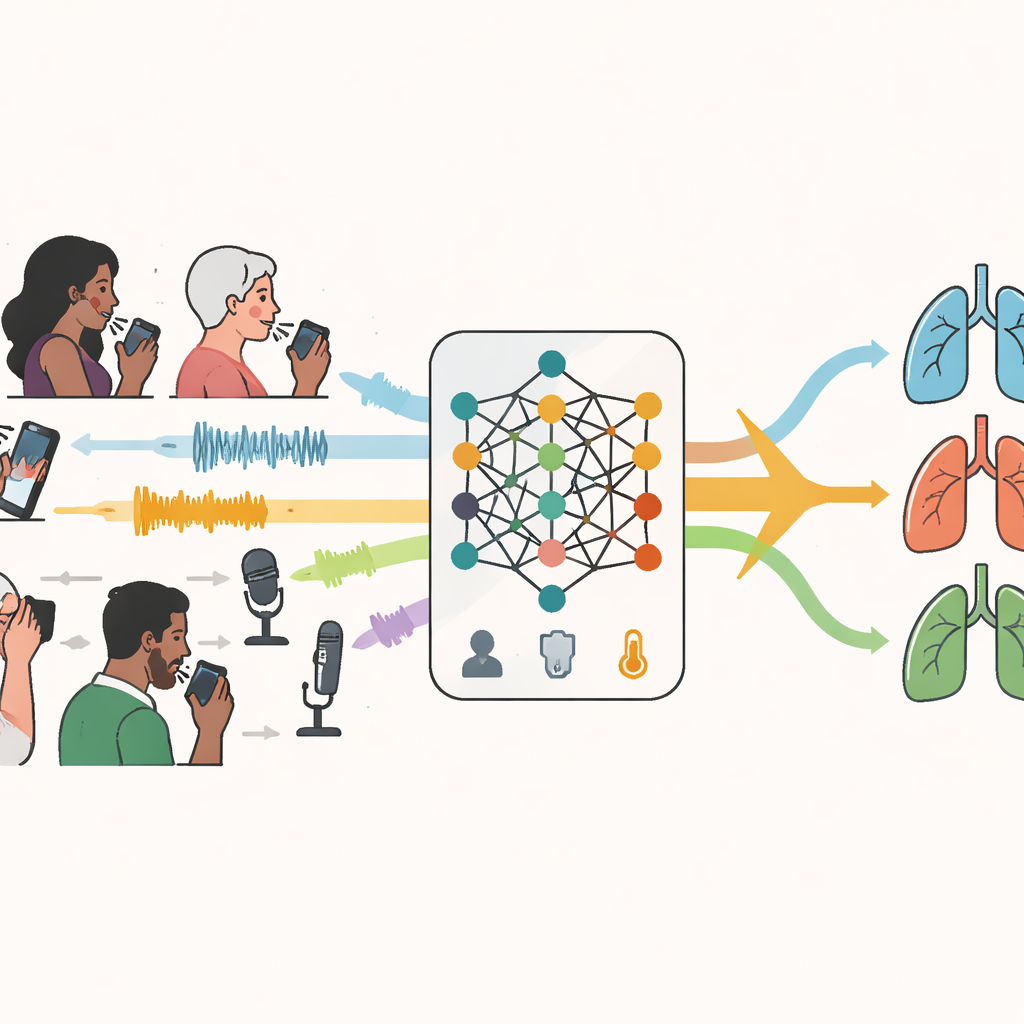
Building a robust digital checkup from thousands of patients
The team assembled a large real-world dataset from more than 12,000 adult outpatients across four hospitals. For each participant they collected at least ten seconds of voluntary coughing in a quiet room and ran every recording through a strict quality-control pipeline to strip out background noise, speech, and invalid coughs. Each approved cough clip was converted into a visual-like sound representation and fed into an audio model originally trained on huge sound collections. At the same time, the researchers encoded simple background information—such as age, sex, height, weight, smoking history, and key symptoms like phlegm or shortness of breath—through a language model tuned for medical text. A fusion network then learned how to combine these two streams to decide which of seven respiratory diseases were likely present in each person.
Teaching AI to ignore the device and focus on disease
A major obstacle for real-world use is that coughs are captured on many types of phones and microphones, each coloring the sound differently. To overcome this “device effect,” the authors added a special training branch that tries to identify which device produced each cough. At the same time, the main model is rewarded for making good disease predictions while being punished whenever its internal features make device recognition easy. This adversarial setup nudges the system to strip out device-specific quirks and keep only patterns related to illness. An additional training trick encourages the model to behave consistently across devices, further stabilizing performance when it meets new hardware it has never seen before.
How well the system spots different lung problems
Using this design, the model reached very high accuracy for three important screening tasks. For COPD, which often goes undiagnosed until late in life, the system achieved an area-under-the-curve score near 0.97, indicating excellent separation between sick and healthy individuals. It performed strongly, though somewhat less perfectly, for lower respiratory tract infections and for so-called pulmonary shadows—spots on imaging that may represent tumors or structural changes. When asked to judge all seven respiratory conditions at once, including combinations of diseases in the same patient, the tool still outperformed several state-of-the-art alternatives. Careful comparisons showed that cough audio carried the strongest signal, while demographics and symptom answers added helpful context. The adversarial training consistently improved results and, crucially, reduced the drop in accuracy when the system was tested on coughs recorded with entirely new phone models.
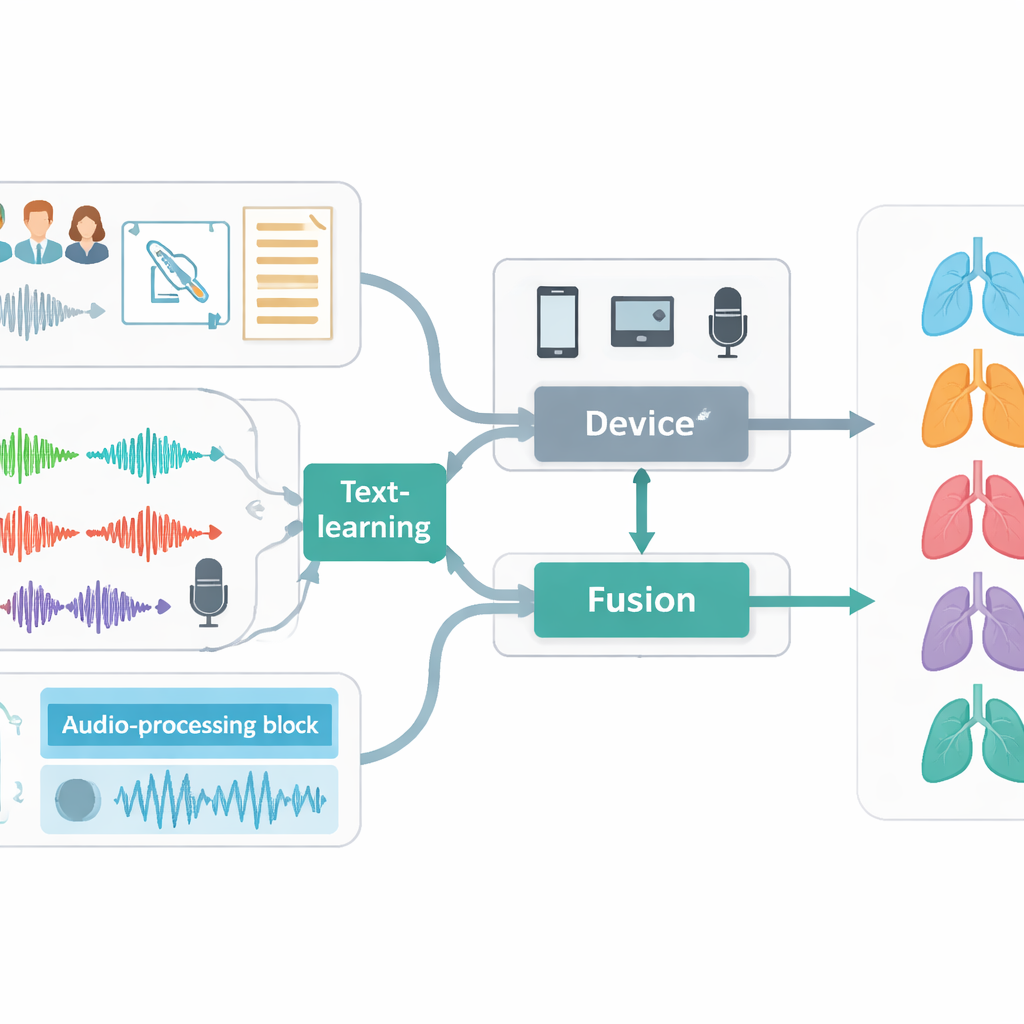
From hospital trial to everyday health companion
While the model is not ready to replace chest scans or specialist assessment—especially for rare or silent problems like tiny lung nodules—it shows real promise as a triage aid. In practice, that could mean a short coughing session into a phone, followed by a quick risk score that helps decide who needs further testing or follow-up. The authors note remaining challenges, including imbalanced data for rare diseases, limited ethnic diversity, and the need to handle noisy home environments. Still, their results show that with careful design, an AI system can listen past the quirks of different devices, fuse simple questionnaire data with cough sounds, and offer scalable, low-cost support for earlier detection and monitoring of respiratory illnesses.
Citation: Yang, M., Liu, X., Du, W. et al. A device-invariant multi-modal learning framework for respiratory disease classification. npj Digit. Med. 9, 290 (2026). https://doi.org/10.1038/s41746-026-02445-4
Keywords: cough analysis, respiratory disease screening, mobile health, multimodal deep learning, device-invariant AI