Clear Sky Science · en
Wearable EEG devices in the detection of mild cognitive impairment: a systematic review
Why brainwave headbands matter for everyday memory
As people live longer, many worry about the blurry line between normal forgetfulness and the early stages of dementia. Today’s tests for mild cognitive impairment—a warning stage before dementia—are either brief paper-and-pencil checks that can miss subtle problems or hospital scans that are pricey, invasive, and hard to access. This article explores whether simple wearable headbands that record brain waves could offer an easier way to spot early trouble long before daily life unravels.
Small devices, big hopes
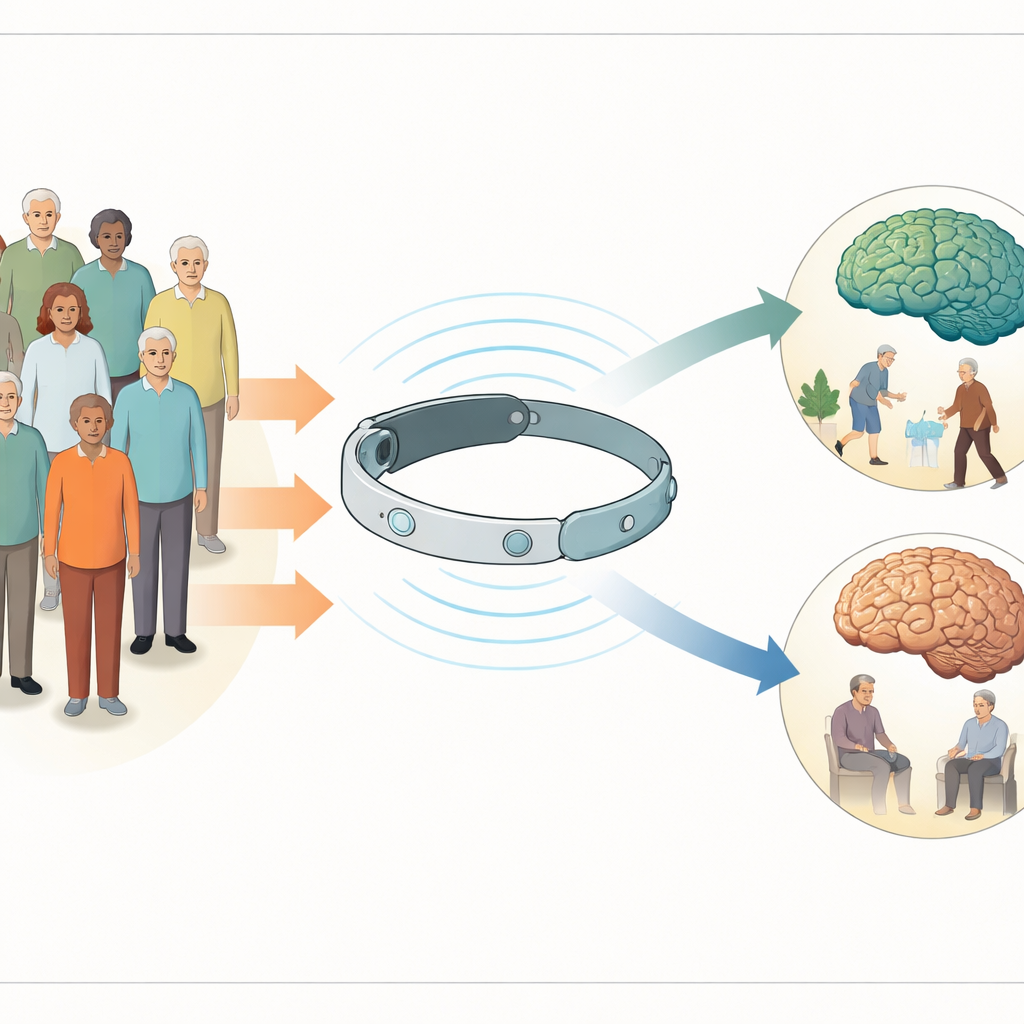
Wearable electroencephalography (EEG) devices look more like sports headbands or lightweight caps than hospital machines. They use small sensors on the scalp to pick up the brain’s electrical activity while people rest or perform short thinking tasks. Because these devices are portable, relatively inexpensive, and work without gels or expert technicians, they could, in principle, be used in community clinics, senior centers, or even at home to screen large numbers of older adults for early cognitive decline.
What the researchers examined
The authors systematically reviewed 21 studies that used 16 different wearable EEG systems to distinguish people with mild cognitive impairment from healthy older volunteers. Together, the studies included 1660 participants from eight countries. The devices ranged from simple two-sensor consumer headbands costing a few hundred dollars to more advanced multi-sensor medical systems costing several thousand. Researchers combined the raw brainwave signals with computer algorithms—mostly classic machine-learning methods—to see how accurately the systems could classify who had mild cognitive impairment. Reported accuracy varied widely, from chance-level performance to results above 90 percent.
How brainwaves reveal early cognitive strain
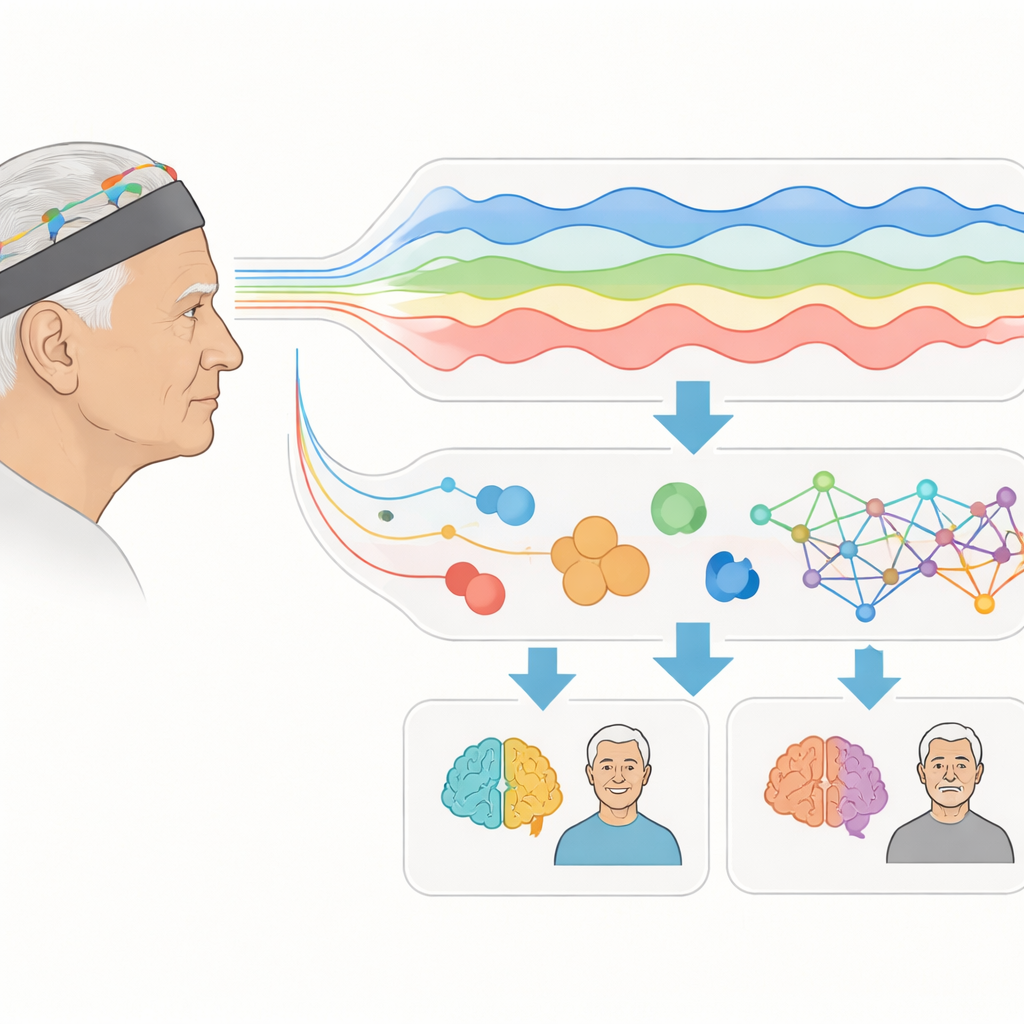
Across studies, a consistent pattern emerged in the brain activity of people with mild cognitive impairment. Their EEG signals tended to “slow down,” showing more power in low-frequency waves and less in faster rhythms linked to focused thinking. Other measures suggested that brain activity became less complex and that communication between distant brain areas weakened. The most informative signals often came from sensors placed over frontal and parietal regions—areas involved in attention, planning, and working memory. When researchers extracted a mixture of features that captured slowing, loss of complexity, and disrupted connections, and then combined them in smarter computer models, classification performance generally improved.
Designing better tests and smarter algorithms
Not all recording setups were equally helpful. The review found that a moderate number of sensors—around four to eight channels—struck the best balance between accuracy, comfort, and cost. Very few sensors missed important details, while much denser systems brought little extra benefit for this task. Likewise, brief thinking tasks that tapped several skills at once—such as attention, memory, language, and visual-spatial ability—often yielded clearer brainwave differences than simple resting with eyes closed. Signal-cleaning steps to remove noise from movement or muscle activity, along with advanced feature selection and ensemble algorithms that combine several machine-learning models, further boosted performance. Adding other wearable data, such as heart rhythm, walking patterns, or handwriting metrics, on top of EEG provided another noticeable lift in accuracy.
Real-world hurdles and what comes next
Despite promising results, the field is still in an early, somewhat messy stage. The studies used many different devices, patient definitions, and testing protocols, making it hard to compare results or set clear performance benchmarks. Many samples were small and not very diverse, and some studies reported only one simple measure of accuracy. The authors call for standardized diagnostic criteria, shared recording and processing guidelines, larger community-based studies, and better reporting practices. They also highlight the need to test these systems in realistic settings—such as primary care clinics—while carefully weighing their cost and ease of use.
What this could mean for everyday memory care
Overall, the review concludes that wearable EEG devices can already distinguish many people with mild cognitive impairment from healthy peers, sometimes with high accuracy, when the system is well designed: a comfortable mid-density headband, sensors over the right brain regions, thoughtfully chosen thinking tasks, careful signal cleaning, and modern data analysis. With further standardization and real-world testing, such headbands could evolve into practical screening tools that flag at-risk individuals early, guiding them toward more thorough evaluation and timely support—long before memory problems become disabling.
Citation: He, C., Yu, X., Zhang, Y. et al. Wearable EEG devices in the detection of mild cognitive impairment: a systematic review. npj Digit. Med. 9, 265 (2026). https://doi.org/10.1038/s41746-026-02342-w
Keywords: wearable EEG, mild cognitive impairment, brainwave screening, digital biomarkers, early dementia detection