Clear Sky Science · en
Dielectric response of graphene and MoS2 nanopores in the detection of single amino acids
Seeing the Building Blocks of Life One by One
Proteins are built from just twenty kinds of amino acids, yet their arrangements underlie everything from muscle strength to immune defense. If scientists could reliably read amino acids one at a time, they could decode proteins as easily as DNA is now sequenced, opening doors for rapid disease diagnosis and personalized medicine. This study explores how ultra-thin materials like graphene and molybdenum disulfide (MoS2) might make such single–amino-acid detection possible using light instead of electrical current.
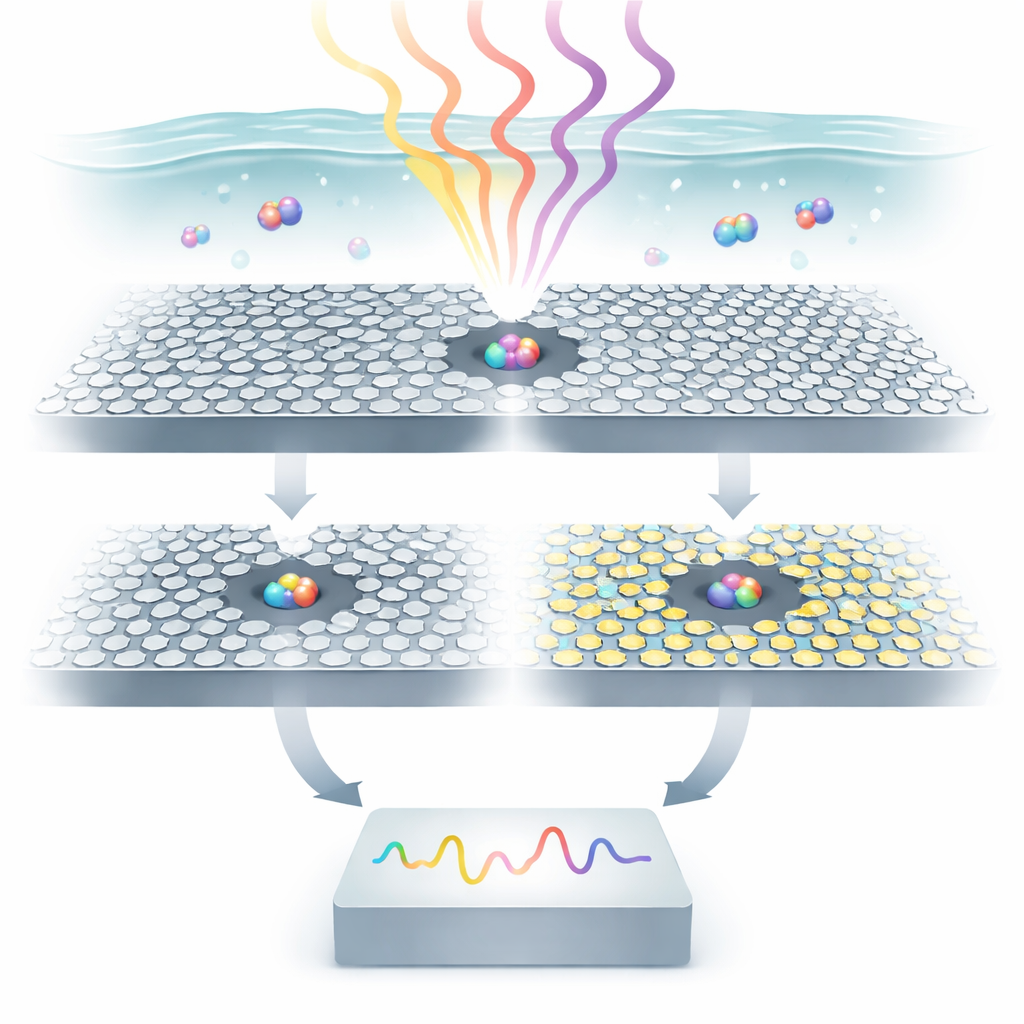
Tiny Holes in Ultra-Thin Sheets
The work centers on nanopores—nanoscale holes drilled in atomically thin sheets of graphene or MoS2. When a single amino acid sits inside such a pore, it slightly alters how charge and light behave in the material around it. Traditional nanopore devices detect DNA by monitoring how ions flowing through a pore are blocked as each base passes. But for proteins, the challenge is greater: there are many more building blocks, and amino acids are smaller and less uniformly charged. The authors ask whether two-dimensional materials can sense individual amino acids more effectively if we look at how they change the material’s interaction with light rather than focusing only on electrical currents.
Simulating Single Molecules in a Nano Window
Because directly probing every detail in an experiment is difficult, the researchers use quantum mechanical simulations to study graphene and MoS2 nanopores with a diameter of about 1.5 nanometers—just large enough to host a single amino acid. They examine five representative amino acids with different sizes and chemical characters, from small ones like glycine to bulkier aromatic ones such as phenylalanine and histidine. The team first determines how each amino acid prefers to orient itself inside each pore, revealing that graphene tends to grip molecules more strongly and in a more direction-sensitive way, while MoS2 interacts more gently, allowing a smoother range of orientations.
Why Electrical Signals Fall Short
The first sensing mode explored is electrical: how much the sideways (transverse) current flowing through the graphene sheet changes when a pore is occupied. Despite graphene’s excellent conductivity, the simulations show only very small current differences—on the order of 2–6 percent—between an empty pore and one blocked by an amino acid. In realistic experimental conditions, such tiny variations would be buried in noise and device imperfections, making it nearly impossible to tell amino acids apart based on current alone. For MoS2, which conducts less well, the absolute current would be even smaller, undermining its usefulness as an electrical readout channel.
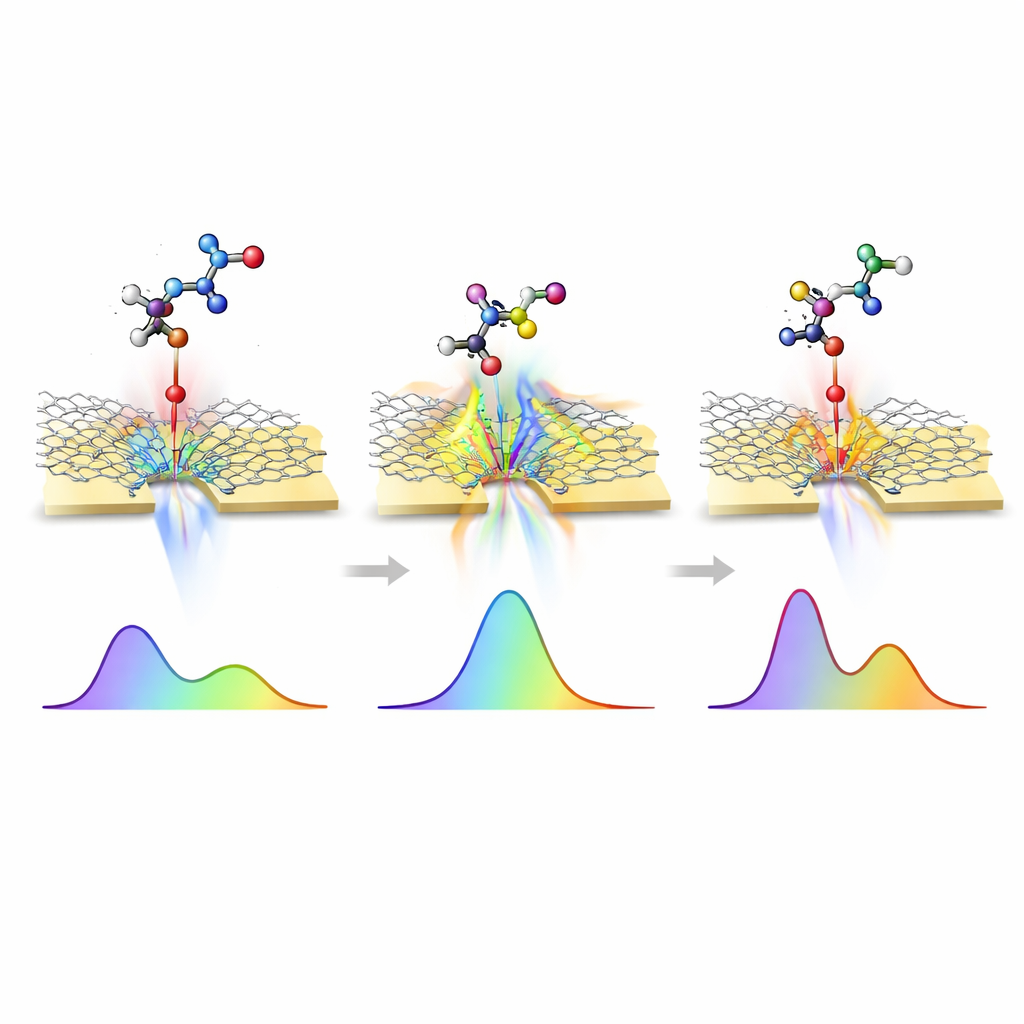
Light as a More Telling Messenger
The study then shifts to an optical approach: instead of tracking current, it calculates how the presence of an amino acid changes the material’s dielectric response—that is, how it polarizes and absorbs light across different photon energies. In graphene nanopores, the changes cluster around a few distinct optical resonances, and aromatic amino acids cause noticeably stronger shifts than simpler ones. Even so, the best optical sensitivities for graphene reach only about 40–65 percent at specific energies. MoS2 nanopores behave strikingly differently. Their optical response is richer and spread across a broader range of energies, from the far infrared up to around 2 electronvolts. When an amino acid is present, the simulated light absorption can change by as much as 70–90 percent at certain low photon energies, and even the weakest amino acids leave strong, distinguishable fingerprints.
Toward Future Protein Readers
These findings suggest that atomically thin nanopores, especially in MoS2, could serve as highly sensitive optical probes of individual amino acids. Rather than relying on small, noisy electrical currents, a future device could shine light on a nanopore and watch how its color- and energy-dependent absorption pattern shifts as each amino acid passes through. Because these optical signatures are broad and distinctive, they could be combined with advanced signal processing to read out protein sequences with high accuracy. In simple terms, this work shows that two-dimensional nanopores, illuminated and read optically, may provide a powerful foundation for next-generation protein sequencing and biosensing technologies.
Citation: Li, L., Fyta, M. Dielectric response of graphene and MoS2 nanopores in the detection of single amino acids. npj 2D Mater Appl 10, 47 (2026). https://doi.org/10.1038/s41699-026-00694-1
Keywords: nanopore sensing, graphene, MoS2, single-molecule detection, optical biosensor