Clear Sky Science · en
MoTe2-based synaptic-bridge memristor for brain-inspired computing: neuromorphic performance evaluation using MLP-CNN frameworks
Why Tiny Electronic “Synapses” Matter
Our phones and computers are getting smarter, but they still waste a lot of energy shuttling data back and forth between memory and processors. The human brain, in contrast, stores and processes information in the same place, using vast networks of energy‑efficient synapses. This paper explores a new kind of tiny electronic component, made from a layered crystal called MoTe2 mixed into a common polymer, that behaves a bit like a biological synapse and could help build brain‑inspired hardware for future artificial intelligence.
Building a New Kind of Switch
At the heart of this work is a device called a memristor, a two‑terminal component whose electrical resistance can be changed and remembered even when power is off. The researchers created a memristor by sandwiching a thin film of MoTe2 flakes mixed with polyvinyl alcohol (PVA) between a bottom indium tin oxide (ITO) electrode and a top silver electrode. The MoTe2 comes from carefully grown high‑quality single crystals, then exfoliated into multilayer flakes that disperse within the PVA, forming a connected but controlled network for current. Microscopy and spectroscopy measurements confirm that the MoTe2 maintains a stable crystal form with clean chemical bonding, while the composite film is about 100 nanometers thick and uniform across the device area. 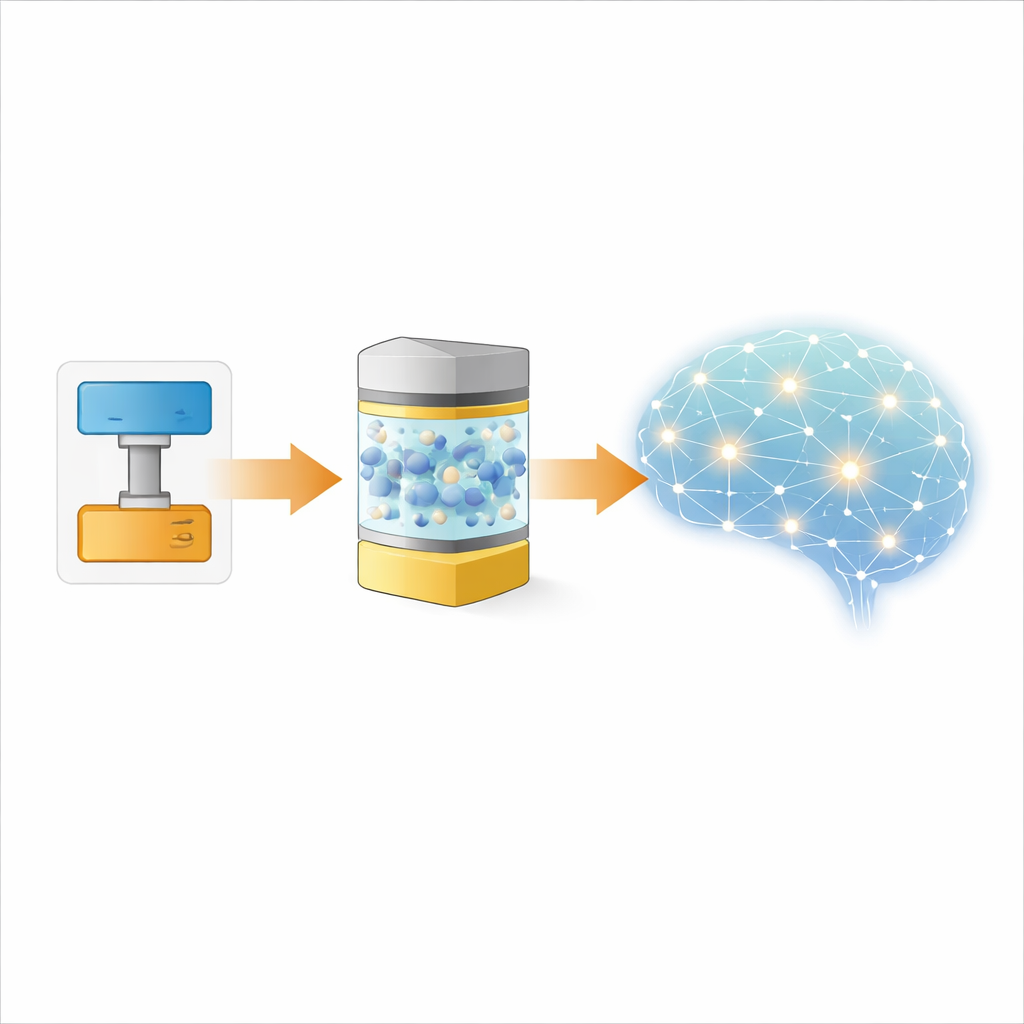
How the Device Remembers
When a voltage is applied, silver atoms from the top electrode can move into the MoTe2‑PVA layer as ions and assemble into a narrow metallic filament that bridges the two electrodes. This filament creates a low‑resistance path, representing an ON state. Reversing the voltage dissolves or thins the filament, returning the device to a high‑resistance OFF state. The authors show that choosing the right MoTe2:PVA mixing ratio (3:1) is crucial: too much polymer breaks up the conductive paths, while too much MoTe2 makes the device difficult to control. With the optimized blend, the device exhibits stable “bipolar” switching—toggling between ON and OFF with opposite voltage polarities—over at least 125 cycles, with small variation in the required voltages and good data retention over many thousands of seconds.
From Simple Memory to Brain‑Like Learning
Because its conductance can be tuned gradually by electrical pulses, the MoTe2 memristor can mimic how biological synapses strengthen or weaken with activity. By applying trains of short voltage pulses, the team demonstrated electronic analogs of key synaptic behaviors: long‑term potentiation and depression (lasting increases or decreases in connection strength), timing‑dependent learning rules where the order of two pulses matters, and dependence on pulse number and rate. The device also shows short‑term facilitation, where a second pulse arriving soon after the first produces a stronger response, much like a neuron that is still “primed.” Together, these behaviors suggest the device can support rich learning dynamics directly in hardware, without constant data movement to a separate memory.
Teaching a Device to “Associate” and to Read Patterns
To illustrate more complex functions, the researchers recreated Pavlov’s famous conditioning experiment in electronic form. They used a weak “neutral” pulse and a stronger “meaningful” pulse as stand‑ins for a bell and food. Initially, only the strong pulse produced a large current response, but after repeatedly applying both together, the weak pulse alone triggered a stronger response, showing associative learning. The same device could distinguish short and long pulses as different current levels, allowing it to recognize Morse code sequences as patterns in time. By converting measured device characteristics into software models, the team then tested how well these memristor‑like synapses would perform in artificial neural networks. Using both a multilayer perceptron and a convolutional neural network, they achieved accurate classification of images from the widely used CIFAR‑10 dataset, indicating that the observed device behavior is suitable for practical neuromorphic computing.
What This Means for Future AI Hardware
In plain terms, this study shows that a simple, solution‑processed stack of MoTe2 flakes in a polymer binder can act as a stable, tunable electronic synapse. It reliably switches between ON and OFF states through a reversible silver filament, holds its memory for long times, and supports a variety of brain‑like learning rules, from basic strengthening and weakening of connections to associative learning and pattern recognition in time. When these behaviors are translated into neural network models, they can underpin effective image‑recognition systems. While practical challenges remain—such as preventing unwanted filament growth and protecting the polymer—the work points toward low‑cost, energy‑efficient chips where memory and computation are tightly intertwined, bringing everyday electronics a step closer to the way our brains process information. 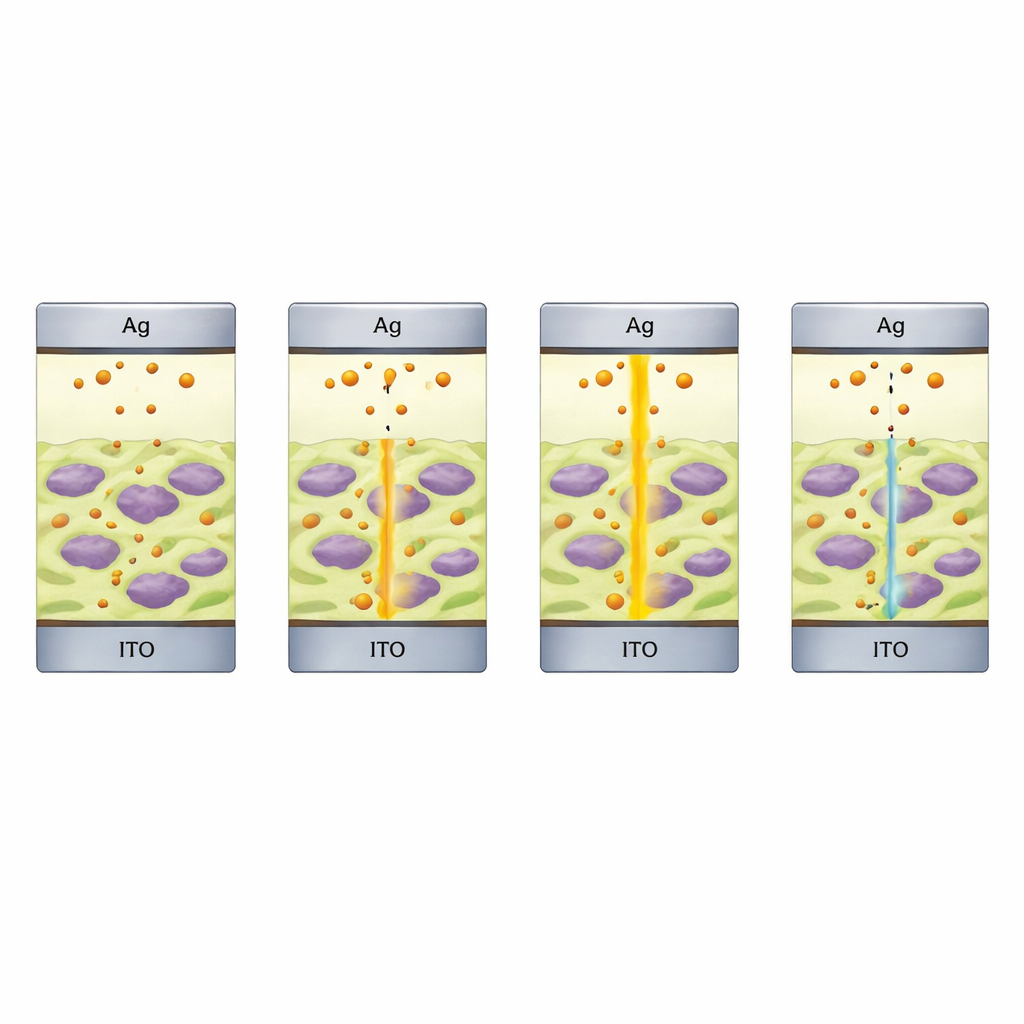
Citation: Bhunia, R., Jana, R., Saraswati, A. et al. MoTe2-based synaptic-bridge memristor for brain-inspired computing: neuromorphic performance evaluation using MLP-CNN frameworks. npj 2D Mater Appl 10, 45 (2026). https://doi.org/10.1038/s41699-026-00682-5
Keywords: neuromorphic computing, memristor, MoTe2, artificial synapse, in-memory computing