Clear Sky Science · en
Dynamic dielectric permittivity tensor of in-plane hyperbolic van der Waals MoOCl2 and emergent chiral photonic applications
Light Control in a Sheet-Thin Crystal
Imagine guiding and filtering light using a crystal flake thousands of times thinner than a human hair. This study explores a layered material called MoOCl₂ that can both squeeze light into tiny volumes and distinguish between left- and right-twisting beams of light. Such abilities could one day help build ultrathin optical components for cameras, sensors, quantum technologies and secure communications.
A Crystal with Two Different Faces
MoOCl₂ belongs to the family of van der Waals materials, whose atoms are arranged in stacked sheets that can be peeled off like pages from a notebook. In this crystal, atoms line up in chains along one in-plane direction and form more insulating links along the perpendicular direction. As a result, light sees the material as almost metallic when it travels along one axis and as a transparent insulator along the other. The researchers first used polarization-sensitive Raman measurements—probing the tiny vibrations of the atoms with a laser—to accurately identify these two special directions in the crystal.
When Light Behaves Strangely
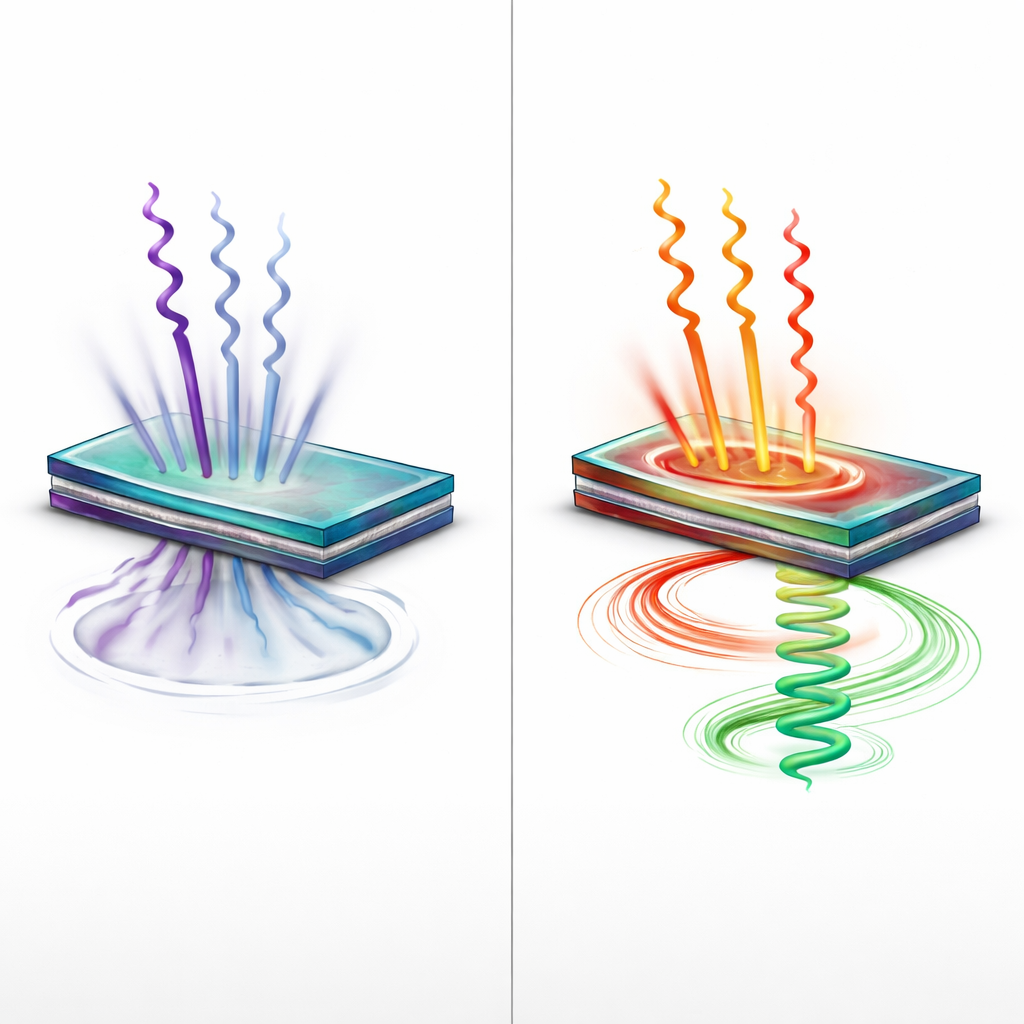
Because MoOCl₂ looks so different along its two in-plane directions, it belongs to a class of so-called hyperbolic materials. In these materials, light waves inside the crystal do not spread out in ordinary circles or spheres, but instead follow highly stretched, cone-like paths that allow them to be confined much more tightly than usual. By carefully measuring how the material reflects and alters polarized light across wavelengths from ultraviolet to near infrared, the team extracted the full “permittivity tensor” that describes how the crystal responds to electric fields along each axis. They discovered two wide wavelength windows where hyperbolic behavior appears: one in the visible and near-infrared range that is relatively low-loss and another in the ultraviolet that is more lossy but arises from strong electronic transitions.
Extreme Directional Contrast
The measurements reveal that at longer wavelengths, light trying to travel along the metallic direction is strongly damped, while along the insulating direction it can pass with very low loss and with a high effective refractive index. This huge contrast means that a single thin flake of MoOCl₂ reflects one polarization of light much more strongly than the other, especially in the second, visible-to-near-infrared hyperbolic window. Simulations show that this linear dichroism—difference in response between two perpendicular polarizations—can exceed 90 percent for realistic layer thicknesses, making the material a powerful built-in polarizer without the need for complex patterning.
Twisting Layers to Create Handed Light
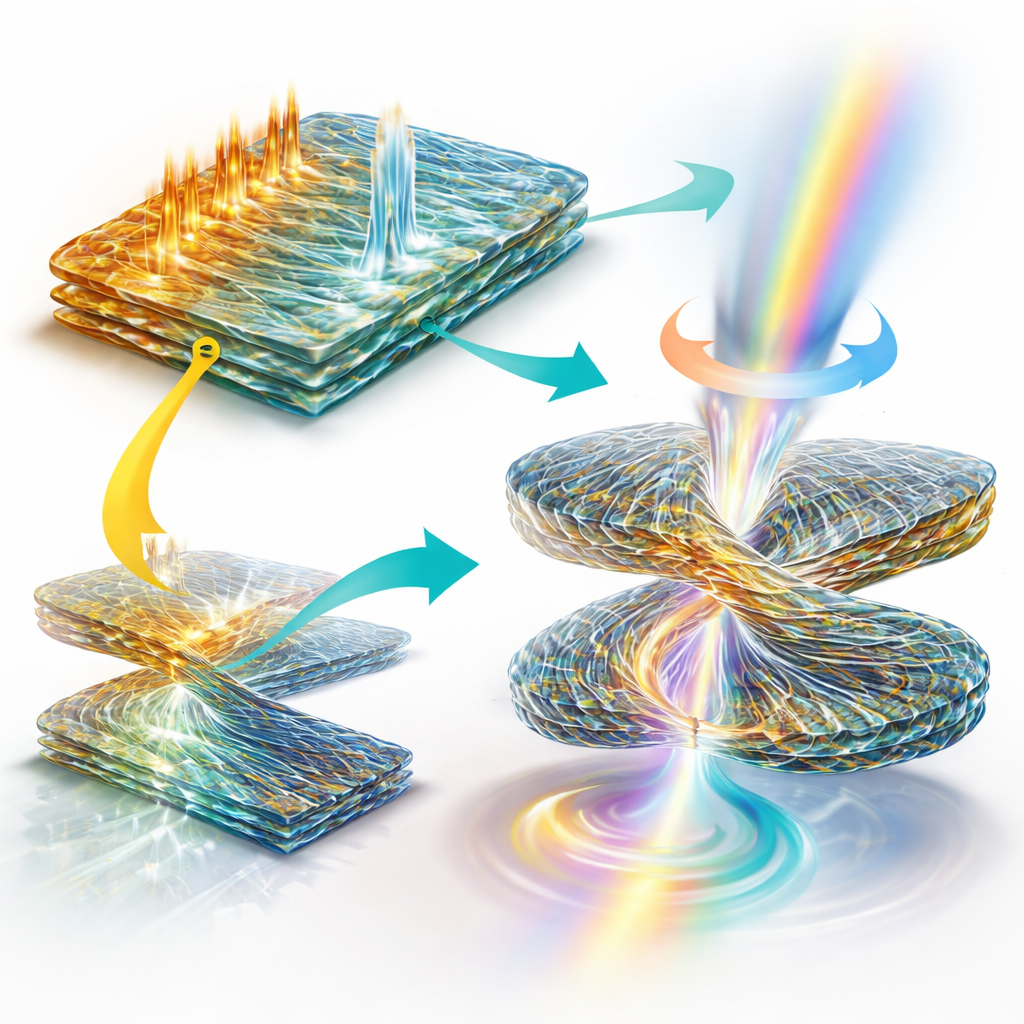
Beyond simple polarization control, the authors ask what happens when two MoOCl₂ sheets are stacked with a twist. By rotating one layer relative to the other, the combined structure loses mirror symmetry and becomes chiral, meaning it can distinguish between light that spirals clockwise versus counterclockwise as it travels. Using the measured optical constants, the team modeled a twisted bilayer placed on glass and explored how thickness, twist angle and anisotropy work together. They identified an optimal design in which a modest total thickness of around 90 nanometers and a twist angle of about 60 degrees lead to very strong preference for one circular polarization over the other.
From Theory to a Working Prototype
To test their predictions, the researchers fabricated a twisted MoOCl₂ bilayer with carefully controlled thickness and twist, then measured how much right- and left-circularly polarized light was transmitted. Using a clever measurement scheme that reconstructs circular behavior from linear polarization data, they found that the device could favor one handedness of light by nearly 50 percent around deep-red wavelengths. This experimental result aligns well with their simulations and demonstrates that strong chiral effects can be achieved using only two ultrathin layers of a natural crystal.
Why This Matters
By charting in detail how MoOCl₂ interacts with light across a broad spectral range, this work establishes the material as a rare platform that combines strong in-plane hyperbolic behavior with powerful chiral response in simple twisted stacks. For non-specialists, the takeaway is that a naturally occurring layered crystal can be used much like a tiny optical circuit board, steering, squeezing and filtering light according to its direction and handedness. Such capabilities could underpin future flat optical elements—like miniaturized polarizers, sensors and communication components—that are far thinner and more versatile than those used in today’s devices.
Citation: Margaryan, A.V., Sargsyan, M.L., Hayrapetyan, M.H. et al. Dynamic dielectric permittivity tensor of in-plane hyperbolic van der Waals MoOCl2 and emergent chiral photonic applications. npj 2D Mater Appl 10, 42 (2026). https://doi.org/10.1038/s41699-026-00681-6
Keywords: hyperbolic materials, van der Waals crystals, optical anisotropy, chiral photonics, circular polarizers