Clear Sky Science · en
Sustainable, solvent-free exfoliation of 2D materials for thermally conductive metal powder coatings
Why hotter gadgets need cooler materials
From smartphones to electric cars, modern electronics pack more power into smaller spaces, creating a constant battle against overheating. This paper explores a new, cleaner way to make metal parts that pull heat away more efficiently, using ultra-thin “sheet” materials such as graphene and hexagonal boron nitride. The work matters for anyone who cares about longer-lasting devices, faster charging, and more sustainable manufacturing.
Peeling crystals into paper-thin sheets
The story begins with layered crystals like graphite, the same carbon material found in pencil lead. These crystals are built from stacks of atom-thin layers that can, in principle, be peeled apart into ultra-thin sheets. Such two-dimensional layers, especially graphene, are famous for conducting heat and electricity extremely well. The challenge has been to produce large amounts of these sheets in a way that is both scalable and environmentally friendly. Many existing methods rely on harsh solvents, sticky additives, or complex multi-step procedures that are hard to scale up and can contaminate the final material.
A dry, simple way to make 2D building blocks
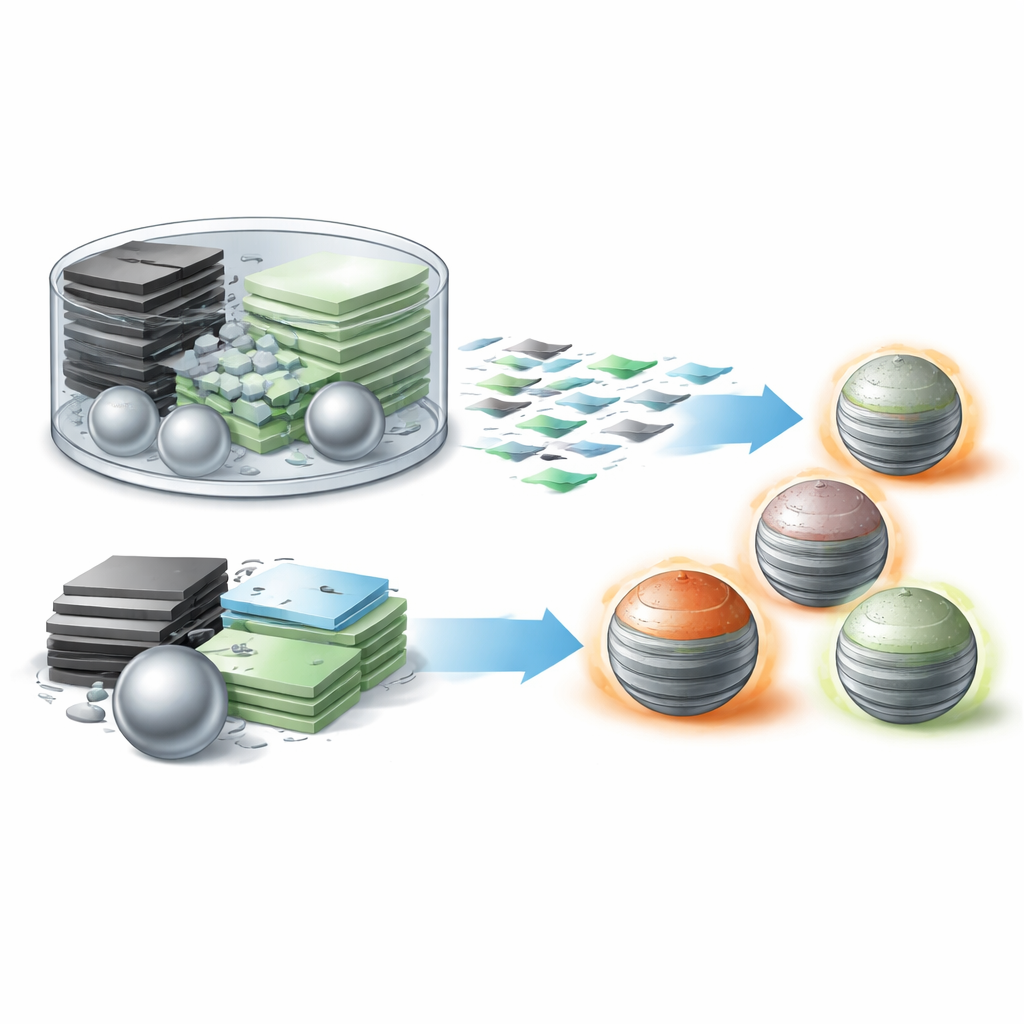
The authors introduce a solvent-free ball-milling process that uses only solid materials and moving steel balls inside a rotating jar. In the first step, large chunks of graphite or hexagonal boron nitride are tumbled at high speed. Early in the process, powerful impacts break the crystals into smaller fragments. As these pieces get finer, the nature of collisions changes: instead of simply smashing, they begin to slide past one another, shearing individual layers away and producing thin, flexible sheets. Experiments combined with computer simulations show that once the particles shrink to around a few tens of micrometers, each sliding event needs very little energy, and the overall exfoliation becomes highly efficient. Importantly, the crystal structure and low defect level of the sheets are largely preserved.
Coating metal powders like tiny planets
In the second step, these freshly made nanosheets are mixed with metal powders such as copper, titanium alloy, aluminum alloy, and stainless steel, again in a dry ball mill but now under gentler conditions. The thin sheets wrap and attach to the surfaces of the metal grains, forming a continuous skin only hundreds of nanometers to a few micrometers thick. High-resolution imaging shows that this coating is uniform and tightly bonded, with no major gaps. The method works across different metals and can be scaled up from grams to hundreds of grams without changing the basic recipe, suggesting it is compatible with industrial production lines.
Turning coated powders into heat highways
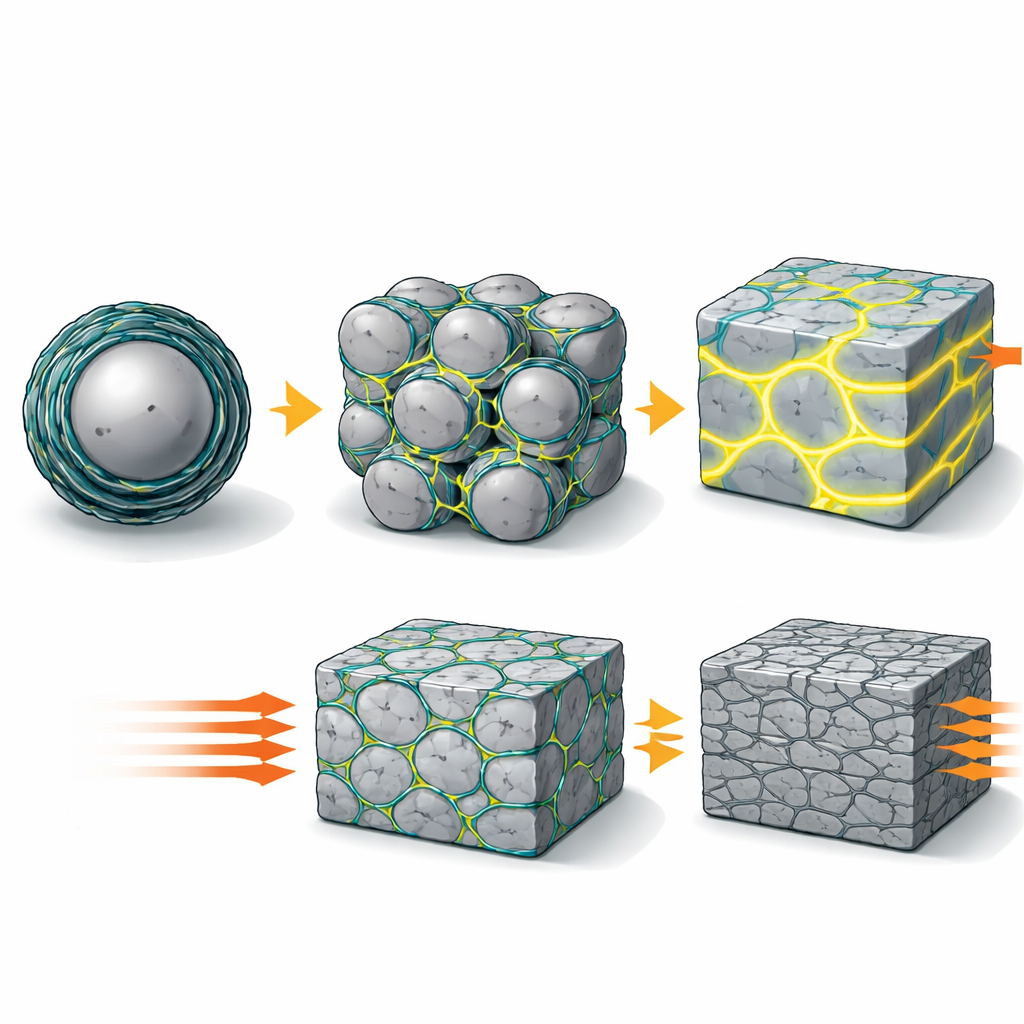
To see whether these coatings actually improve performance, the researchers press and sinter the coated titanium alloy powders into dense solid pieces. Inside these solids, the graphene layers form interconnected networks between metal grains, acting as highways for heat. Measurements reveal that adding 10% graphene by weight more than doubles the thermal conductivity of the titanium alloy, from about 6.7 to 17 watts per meter-kelvin—placing these composites among the best-performing heat-spreading titanium systems made by scalable methods. At the same time, strong bonding at the metal–carbon interface helps maintain structural integrity. The coated powders also process well in laser powder bed fusion, a common 3D-printing approach, meaning intricate, custom-shaped parts can be built directly from these advanced powders.
What this means for everyday technology
In simple terms, this work shows how to peel special crystals into atomically thin sheets without using liquids, then use those sheets to give ordinary metal powders a powerful heat-handling upgrade. Because the method is clean, scalable, and compatible with modern additive manufacturing, it offers a practical path toward lighter, cooler, and more energy-efficient components in electronics, transportation, and energy systems. By turning simple powders into smart, heat-conducting composites, the study points to a future where thermal management is built in from the grain level up.
Citation: Koutsioukis, A., Ruan, S., Cabello, R. et al. Sustainable, solvent-free exfoliation of 2D materials for thermally conductive metal powder coatings. npj 2D Mater Appl 10, 41 (2026). https://doi.org/10.1038/s41699-026-00680-7
Keywords: graphene, heat management, metal composites, additive manufacturing, sustainable processing