Clear Sky Science · en
Large spin signal and spin rectification in folded-bilayer graphene
Why this tiny carbon ribbon matters
Modern computers mostly shuffle electric charge, but there is another property of electrons—called spin—that could one day make devices faster, cooler, and capable of new brain-like tasks. This paper shows how a carefully folded strip of graphene, a single-atom-thick form of carbon, can generate unusually strong spin-based signals and behave like a diode for spin, letting spin flow much more easily in one direction than the other. Such behavior is a key ingredient for turning spin physics into practical logic and memory technologies. 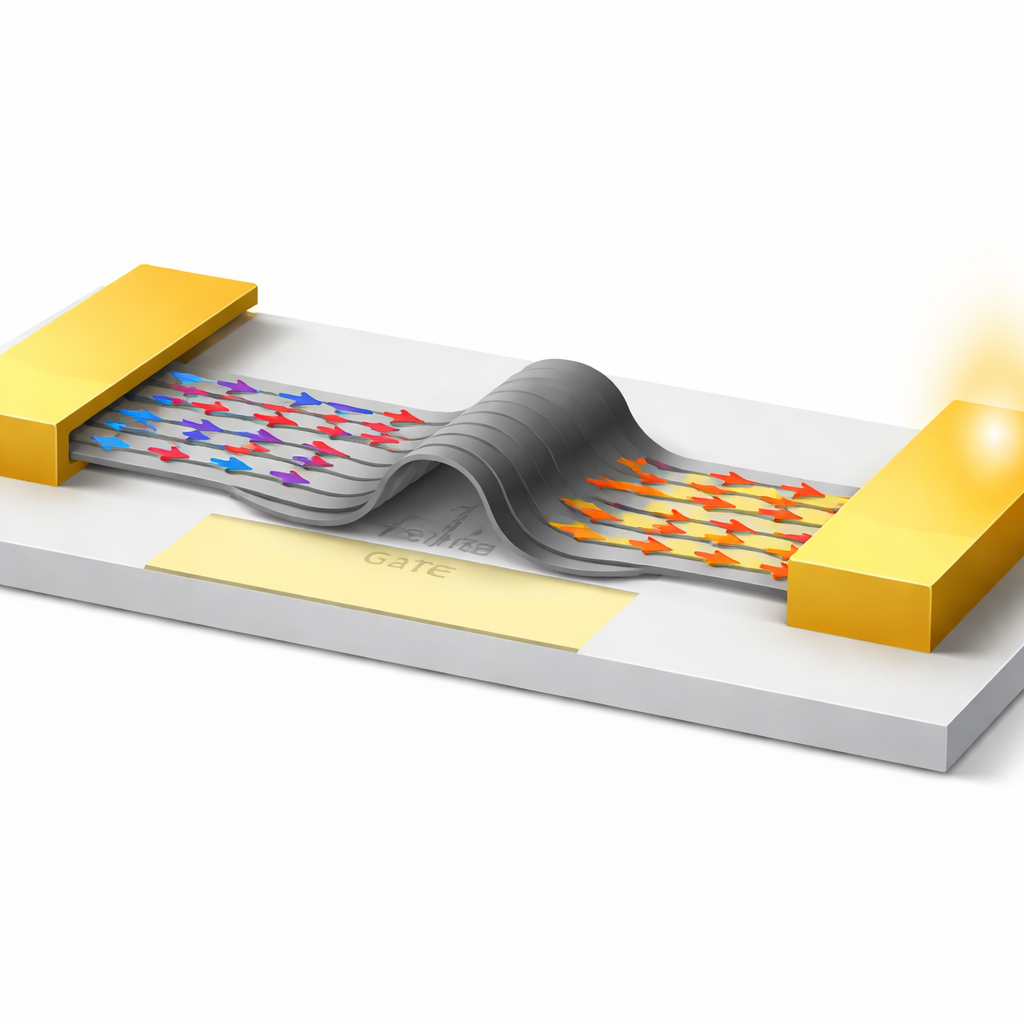
A new twist on graphene
Graphene has long been hailed as an excellent highway for spin, allowing spin information to travel tens of micrometers at room temperature with little loss. The usual problem is that the signals are tiny and hard to control. The authors tackle this by using a special geometry: instead of a single flat sheet, they study a narrow ribbon formed by folding a graphene bilayer back on itself two to three times. This folded ribbon sits on a standard silicon wafer and is contacted by magnetic metal electrodes separated by about one and a half micrometers, forming a so-called spin-valve device. In this setup, one contact pumps spin-polarized electrons into the graphene while the other reads out how much spin arrives, without being affected by ordinary charge flow.
Giant spin signals from better matching
The folded geometry accomplishes something subtle but crucial: it improves how well the magnetic contacts and graphene “impedances” match, meaning their resistances are tuned so that spin can enter the graphene efficiently instead of reflecting back at the interface. Because the channel is narrow, its contact area is small and the resistance at each magnetic tunnel junction becomes relatively large compared with the resistance of the graphene ribbon itself—near the ideal condition for spin injection. In measurements where the spin is manipulated by magnetic fields, the team detects spin signals corresponding to voltage changes of several millivolts and resistances on the order of hundreds of ohms, among the largest reported for graphene. From these data they infer a spin accumulation—an imbalance between up and down spins—of about 20 millielectronvolts at room temperature, far exceeding typical values. 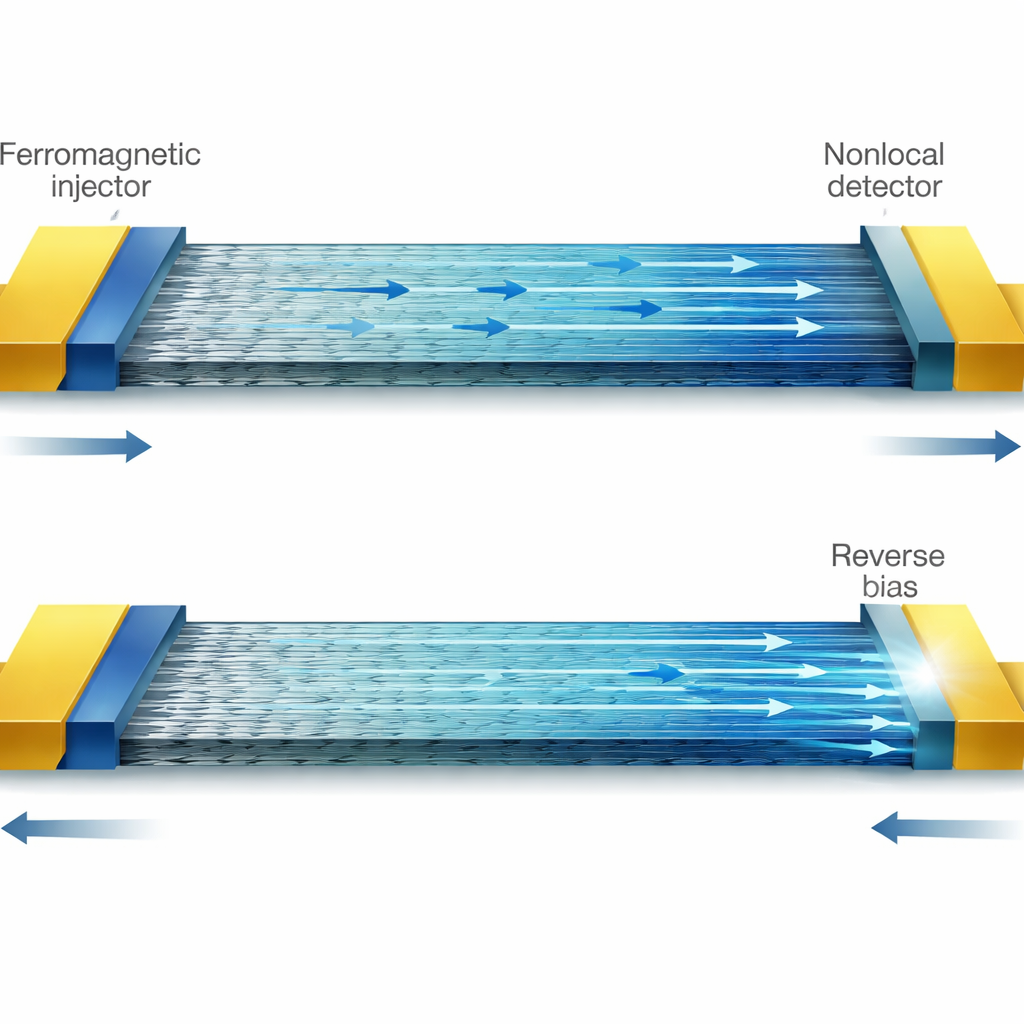
Spin flowing more easily one way than the other
With such a large spin buildup, the device leaves the simple, linear regime and enters a world where spin and charge currents interact in a strongly nonlinear way. By reversing the direction of the current through the injector contact, the researchers can either inject spins into the graphene or pull spins out of it. In a purely linear system, the size of the spin signal would be the same for positive and negative currents, just with opposite sign. Instead, they observe more than an order of magnitude difference between the two directions: for one current polarity, spins are effectively swept away from the detector, producing a weak signal; for the opposite polarity, the electric field helps push spins toward the detector, sharply boosting the signal. This strong asymmetry is the hallmark of a spin diode—an element that favors spin transport in one direction, much like a conventional diode favors charge in one direction.
Tuning spin with a simple gate
The folded graphene device also responds strongly to an applied gate voltage, which changes the density of charge carriers in the ribbon. By sweeping this gate, the team tracks how the spin signal, spin lifetime, and distance over which spin can travel depend on the electrical environment. They find that the spin signal peaks near the charge neutrality point, where graphene has its highest resistance, consistent with theoretical expectations for well-designed tunnel contacts. Estimates from their measurements show relatively long spin-diffusion lengths of a few micrometers and substantial spin polarization of about a quarter of the electrons coming from the magnetic contacts, unusually high for this kind of metal-oxide interface. Together, these traits confirm that the folded geometry is not just a mechanical curiosity but a powerful method for optimizing spin injection and transport.
What this means for future devices
For a non-specialist, the main message is that by simply folding a sheet of graphene into a narrow strip and pairing it with suitable magnetic contacts, it becomes possible to create strong, direction-dependent spin signals at room temperature. This combination of large signal strength, diode-like rectification, and electrical tunability brings spin-based components closer to the level of practicality required for memory, logic, and neuromorphic circuits. While further progress is needed to make such devices reproducible and scalable, folded-bilayer graphene offers a promising route to active spintronic elements that could eventually complement or even replace some charge-based components in future low-power electronics.
Citation: Hoque, M.A., Kovács-Krausz, Z., Zhao, B. et al. Large spin signal and spin rectification in folded-bilayer graphene. npj 2D Mater Appl 10, 43 (2026). https://doi.org/10.1038/s41699-026-00679-0
Keywords: graphene spintronics, spin diode, folded bilayer graphene, nonlinear spin transport, spin-based logic