Clear Sky Science · en
Phase-controlled synthesis and two-dimensional electronic transport of ultrathin tungsten carbide platelets
Why ultrathin carbides matter
From faster electronics to better batteries and radiation shielding, the search for new high-performance materials increasingly focuses on structures just a few atoms thick. This paper explores how to grow and control ultrathin forms of tungsten carbide—a hard, metal-like compound already used in cutting tools—and reveals that by carefully choosing the liquid metal used in the growth process, scientists can switch between two distinct electronic behaviors, including a form of near-two-dimensional superconductivity.
Making flat crystals on liquid metal
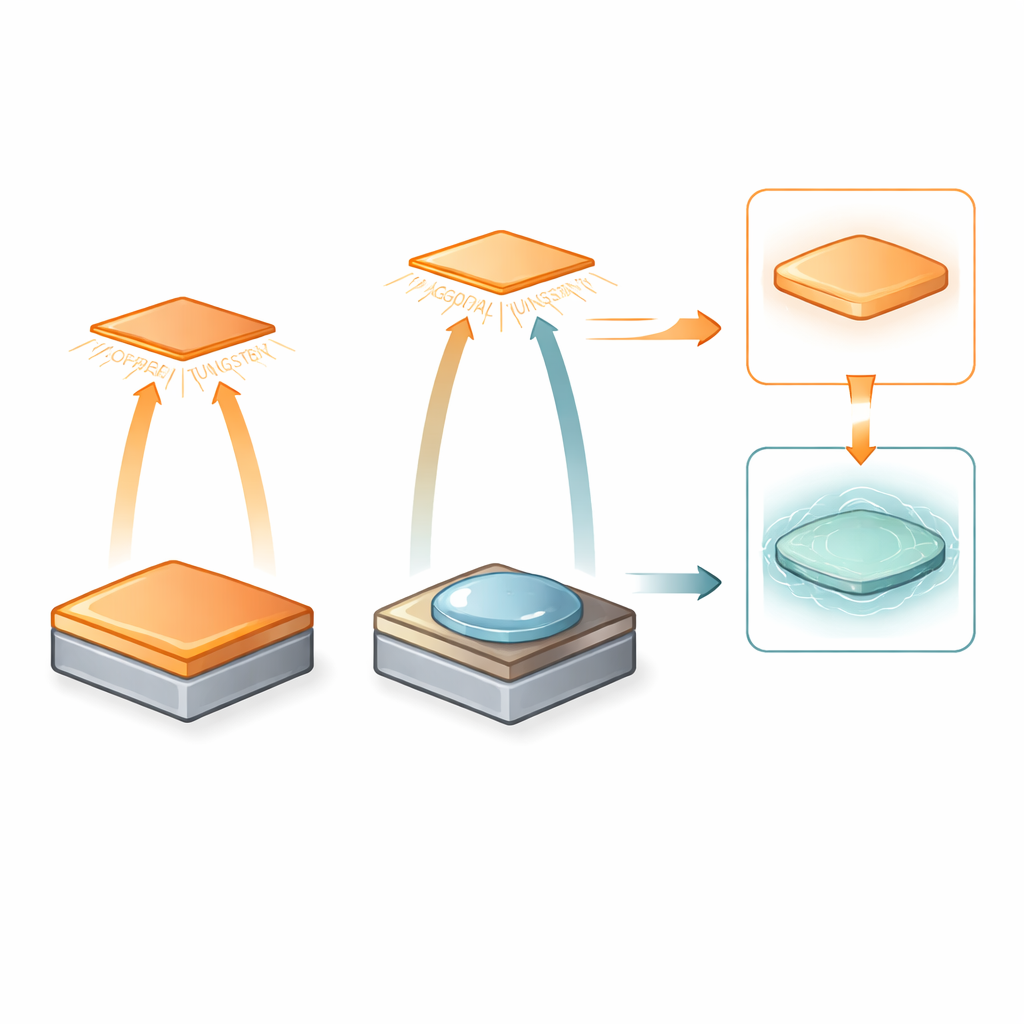
The researchers use a technique called liquid metal-assisted chemical vapor deposition, where a thin layer of molten metal sits on top of a tungsten foil inside a hot furnace. Methane gas supplies carbon, which diffuses through the liquid layer and reacts with tungsten to form ultrathin carbide platelets. When the top liquid layer is copper, the system mainly produces triangular platelets of a phase known as WC. When it is gallium instead, the system produces hexagonal platelets of a different phase called W2C. Atomic-scale imaging and diffraction show that both types of platelets are single crystals only tens of nanometers thick, with well-defined arrangements of tungsten and carbon atoms.
Tuning structure with chemistry and heat
Because different atomic arrangements can give the same elements dramatically different properties, the team performs a detailed structural and chemical analysis. Electron microscopy, X-ray diffraction, and spectroscopy confirm that the copper-based route stabilizes the carbon-richer WC phase, while the gallium-based route favors the carbon-lean W2C phase. Computer simulations of the underlying thermodynamics support this picture: under carbon-rich conditions, WC is more stable, whereas under carbon-poor conditions, W2C becomes favorable, especially when surfaces are taken into account. Gallium dissolves less carbon than copper and tends to form surface oxides that alter diffusion, helping to shift the effective carbon environment and steer the system toward W2C.
Shaping the platelets and byproducts
The authors also explore how gas flow and hydrogen content influence the morphology of the W2C platelets. By varying methane and hydrogen flows, they can switch between flat hexagonal sheets, pyramid-like shapes, and coalesced islands. Along the way, they observe the formation of gallium oxide crystals at the platelet edges, which can interfere with further growth by blocking the movement of tungsten and carbon. Raman measurements reveal that graphitic carbon—sometimes high-quality graphene—can grow alongside the carbides, especially on copper, hinting at integrated carbide–graphene stacks for future devices.
From hard metal to near-2D superconductor
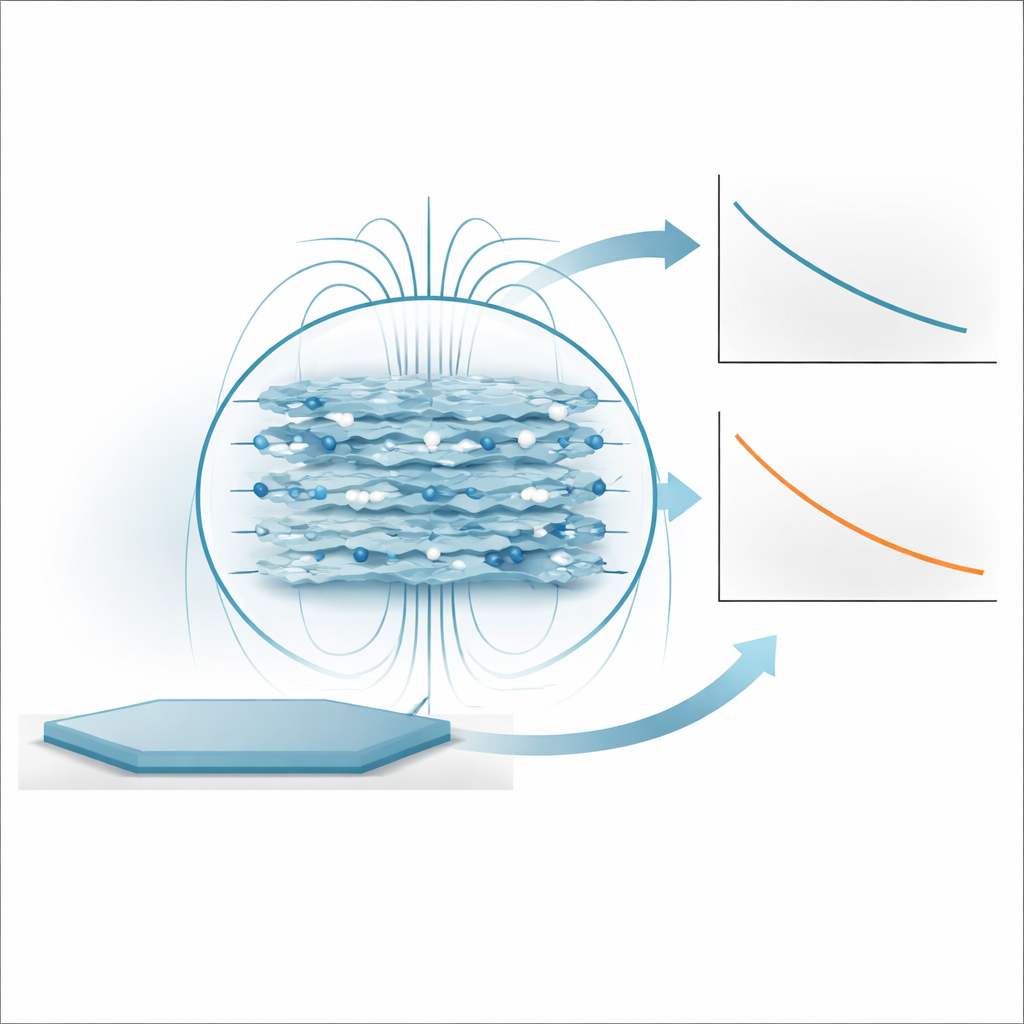
With phase control in hand, the team measures how electric current flows through individual platelets at very low temperatures. Ultrathin WC behaves as a normal metal all the way down to 12 millikelvin, showing no sign of superconductivity. In contrast, W2C platelets grown on gallium become superconducting below about 2.8 kelvin: their resistance suddenly drops to zero. By applying magnetic fields in different directions, the researchers find that fields parallel to the platelet surface must be stronger than perpendicular fields to suppress superconductivity. The temperature and angle dependence of these critical fields matches expectations for a system that is not fully three-dimensional, but not perfectly two-dimensional either—a quasi-2D superconductor whose thickness sits between key quantum length scales.
What this means for future technologies
In accessible terms, this work shows that changing the liquid metal beneath a growing film acts like a switch: copper favors a non-superconducting phase, while gallium favors a superconducting phase that behaves almost like an ultra-thin sheet. This phase control in ultrathin tungsten carbides opens a pathway to engineer similar behavior in other metal carbides and nitrides, potentially enabling new families of atomically thin superconductors, catalytic layers, and radiation shields. By tying together growth conditions, atomic structure, and electronic behavior, the study provides a blueprint for designing next-generation 2D materials with properties tuned on demand.
Citation: Sredenschek, A.J., Sanchez, D., Wang, J. et al. Phase-controlled synthesis and two-dimensional electronic transport of ultrathin tungsten carbide platelets. npj 2D Mater Appl 10, 38 (2026). https://doi.org/10.1038/s41699-026-00676-3
Keywords: tungsten carbide, ultrathin materials, superconductivity, liquid metal growth, 2D carbides