Clear Sky Science · en
AI-driven body composition atlas reveals its association with NSCLC immunotherapy outcome and molecular background: a multicenter study
Why body shape matters for cancer treatment
When people hear about cancer treatment, they often think about drugs that target tumors directly. This study asks a different question: can the way fat and muscle are arranged inside the body help predict who benefits from modern immune therapies for lung cancer? Using artificial intelligence to read routine medical scans, the researchers show that subtle patterns in body tissues are linked to how long patients live and how their immune cells behave, and that these patterns differ between men and women.
Looking inside the body with smart scans
The team focused on non small cell lung cancer, the most common type of lung cancer, in patients receiving immune checkpoint inhibitors, a class of drugs that helps the immune system attack tumors. Instead of relying on simple measures such as body mass index, they used deep learning algorithms to measure 92 features of body composition from standard CT scans. These features covered the volumes and densities of subcutaneous fat just under the skin, deeper visceral fat around organs, skeletal muscle, and intermuscular fat nestled between muscles, across multiple levels of the spine from the chest to the lower back. Their automated system closely matched expert human measurements while working roughly a hundred times faster, making it realistic for busy hospitals. 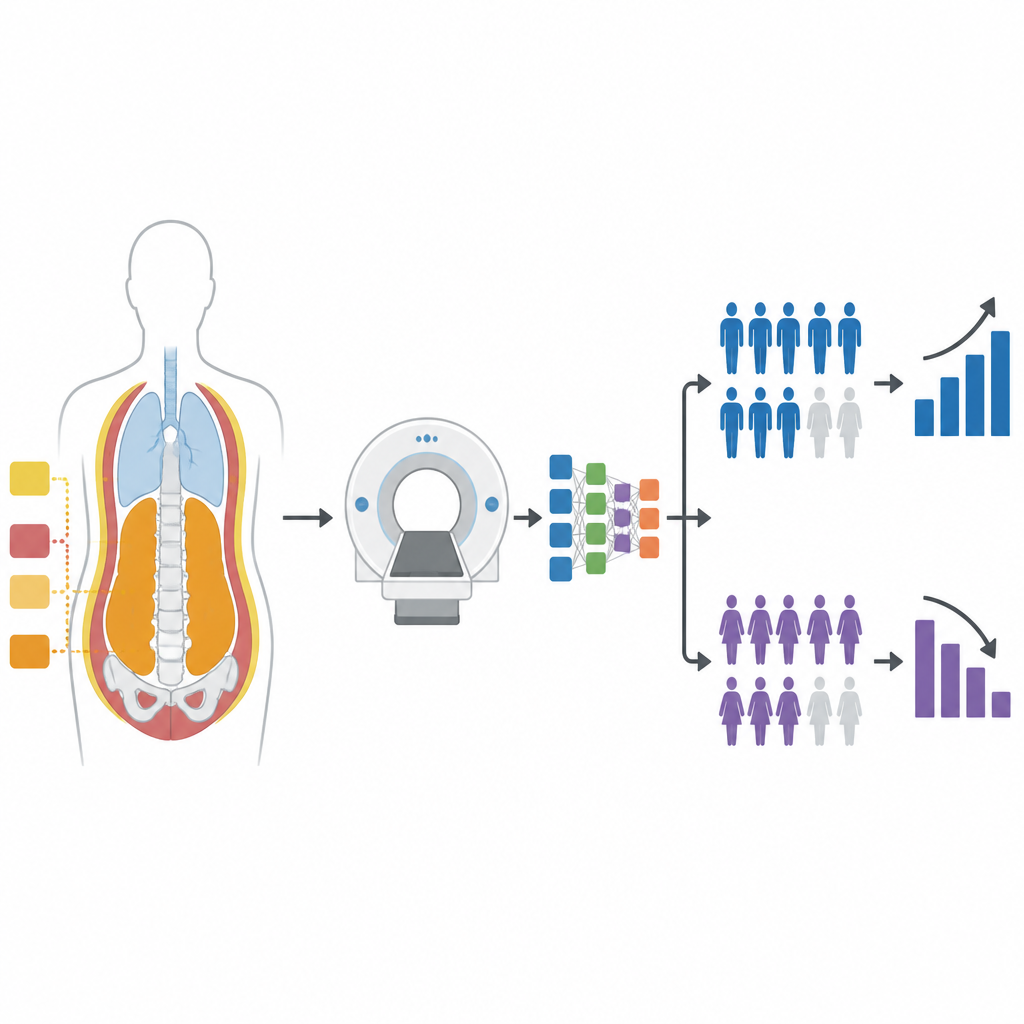
Patterns of fat and muscle linked to survival
Drawing on data from eight cohorts and more than two thousand patients, the researchers tested how each body composition feature related to overall survival after immunotherapy. They found that the picture is far more nuanced than the old idea that “thin is good, fat is bad” or vice versa. In men, higher amounts of intermuscular fat and certain types of subcutaneous fat, as well as larger vertebral bone volume, were consistently linked to longer survival, even after accounting for age, disease stage, and blood markers. In women, some fat measures, especially those around the abdomen, could be linked either to better or worse survival depending on their density and location, highlighting that the same tissue type can play different roles between sexes and along the spine.
From body shape to immune behavior
To move beyond statistics and toward biology, the team combined CT based body measurements with genetic readouts from tumors. In two groups of patients with bulk RNA sequencing data, they showed that specific body features tracked with how many immune cells had entered the tumor and with the activity of genes related to immune checkpoints such as PD L1. For example, in men, higher intermuscular fat tended to go hand in hand with stronger immune infiltration and higher checkpoint signals, a state that previous work has linked to better responses to immunotherapy. In women, different fat density patterns showed opposite relationships, again underlining sex specific effects. 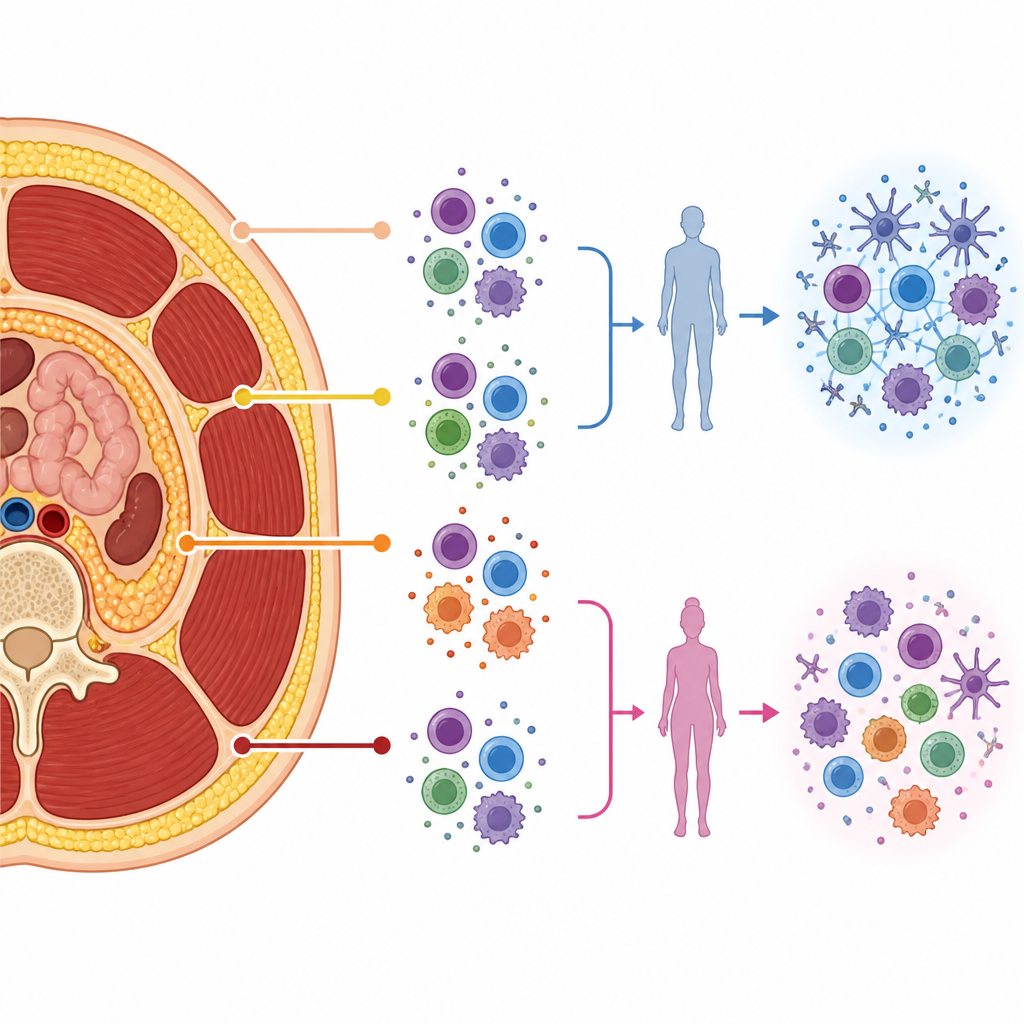
Zooming in on single immune cells
The researchers then analyzed single cell RNA sequencing data from a smaller group of patients to see how individual immune cells inside tumors behaved under different body composition profiles. In men with higher intermuscular fat, killer T cells and natural killer cells showed more active antiviral like signaling and lower signs of exhaustion, meaning they were less “tired” and more capable of attacking cancer cells. Dendritic cells, which help present tumor fragments to the immune system, also appeared more active, and macrophages shifted toward a profile associated with attacking rather than supporting tumors. In women, some of these patterns were reversed or muted, with intermuscular fat linked to more exhausted immune cells but still to macrophages that looked more aggressive toward cancer.
What this means for patients and doctors
For a layperson, the key message is that where and how fat and muscle sit in the body is not just a matter of weight or appearance; it is tied to how the immune system fights lung cancer, and these ties differ between men and women and across regions of the torso. The authors suggest that a detailed “body composition atlas,” automatically read from routine CT scans, could help doctors estimate which patients are more likely to benefit from immune therapy and might guide future strategies that combine lifestyle or metabolic interventions with cancer drugs. While more studies are needed to prove cause and effect, this work shows that everyday imaging holds hidden clues about the inner battle between tumors and the immune system.
Citation: Guo, Y., Gong, B., Lou, J. et al. AI-driven body composition atlas reveals its association with NSCLC immunotherapy outcome and molecular background: a multicenter study. npj Precis. Onc. 10, 185 (2026). https://doi.org/10.1038/s41698-026-01382-5
Keywords: body composition, lung cancer, immunotherapy, CT imaging, artificial intelligence