Clear Sky Science · en
Ontogeny of zebrafish behaviors: comparative evaluation of locomotor, social and anxiety parameters in larval, juvenile and adult stages
Why tiny fish can teach us about growing up
Adolescence is a turbulent time not only for humans but for many animals. Yet it is surprisingly hard to study how brains and behavior change during this period. This study uses zebrafish—small striped aquarium fish widely used in research—to track how movement, sociability and anxiety-like responses shift from early life through youth to adulthood. By building a single testing platform that works for very young larvae, fast-changing juveniles and adults, the authors show that zebrafish go through a kind of behavioral metamorphosis as they grow, offering a new window into how developing brains shape behavior.
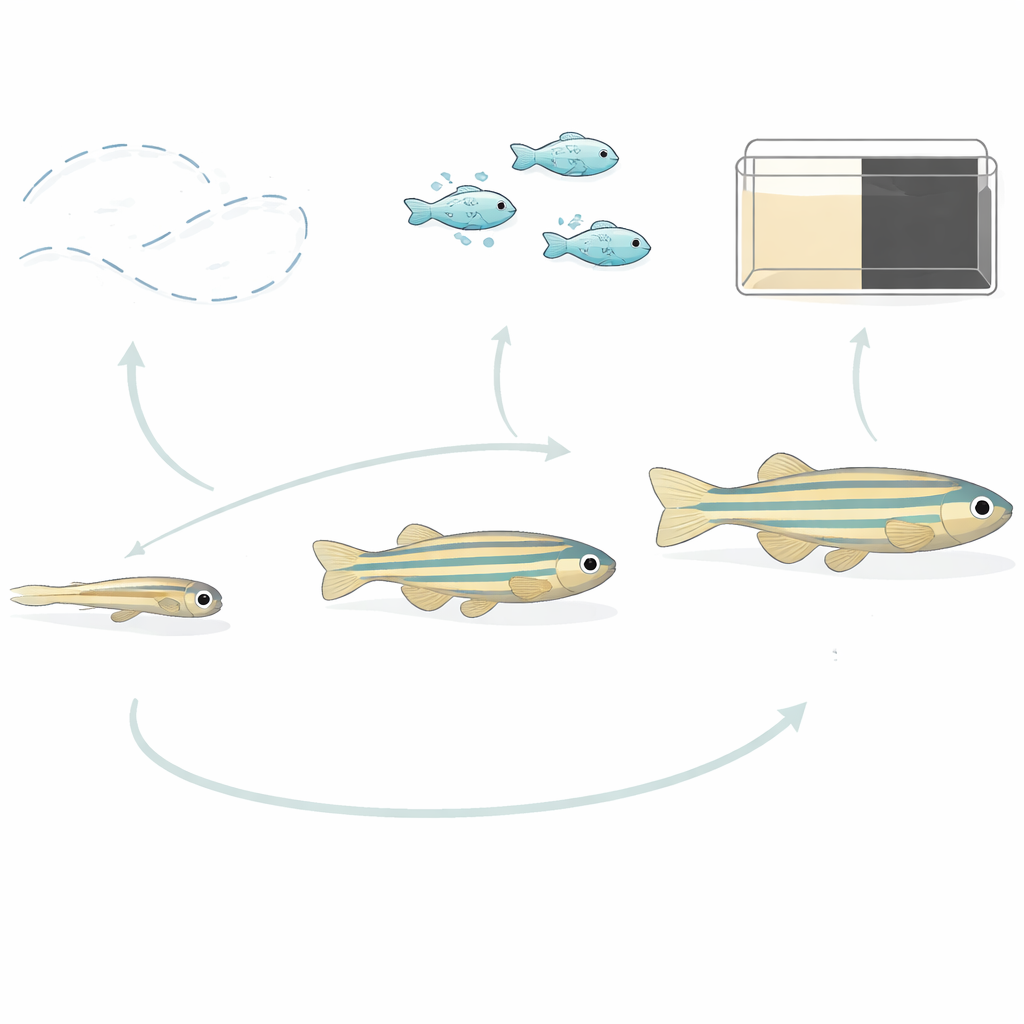
Following fish from baby to adult
The researchers wanted to compare behavior across five life stages: early larval, late larval, early juvenile, late juvenile and adult zebrafish. Rather than relying only on age in days—which can be misleading because growth depends on temperature, crowding and other factors—they grouped fish by visible body features such as size, fin shape, scale coverage and swim bladder structure. They then adapted three common behavioral tests, usually designed for adults, so they could be run in similarly shaped tanks across all ages. These tests measured basic movement, preference for social company and how fish split time between light and dark spaces, a widely used readout of anxiety-like states.
How swimming style matures
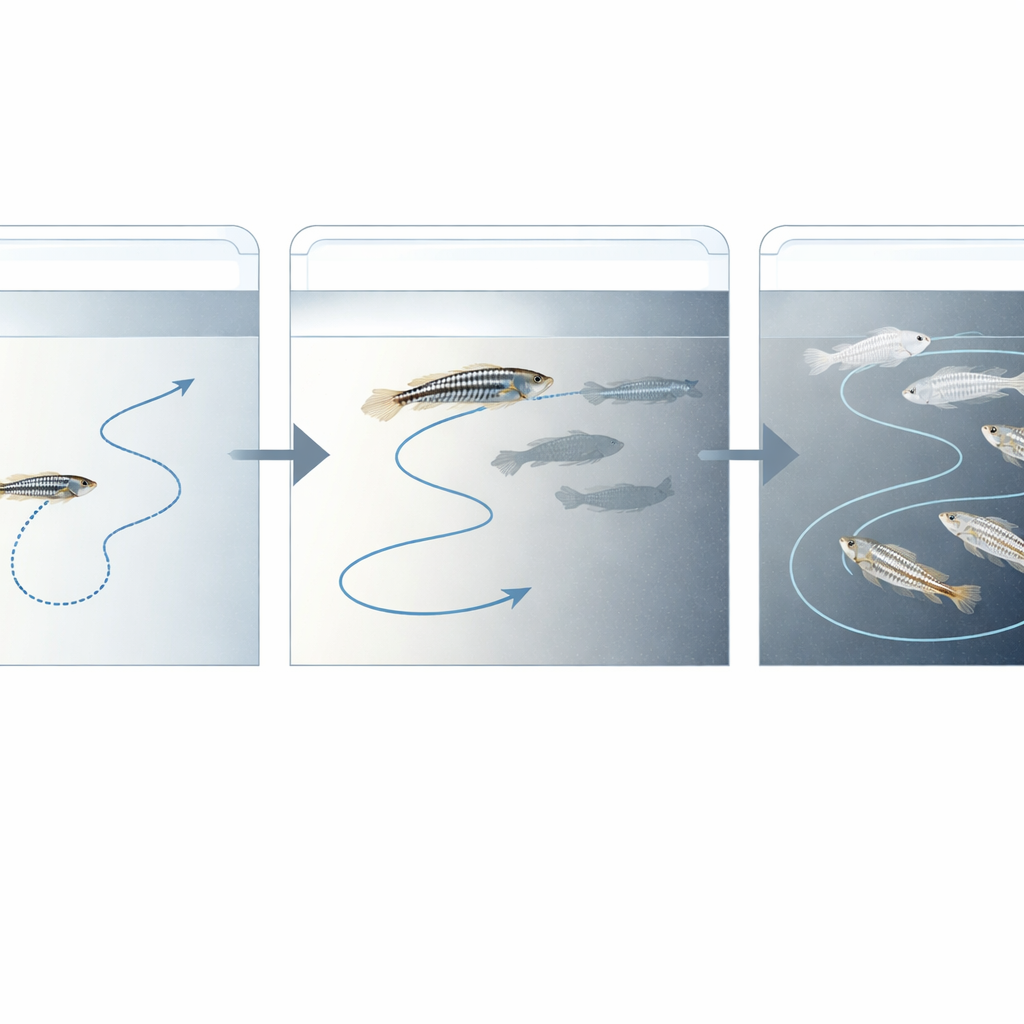
In a “novel tank” test, a fish is placed into a new rectangular tank and its movement is tracked. The team found that late larval and early juvenile fish were the most active: they traveled farther and spent less time motionless than both the youngest larvae and the adults. Juveniles also swam in a more controlled way, with fewer abrupt turns and erratic changes in direction. All ages preferred the bottom of the tank when first exposed to this new environment, suggesting that hugging the bottom is a built-in safety strategy that persists for life. However, adults tended to stay near the bottom for longer, while juveniles ventured more into the upper water, hinting that young fish may be more inclined to explore and take risks.
Learning to like company
To probe sociability, each fish was given a choice between swimming near a group of same-age companions or near an empty tank. Younger stages visited both sides frequently but did not linger with the group. As fish matured, their behavior shifted from simply exploring both sides to clearly preferring the side with other fish. Adults spent the most time near their peers and showed the strongest overall social preference, while late juveniles already displayed a marked tilt toward conspecifics compared with early larvae. These gradual changes support the idea that social skills in zebrafish, much like in humans, are built up step by step during development rather than appearing all at once.
A flip in light and dark preference
The light/dark, or scototaxis, test asked whether fish preferred a bright or shaded half of a tank. Early and mid larval zebrafish strongly favored the light side, whereas adults, as known from previous work, prefer darkness, which is considered a safer, less exposed space. By including multiple ages, the team pinpointed when this switch occurs: between roughly two and three weeks after hatching, during the transition from mid to late larva. From late larval stages through juveniles and into adulthood, fish consistently spent more time in the dark half. This early and lasting reversal appears to be one of the first clear signs that the animal’s relationship with its environment—and perhaps its underlying brain circuits—has fundamentally changed.
What this means for brain and disease research
Taken together, the results show that juvenile zebrafish are not just “in-between” versions of larvae and adults. They have their own characteristic mix of higher mobility, smoother swimming, growing social interest and a newly established preference for darker spaces. These patterns fit with the idea of a behavioral metamorphosis that parallels the fish’s physical changes. By standardizing tests that work from larva to adult, this study lays the groundwork for following the same individuals over time, or for testing how drugs and genetic changes affect behavior at specific stages. Because many brain circuits are similar between zebrafish and mammals, understanding how normal adolescent behavior unfolds in this tiny fish could ultimately help scientists probe why mental health problems so often emerge during the teenage years in humans.
Citation: Petersen, B.D., Rodrigues, G., Liriel, K. et al. Ontogeny of zebrafish behaviors: comparative evaluation of locomotor, social and anxiety parameters in larval, juvenile and adult stages. Lab Anim 55, 172–180 (2026). https://doi.org/10.1038/s41684-026-01712-x
Keywords: zebrafish behavior, adolescent brain, animal models, social development, anxiety research