Clear Sky Science · en
GrimACE: automated, multimodal cage-side assessment of pain and well-being in mice
Why Caring About Mouse Comfort Matters
Many medical breakthroughs depend on experiments in mice, from new cancer drugs to brain therapies. Yet it is surprisingly hard to tell when a mouse is in pain after surgery. If researchers miss warning signs, animals may suffer and the science itself can be skewed, because pain changes behavior and biology in ways that muddy results. This study introduces a new tool, called GrimACE, that uses cameras and artificial intelligence to watch individual mice in a small box and automatically flag signs of pain and recovery, aiming to improve both animal welfare and research quality.
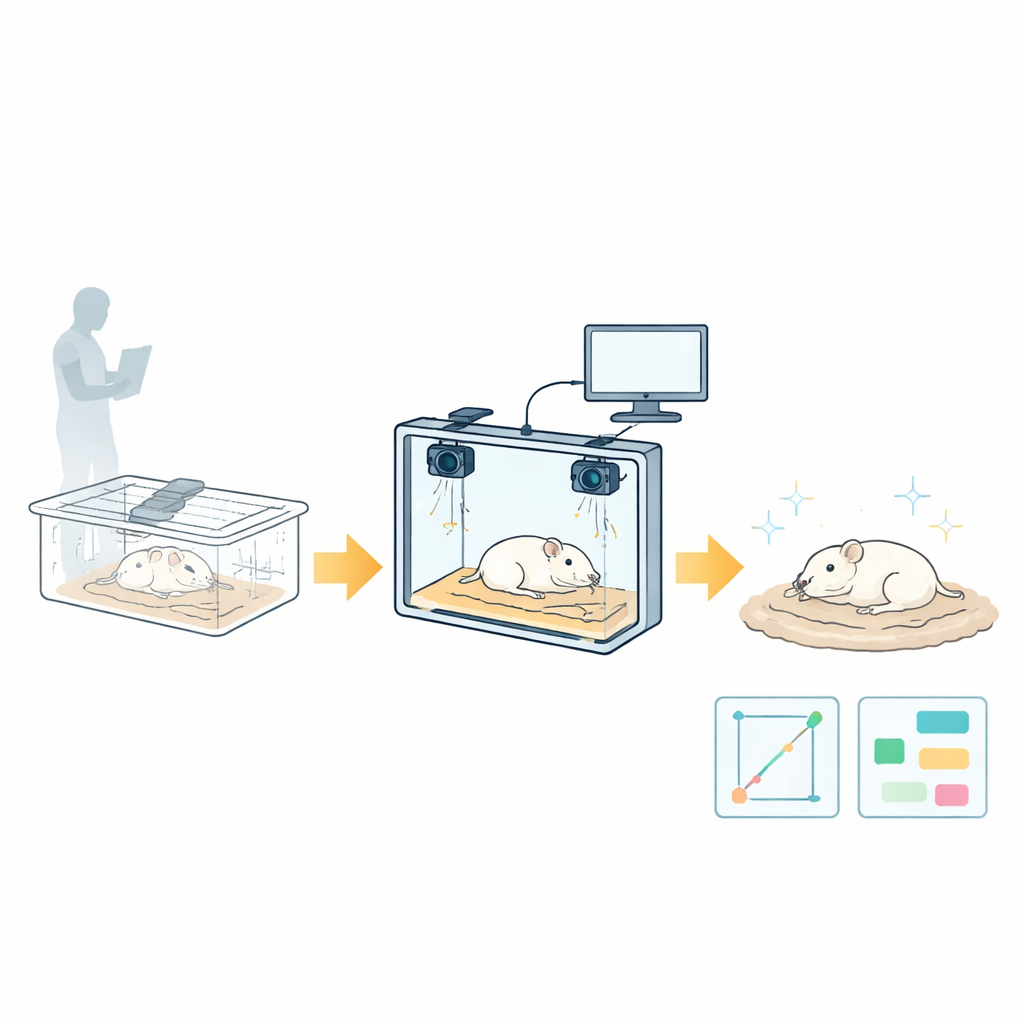
A New Way to Watch Mice Gently
Traditional checks after surgery rely on a person peering into the cage and judging posture, grooming and movement. These quick looks are subjective and can miss subtle discomfort, especially because prey animals tend to hide weakness when humans come close. GrimACE replaces this brief inspection with a calm, dark observation box built into an aluminum frame. A mouse is placed in a small acrylic arena with infrared lighting and two cameras, one looking from the front at the face and one from above at the whole body. The environment feels safe for the animal, while the setup ensures that every mouse is recorded in exactly the same way, producing clear videos that are ideal for computerized analysis.
Reading Mouse Faces for Pain
Over the past decade, scientists have learned that mouse faces change in reliable ways when the animal hurts, much like a human grimace. A system called the mouse grimace scale scores five facial features, such as narrowed eyes and changes in the ears and whiskers. However, scoring still images by hand is slow, requires considerable training and can vary between raters. GrimACE automates this process. One neural network scans every video frame and picks the sharp, well-posed images; another finds and crops the face; a third, more advanced network scores each facial feature. The authors trained these algorithms on hundreds of expert-scored images and showed that the automatic scores match expert ratings extremely well, with overall agreement close to what is seen between two highly trained people.
Following Every Step and Sidelong Effect
GrimACE does more than read expressions; it also tracks how the whole body moves. Using modern pose-estimation methods, the system follows key points on the mouse from above, allowing the team to measure how far it travels and to break behavior into patterns such as exploring, resting, rearing or grooming. In two experiments, mice underwent common brain surgeries involving tiny implants. One group received only the anti-inflammatory drug meloxicam, while another also received the opioid buprenorphine. In routine cage checks, all mice appeared normal. GrimACE, however, revealed a clear rise in facial pain scores peaking about four hours after surgery and fading back toward baseline within two days. Movement analysis showed that mice given buprenorphine were markedly more active shortly after surgery and lost slightly more weight, consistent with the known hyperactivity and side effects of opioids.
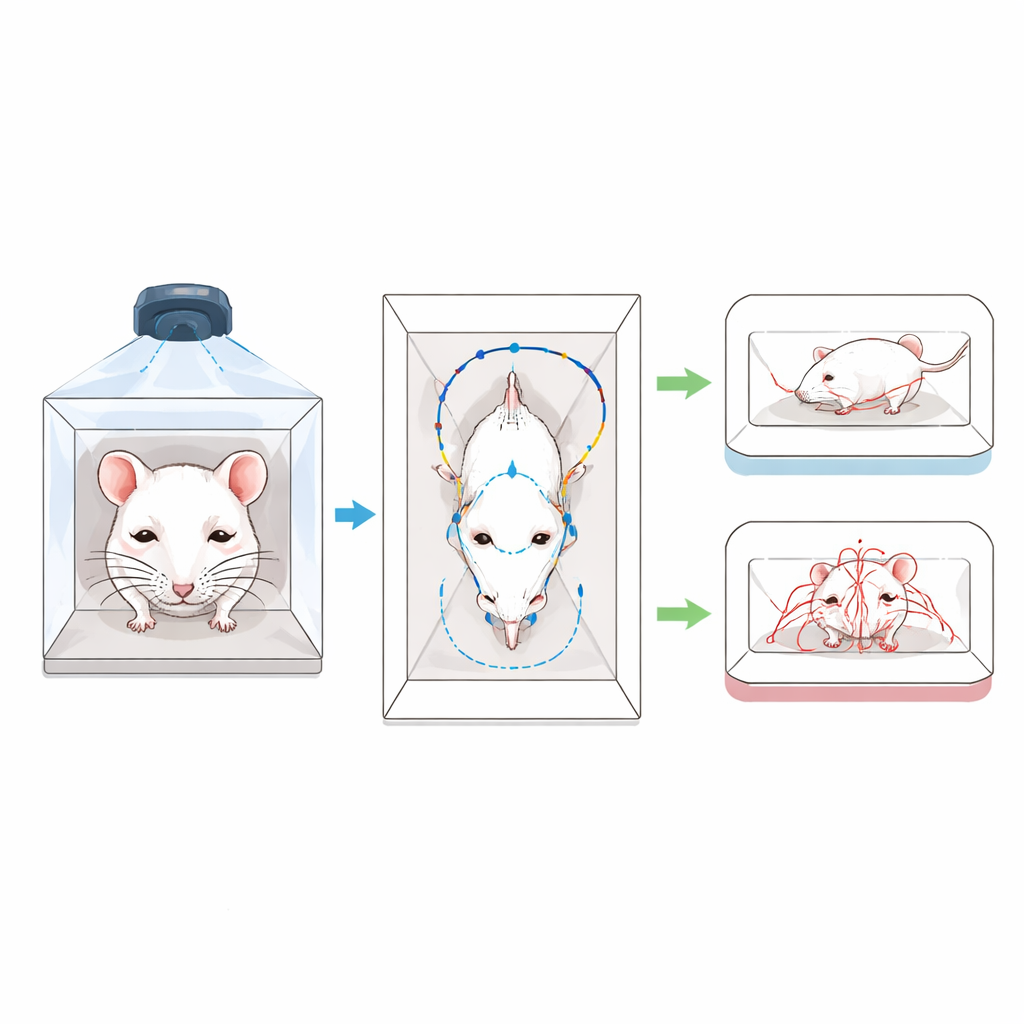
Checking That the Box Itself Is Not the Problem
To see whether repeated visits to GrimACE might themselves stress animals or distort readings, the researchers ran a control group of mice that experienced the same schedule in the box but without any surgery or drugs. In these controls, facial pain scores stayed very low and stable over several days, even though general activity gradually decreased as the mice became familiar with the setting. Detailed pattern analysis showed that behavior clusters linked to pain or drug treatment in the surgery groups did not change in these untouched mice. This suggests that the system can be used repeatedly to follow recovery without needing long prior training or risking confusing the measurements.
What This Means for Animal Care and Science
In plain terms, GrimACE is a camera-based, automated nurse for mice: it quietly watches animals after delicate brain operations, picks up small changes in facial expression and movement that people may overlook, and does so in a standardized, unbiased way. The work confirms that commonly used pain relief with meloxicam is generally adequate for craniotomy surgeries and that adding buprenorphine brings little extra pain control while triggering restlessness and weight loss. More broadly, the system offers laboratories a practical route to monitor animal comfort more closely, refine drug regimens and detect problems earlier. By making pain and well-being easier to measure, GrimACE helps align humane treatment with more reliable, reproducible research.
Citation: Sturman, O., Schmutz, M., Lorimer, T. et al. GrimACE: automated, multimodal cage-side assessment of pain and well-being in mice. Lab Anim 55, 137–146 (2026). https://doi.org/10.1038/s41684-026-01695-9
Keywords: mouse pain assessment, animal welfare, automated behavior monitoring, postoperative analgesia, computer vision in neuroscience