Clear Sky Science · en
Interlinks between sea-ice melting and continental wetting under a changing Arctic moisture transport
Why a Warming Arctic Matters to Us All
The Arctic is heating up much faster than the rest of the planet, and that extra warmth does not stay locked at the North Pole. It changes storm tracks, shifts rainfall patterns, and can even influence heat waves and cold snaps far to the south. This study asks a deceptively simple question with far‑reaching consequences: where does the Arctic’s moisture come from, how is that changing as sea ice melts, and how does that, in turn, reshape the climate over both ocean and land?
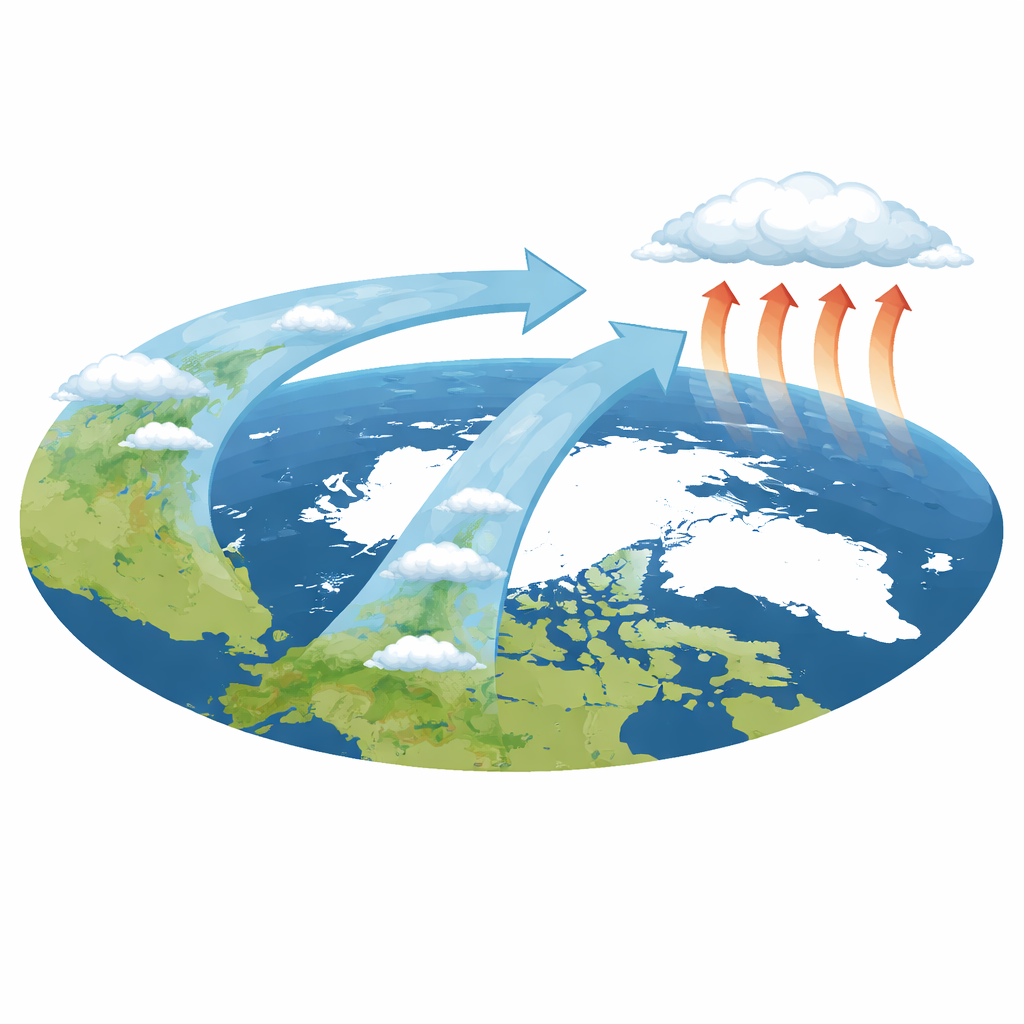
Following Water on Its Journey North
To tackle this, the researchers used a specialized “tagged” moisture model that can follow water vapor through the atmosphere much like tracking colored dye in a stream. Driven by three independent global weather reanalyses, the model traced moisture from broad source regions—northern continents, the Arctic Ocean, and nearby Atlantic and Pacific zones—into the polar cap from 1980 to 2024. This allowed the team to see not only how much water vapor reached the Arctic each season, but also whether it started out over land or sea.
Summer Air from Wet Lands, Autumn Air from Open Seas
The analysis revealed a clear seasonal rhythm that has become stronger over the past 45 years. In winter, most of the Arctic’s atmospheric moisture still comes from the surrounding oceans. In summer, however, the main suppliers are the vast land areas of Eurasia and North America, especially the river basins of Siberia. Over time, summer moisture arriving from land has increased sharply, while in autumn it is the moisture evaporating from newly opened Arctic waters that has surged. Across all three underlying datasets, the pattern is consistent: land‑fed moist air now dominates the summer buildup, and ocean‑fed moist air takes over in the darker, colder months.
Winds that Steer Moisture and Melt Ice
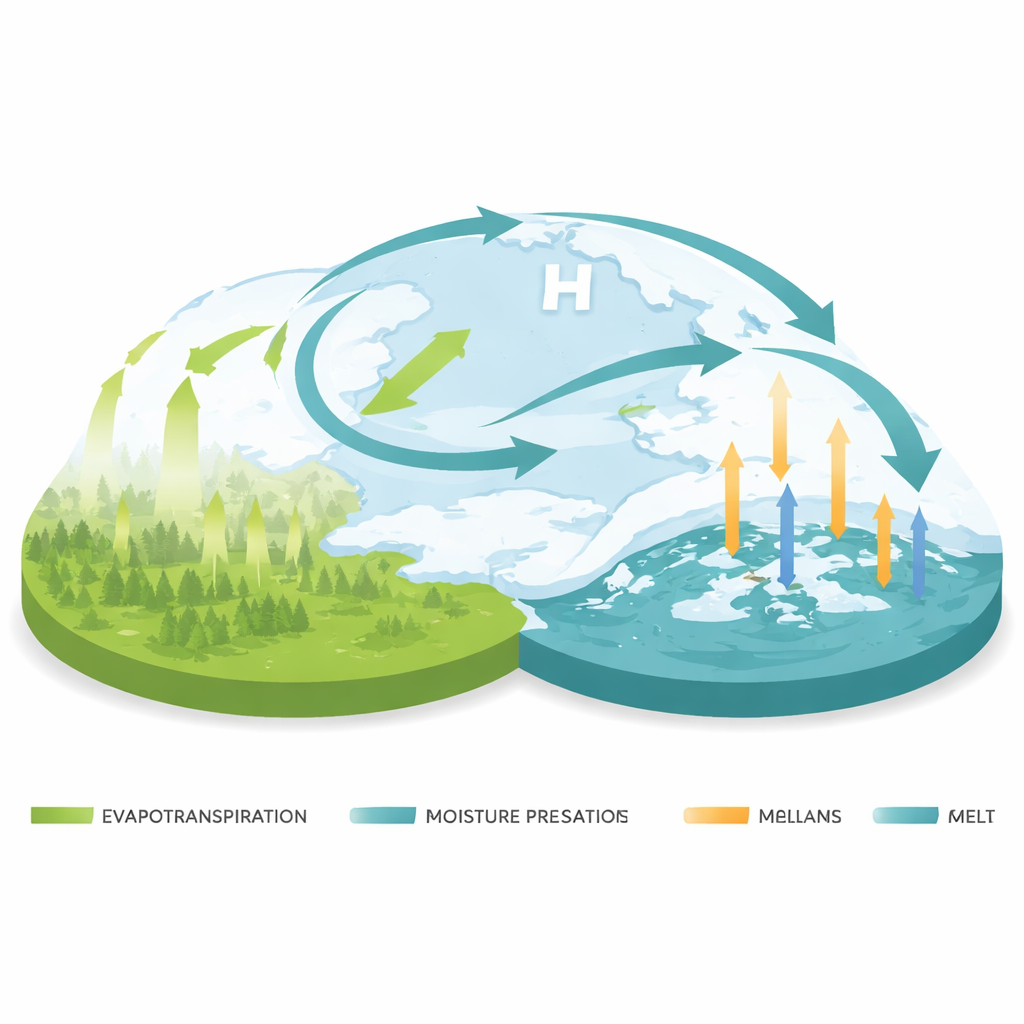
These shifts are not just a matter of warmer air holding more water. The model shows that changes in wind patterns are crucial in steering moisture pathways. In summer, the atmosphere more often falls into a pattern known as an Arctic Dipole, with lower pressure over Siberia and higher pressure near Greenland. This setup channels moist air from wet northern continents into the central Arctic. That imported moisture strengthens downward longwave (heat) radiation, which melts sea ice and allows the ocean to soak up more sunlight. In autumn, after the ice has retreated, the now‑warmer open ocean releases heat and moisture back to the air, and the main moisture source flips from land to sea.
A Hidden Feedback Loop Between Land, Ocean, and Sky
By breaking down the moisture by source, the study exposes a feedback loop that ties sea‑ice loss to changes on land. Extra summer moisture from continents helps melt more ice and warm the Arctic Ocean. The warmer, less icy ocean then boosts evaporation and heat release in autumn and winter. That added surface heating, especially along the Eurasian Arctic coast, can in turn encourage the same Dipole‑like wind pattern that drew in the land moisture in the first place. Climate model experiments that mimic future Arctic warming show similar circulation responses, suggesting that this loop is a robust part of how the system behaves, even if it is only one piece of a complex puzzle.
What This Means for Our Future Climate
For a non‑specialist, the takeaway is that Arctic warming is not just about ice quietly disappearing; it involves an active exchange of moisture and heat between continents, ocean, and atmosphere that reinforces itself over time. Wetting of northern lands and melting of sea ice are tied together through the winds that move water vapor northward and the radiation that warms the surface. While there are still uncertainties—especially in exactly how much water evaporates from land and sea—the consistent signal is that circulation‑driven moisture inflow in summer and evaporation from a warming Arctic Ocean in autumn are key engines of ongoing Arctic amplification. Because these processes can ripple into the mid‑latitudes, improving how models represent them is essential for better forecasts of extreme weather and long‑term climate risks across the Northern Hemisphere.
Citation: Nakamura, T., Sato, T., Fukutomi, Y. et al. Interlinks between sea-ice melting and continental wetting under a changing Arctic moisture transport. npj Clim Atmos Sci 9, 98 (2026). https://doi.org/10.1038/s41612-026-01389-6
Keywords: Arctic amplification, moisture transport, sea ice melt, Siberian hydrology, atmospheric circulation