Clear Sky Science · en
Improving seasonal prediction of global mean surface temperature by incorporating dynamic ENSO realistic forecasts
Why better seasonal forecasts matter
Farmers, energy planners, and disaster managers increasingly need to know how warm the planet is likely to be in the coming seasons. This study explores why current short term forecasts of Earth’s average surface temperature sometimes miss the mark and shows how tracking familiar tropical climate patterns can make those forecasts earlier and more reliable.
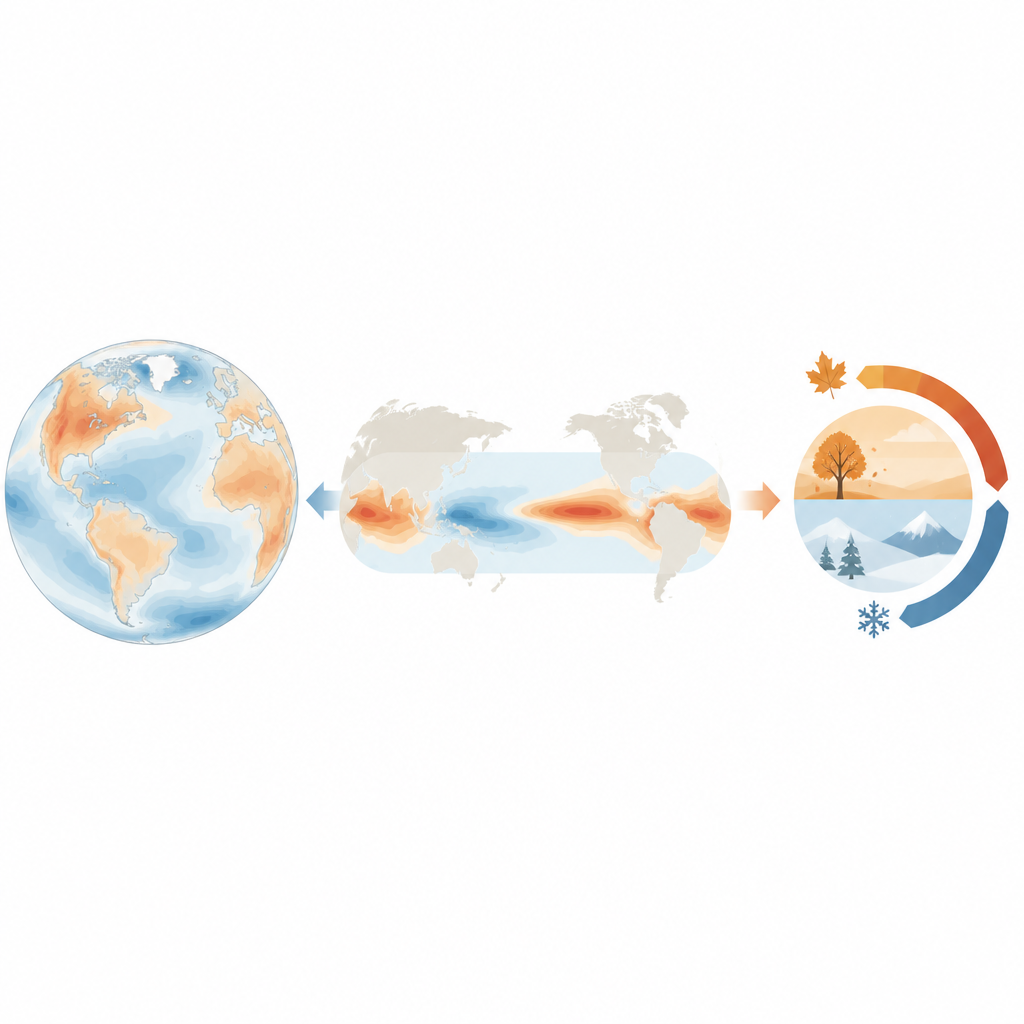
A global thermometer with real world consequences
Global mean surface temperature, or the planet’s average near surface warmth, is a simple number that hides complex physics. Yet it has direct consequences for harvest timing, fuel demand, heat stress, and weather related risks. Seasonal forecasts of this global temperature can help societies prepare a few months in advance. Existing climate models and even modern machine learning systems, however, struggle to predict the ups and downs from year to year, especially for the crucial northern autumn and winter months when many climate extremes occur.
The puzzle of autumn forecast errors
The authors examined why their earlier prediction system, developed at the Institute of Atmospheric Physics in Beijing, began to lose accuracy when forecasts were started in autumn. By comparing predictions with observations from 1980 to 2024, they found that errors were tightly linked to what was happening across the tropical oceans. During El Niño events, when the central and eastern Pacific warms, their model tended to underestimate the global temperature. During La Niña, with cooler Pacific waters, it often overestimated. The pattern of errors was not confined to the Pacific, but spread across the Indian and Atlantic Oceans as well, revealing a pantropical chain of interactions that the original model did not fully capture.
Tropical oceans working together
Physically, the study shows how a warm El Niño phase weakens and shifts a key atmospheric circulation over the Pacific. This shift alters winds and currents in the Indian Ocean, favoring a warm patch in its western and central regions, and also changes winds over the tropical North Atlantic, leading to warming there. These linked ocean basins act together to influence the planet’s overall surface temperature in the following seasons. When these basin wide responses are stronger than the model expects, the global temperature forecast comes out too cool, and when they are weaker, it comes out too warm. The reverse happens during La Niña, when basin wide cooling is common. Recognizing this chain helps explain why errors cluster in years with strong El Niño or La Niña conditions.
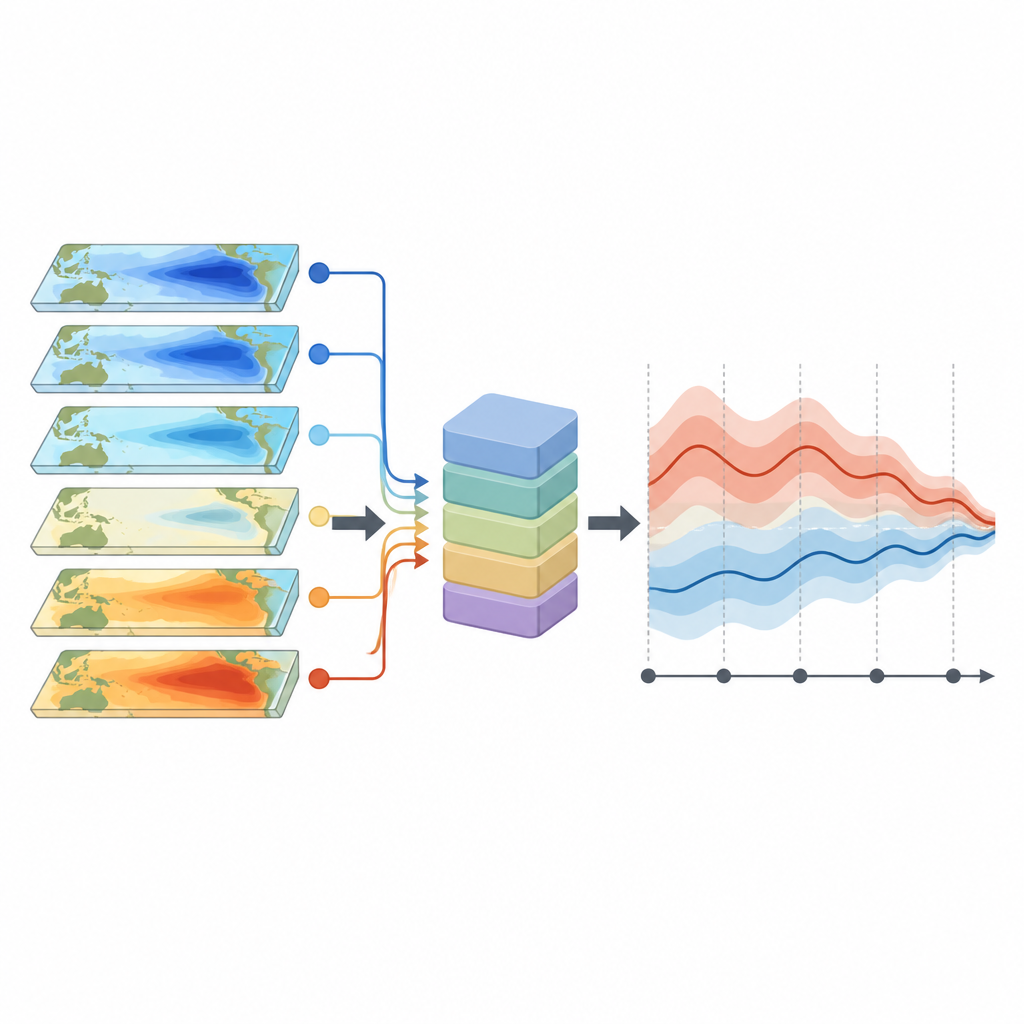
Blending physical insight with statistics
To turn this understanding into a practical tool, the authors designed a hybrid prediction framework. They kept their existing statistical system that already separated slower and faster climate swings, but added information from a separate model that predicts the strength of El Niño and La Niña months ahead. Using past data, they learned how forecast errors changed with the predicted Pacific signal and then used that relationship to correct new forecasts in real time. They also tested including additional indices from the Indian and Atlantic Oceans. While these helped remove some average bias, they did not improve the year to year skill as much as focusing on the Pacific alone, likely because their behavior is already strongly tied to El Niño and La Niña.
What the new system delivers
With this combined approach, the improved forecasts cut average errors by about two fifths for predictions started in September and October and brought many large El Niño and La Niña years back within observational uncertainty. In roughly two thirds of the years studied, the corrected forecasts were closer to reality, with especially large gains during El Niño episodes. Most notably, the time horizon for reliable global temperature prediction lengthened from two to four months. For users of climate information, this means earlier warning of unusually warm or cool seasons at the planetary scale, achieved with a method that is simpler and less computationally demanding than many full scale climate models.
Citation: Li, KX., Zheng, F. Improving seasonal prediction of global mean surface temperature by incorporating dynamic ENSO realistic forecasts. npj Clim Atmos Sci 9, 114 (2026). https://doi.org/10.1038/s41612-026-01386-9
Keywords: seasonal climate prediction, global mean surface temperature, ENSO, El Niño, pantropical oceans