Clear Sky Science · en
SIGMAformer: a spatiotemporal Gaussian mixture correlation transformer for global weather forecasting
Why smarter weather forecasts matter
From heat waves to sudden wind storms, extreme weather affects daily life, energy use, and safety around the world. Modern computer models already simulate the atmosphere in impressive detail, but they can be expensive to run and may miss sharp local changes. This article presents a new artificial intelligence approach that learns directly from thousands of ground stations to make global forecasts of wind and temperature more accurate and more informative, especially when the weather turns wild. 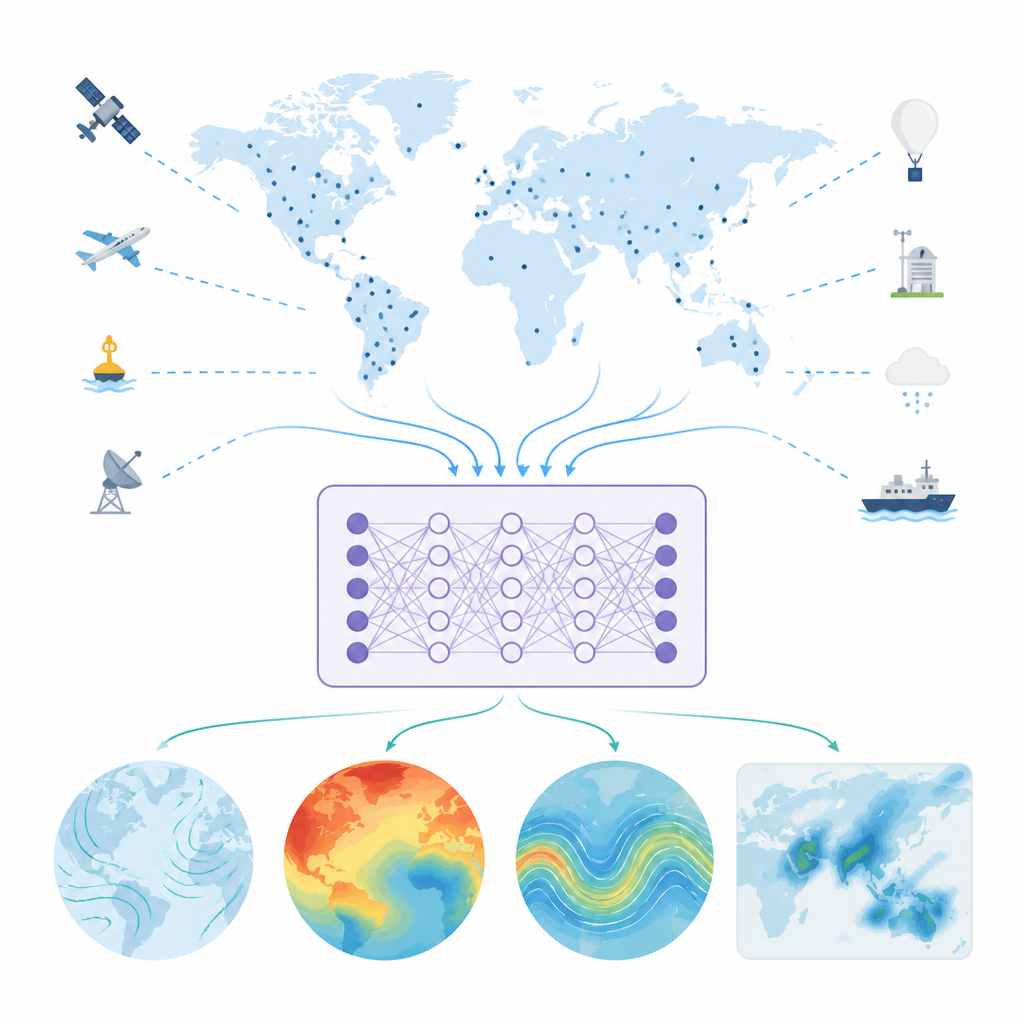
From raw station data to global insight
Traditional weather prediction relies on physics based models that solve complex equations on a fixed grid. At the same time, millions of measurements pour in from stations scattered unevenly across the globe. These station records capture local quirks such as mountain winds or urban heat, but they are hard to weave into a single coherent picture. Many recent machine learning systems can handle either large scale atmospheric patterns or local detail, yet they often struggle to capture both at once, and they usually behave like black boxes with little explanation of why they make a given forecast.
A new way to spot shared patterns
The authors introduce SIGMAformer, a forecasting architecture designed to learn how weather at thousands of locations coevolves over time. At its core is a pattern finder that groups similar shapes in the data, such as recurring swings in wind speed or temperature, into a handful of representative patterns. Instead of treating every station and every hour separately, the model learns which pattern is active where and when. These patterns then guide a second part of the system that pays closer attention to the most relevant moments and places, while downplaying noisy or unhelpful signals. This targeted focus allows the model to link distant regions that often share weather behavior, such as parts of East Asia and North America connected by the jet stream. 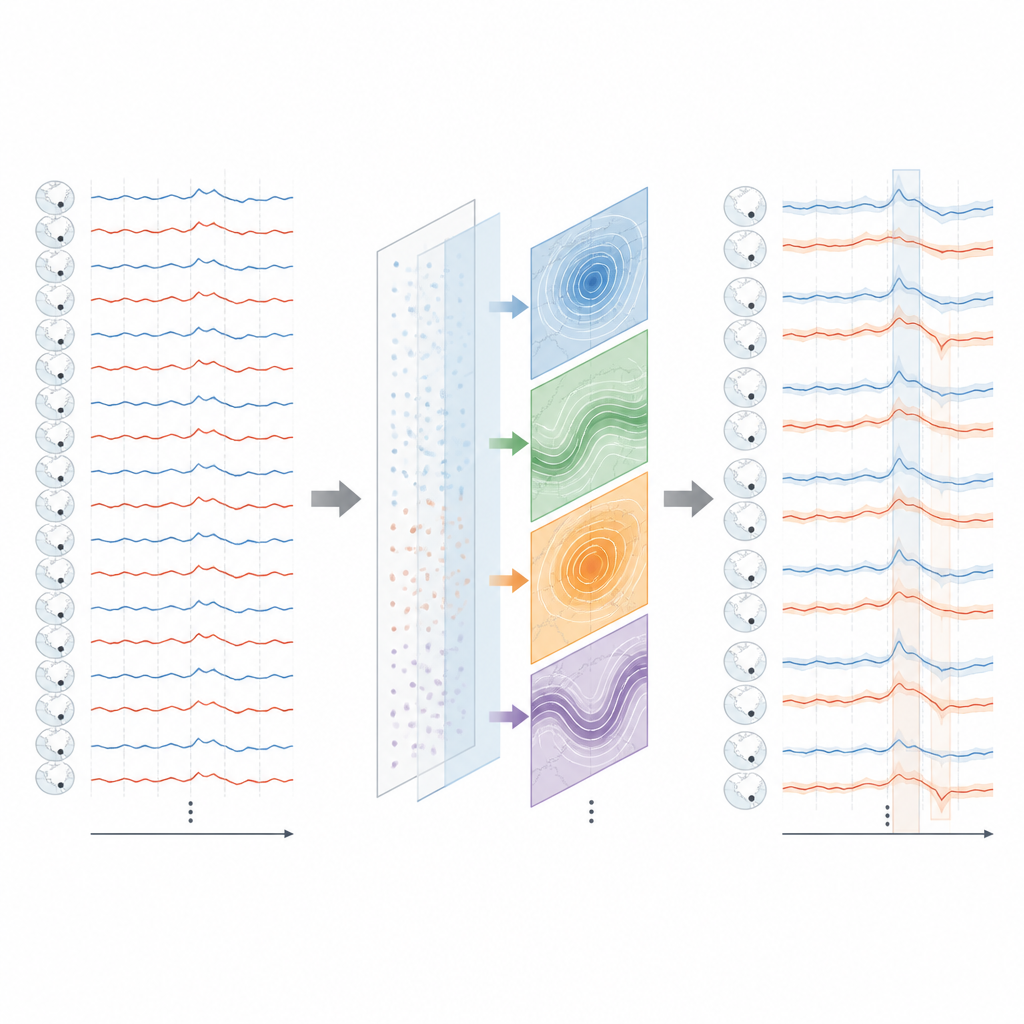
Following weather across space and time
To test SIGMAformer, the authors trained it on two years of hourly wind speed and temperature data from 3850 stations worldwide. They compared its performance with both standard statistical methods and leading deep learning models, using common measures of forecast quality. Across the board, SIGMAformer produced the lowest errors for both variables, with especially clear gains for wind speed, which is typically more erratic than temperature. When the researchers removed key parts of the design, such as the module that learns changing links between stations, performance dropped noticeably, showing that these components are central to the model’s skill.
Seeing how the model “thinks”
Beyond raw accuracy, the study shows that SIGMAformer offers a window into how it interprets the atmosphere. The model produces maps and charts that reveal which stations and time periods it considered most important for a given forecast. For temperature, it highlighted both nearby stations and far flung regions known to be connected by large scale climate patterns. For wind, it focused on shorter range and faster moving signals that match known behavior of jet streams and planetary waves. These visual patterns suggest that the system is not simply memorizing the data, but is aligning with recognized physical processes, which can help forecasters trust and refine its outputs.
What this means for future weather tools
Overall, the article concludes that SIGMAformer is a promising step toward data driven weather systems that blend detail, scale, and interpretability. It does require more computing time than some other neural network models, because it explicitly tracks relationships across thousands of stations. However, in return it delivers more accurate forecasts, better detection of extreme heat and strong winds, and clearer clues about why those forecasts were made. As the approach is expanded to include more weather variables and tuned for faster operation, it could become a useful building block for real time warning systems and for combining information from many different environmental sensors into a single, coherent view of the changing atmosphere.
Citation: Kim, DY., Suk, HI. SIGMAformer: a spatiotemporal Gaussian mixture correlation transformer for global weather forecasting. npj Clim Atmos Sci 9, 113 (2026). https://doi.org/10.1038/s41612-026-01385-w
Keywords: weather forecasting, machine learning, wind speed prediction, temperature prediction, sensor networks