Clear Sky Science · en
Anthropogenic warming-driven atmospheric circulation shifts and angular momentum increase: influence on the Earth’s rotation
Why the length of a day is quietly changing
We tend to think of a day as a fixed 24 hours, set by the steady spin of our planet. But Earth’s rotation is subtly changing all the time, and this new research shows that human-driven climate change is now becoming part of that story. By reshaping global wind patterns and the distribution of air around the globe, warming is ever so slightly slowing Earth’s spin and lengthening the day by measurable amounts.

How air and planet share a cosmic spin
Earth and its atmosphere behave like a coupled system of spinning parts. The solid planet has most of the mass, but the moving air above it also carries rotational "oomph," known as angular momentum. When the atmosphere speeds up, the solid Earth must slow down to keep the total spin of the system balanced—much like a figure skater extending their arms to slow their spin. The authors focus on how long-term climate change alters this delicate exchange, and what that means for the exact length of a day.
Stronger high-altitude winds and shifting climate belts
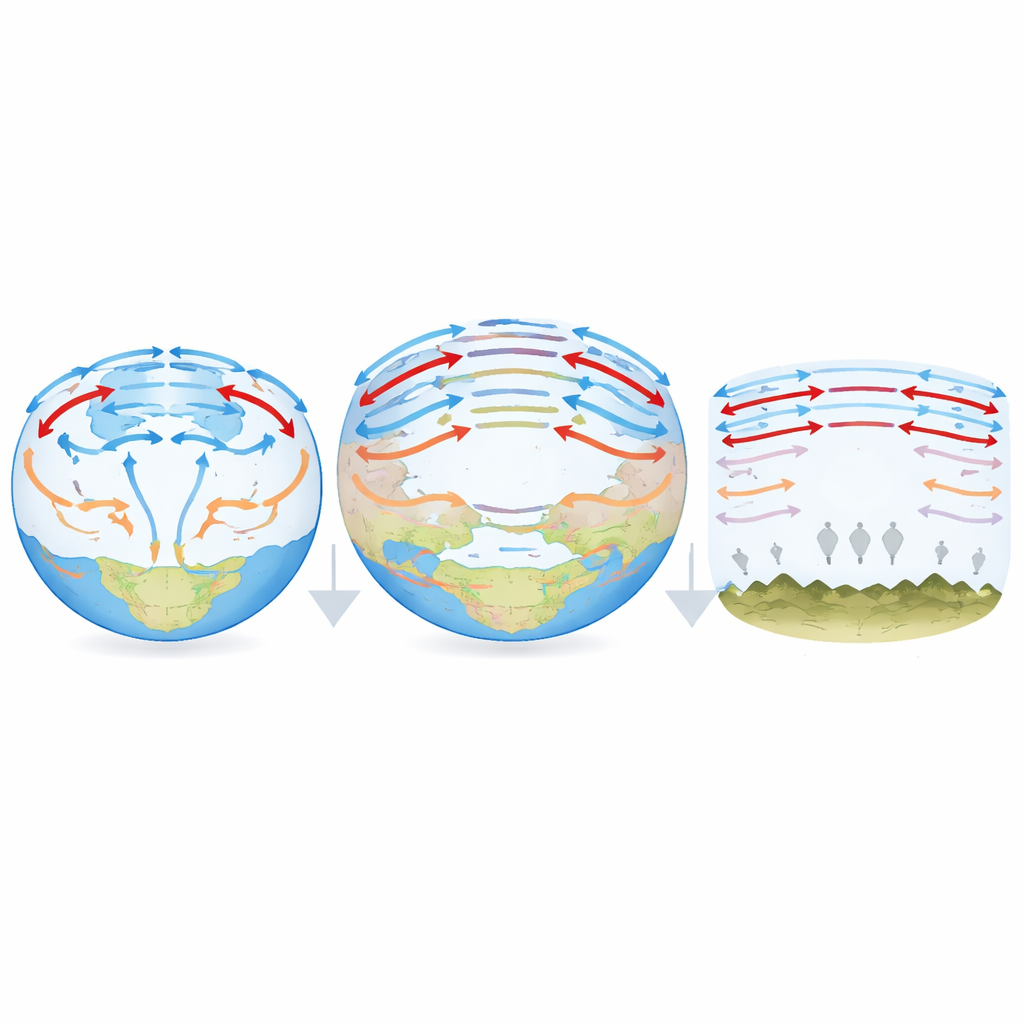
Using large sets of simulations from three modern climate models, run under a high-emissions scenario through the year 2100, the study tracks how warming reshapes global air currents. As the planet heats up, the tropical circulation known as the Hadley cell expands toward the poles, and high-altitude jet streams in the subtropics strengthen. At the same time, the usual near-surface trade winds in the tropics weaken. These changes shift more of the atmosphere’s motion into fast, high-altitude westerly winds that wrap around the planet. Because these winds move in the same direction as Earth’s spin, they increase the atmosphere’s share of angular momentum.
Heavier belts of air and rising pressure systems
The team also examines how the weight of the air—its mass, reflected in surface pressure—moves around the globe. Warming intensifies large high-pressure systems, especially in the subtropics around 30 degrees north and south. This places more atmospheric mass farther from Earth’s rotation axis, adding another, smaller boost to the atmosphere’s angular momentum. Although this mass-related effect is weaker than the boost from faster winds, both act in the same direction: they help the air spin up while the solid Earth spins down.
Looser grip between air and ground
Normally, mountains and surface friction help the planet and atmosphere trade momentum. Pressure differences across big ranges like the Himalayas or the Andes exert a push on the solid Earth, and surface winds rub against the ground, sharing spin. The simulations reveal that under continued warming, these exchanges weaken. Pressure forces across mountains become more strongly aligned in a way that resists Earth’s rotation, and tropical surface winds that used to transfer spin to the planet lose strength. As a result, the atmosphere hangs on to more of its angular momentum instead of giving it back to the ground.
How much longer the day will become
Putting these pieces together, the authors translate the changing atmospheric spin into changes in day length. Across the three climate model ensembles, they find that for every degree Celsius of global warming, the day lengthens by about one-tenth of a millisecond. By late in the 21st century, the influence of these atmospheric changes could add roughly 10–18% to the long-term slowing of Earth’s rotation usually attributed to the Moon’s tidal pull. In everyday life, this extra fraction of a millisecond per day will go unnoticed. But for precision timekeeping and for scientists who study Earth’s deep interior, it signals that human-driven climate change is now reaching all the way into the timing of the planet’s spin.
Citation: Satpathy, S.S., Franzke, C.L.E., Yuan, N. et al. Anthropogenic warming-driven atmospheric circulation shifts and angular momentum increase: influence on the Earth’s rotation. npj Clim Atmos Sci 9, 101 (2026). https://doi.org/10.1038/s41612-026-01382-z
Keywords: Earth rotation, atmospheric circulation, climate change, length of day, angular momentum