Clear Sky Science · en
Complex interplay between transboundary ozone and domestic emissions shapes surface ozone pollution in China
Why faraway air matters close to home
Ozone near the ground is a serious air pollution problem, harming lungs, crops, and ecosystems. Many people assume that each country can control its own ozone levels simply by cutting local emissions from cars, factories, and power plants. This study shows that the story is more complicated for China: ozone drifting in from other regions of the world and gases released inside the country constantly interact in the air, so that foreign and domestic pollution are tightly intertwined rather than separate problems.
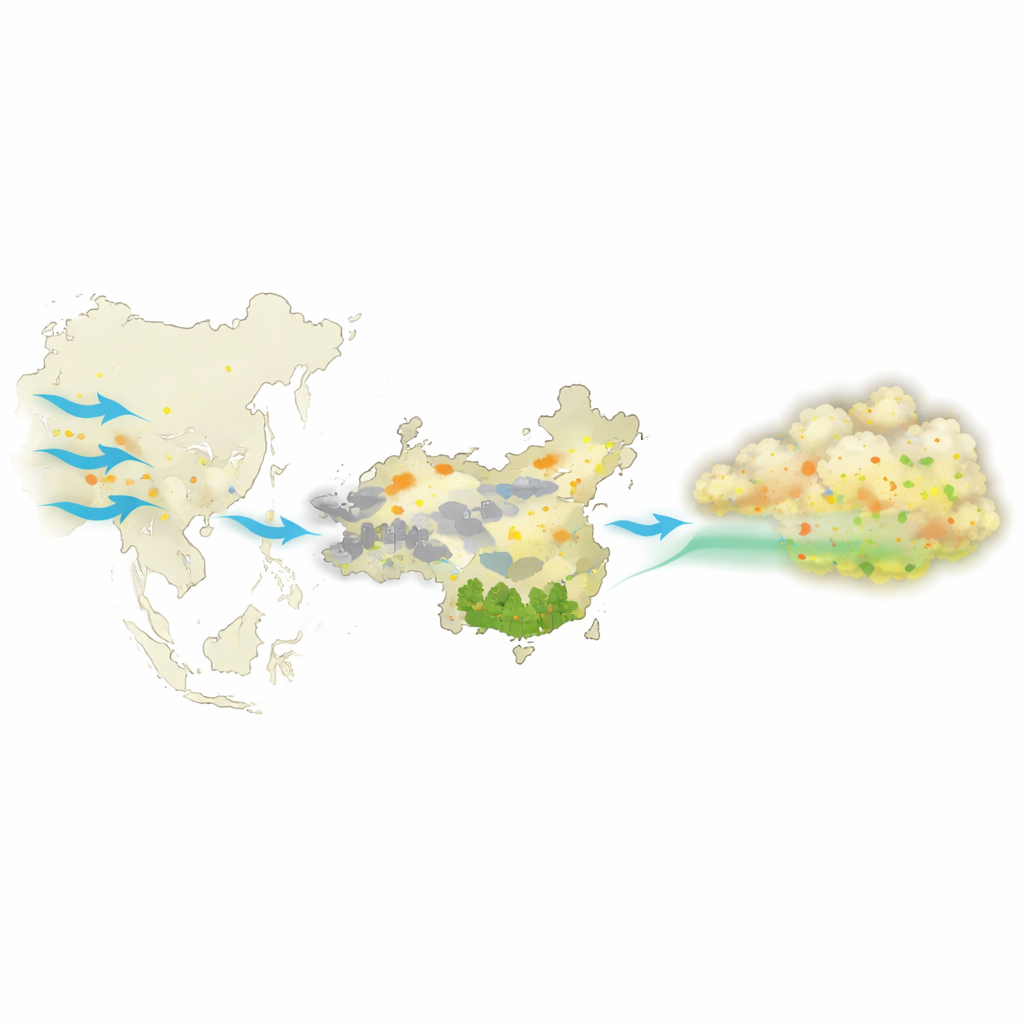
Ozone you can control and ozone you cannot
Scientists often split surface ozone into a "background" part that comes from natural sources and long-distance transport, and a "controllable" part created from local human activities. Policies have been built on the idea that this background is largely fixed and does not respond much when a country changes its own emissions. The authors challenge this view. Using a sophisticated computer model of the atmosphere, they followed how ozone and its short‑lived chemical relatives move and change during a month‑long smog episode over China in autumn 2019, when much of eastern China exceeded health guidelines on more than half the days.
Following every step in ozone’s life cycle
The team introduced a new tracking method into a widely used weather‑chemistry model. Instead of only counting ozone itself, they also tracked a broader chemical family that includes the highly reactive short‑lived radicals that create or destroy ozone. They tagged these chemicals according to where they came from: ozone and gases carried in from outside China; gases from human activities such as industry and traffic; and gases naturally released by vegetation. This allowed them to follow how foreign and domestic ingredients met in the air and how often ozone created from one source was recycled through reactions with another.
Foreign and local pollution work together
The results show that the mixing of incoming ozone with domestic emissions is not a minor side effect but a central feature of China’s surface ozone. Across eastern China, nearly half of the near‑surface ozone during the study period came from this interaction between transported ozone and local gases, not from either source alone. Ozone that arrived from outside China often broke apart in sunlight to form radicals, which then reacted with locally emitted gases to make new ozone. At the same time, those reactions could also remove radicals and slow further ozone production. Over western China, incoming ozone dominated because local emissions are weaker, but over the more industrialized east and south, the chemistry was driven by the constant back‑and‑forth between foreign ozone and domestic pollutants.
Hidden twists in cleanup strategies
Because of this complex chemistry, cutting one type of emission does not always give the expected ozone benefit. In some regions, removing the influence of transported ozone in the model actually made ozone from domestic sources go up, because the loss of one radical sink left more reactive power available to turn local gases into ozone. In other areas, cutting certain domestic gases could unintentionally boost the impact of others. The authors used their tagging system to define a new measure of how strongly each type of gas can generate ozone under real‑world conditions, and they found that this effectiveness varies a lot across China and is strongly reduced by the presence of transported ozone. This means standard metrics that ignore these interactions can underestimate how much ozone certain emissions really create over their lifetimes.
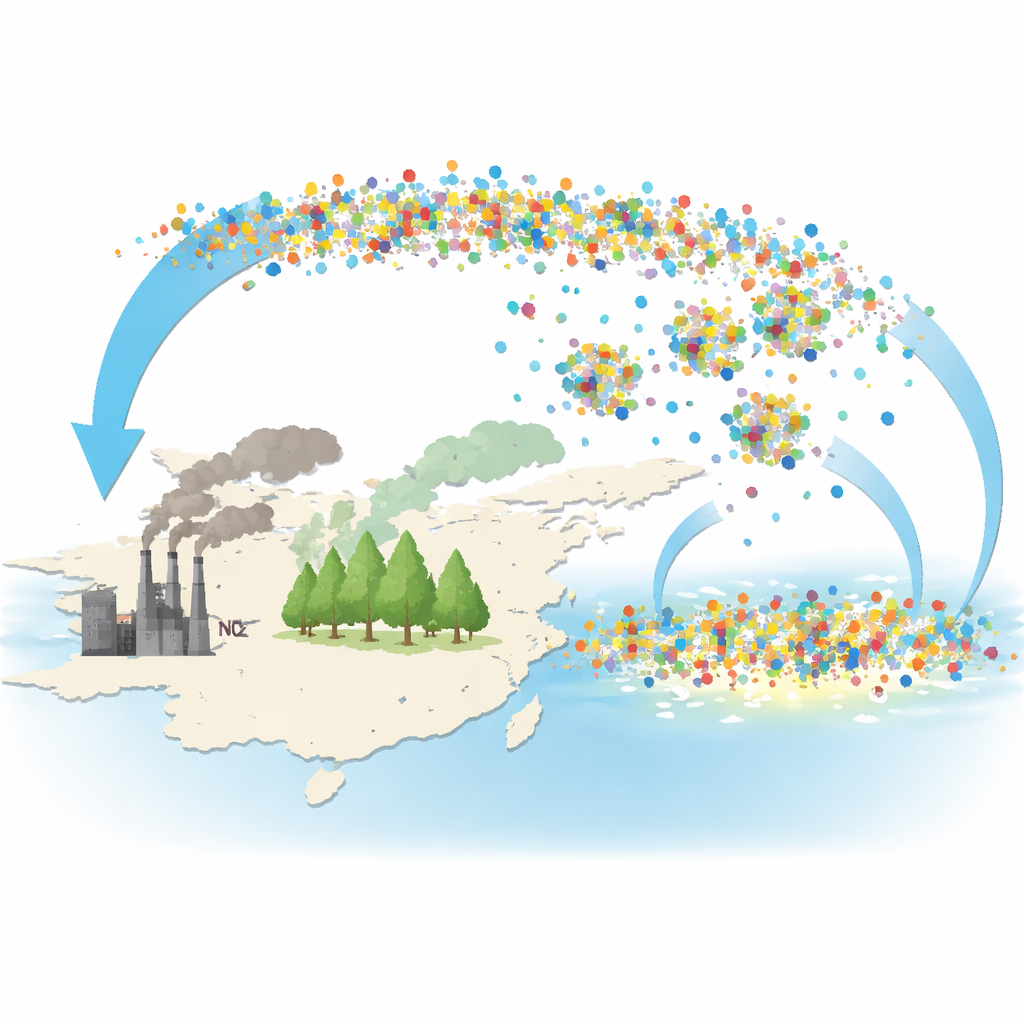
Rethinking what can be cleaned up
The study concludes that the supposed "background" ozone over China is not chemically passive. Instead, ozone transported from afar actively shapes how much additional ozone domestic emissions can make and how effective local controls will be. As a result, the boundary between what is controllable and uncontrollable is blurrier than previously believed. For policymakers, this implies that successful ozone reduction will require strategies tailored to each region that account for both local emissions and the shifting influence of pollution blown in from other parts of the world, especially in a warming climate that is likely to strengthen both natural emissions and long‑range transport.
Citation: Tao, W., Fu, TM., Liu, J. et al. Complex interplay between transboundary ozone and domestic emissions shapes surface ozone pollution in China. npj Clim Atmos Sci 9, 107 (2026). https://doi.org/10.1038/s41612-026-01379-8
Keywords: surface ozone, transboundary pollution, China air quality, atmospheric chemistry, emission control