Clear Sky Science · en
Analysis of the abundance and impacts of volatile organic compounds across Europe
Why city air and hidden chemicals matter
When we think about city smog, we often picture hazy skylines and traffic jams, but much of the real action happens at the scale of invisible molecules. This study looks at a large family of gases called volatile organic compounds, or VOCs, measured over more than twenty years in cities across six European countries. These gases help create harmful ozone near the ground and fine particles in the air, and they can also move from the air into our bodies. By combining long-term air measurements with models of how chemicals travel through our organs, the researchers show how Europe’s pollution rules have changed the air we breathe—and what that still means for our health.
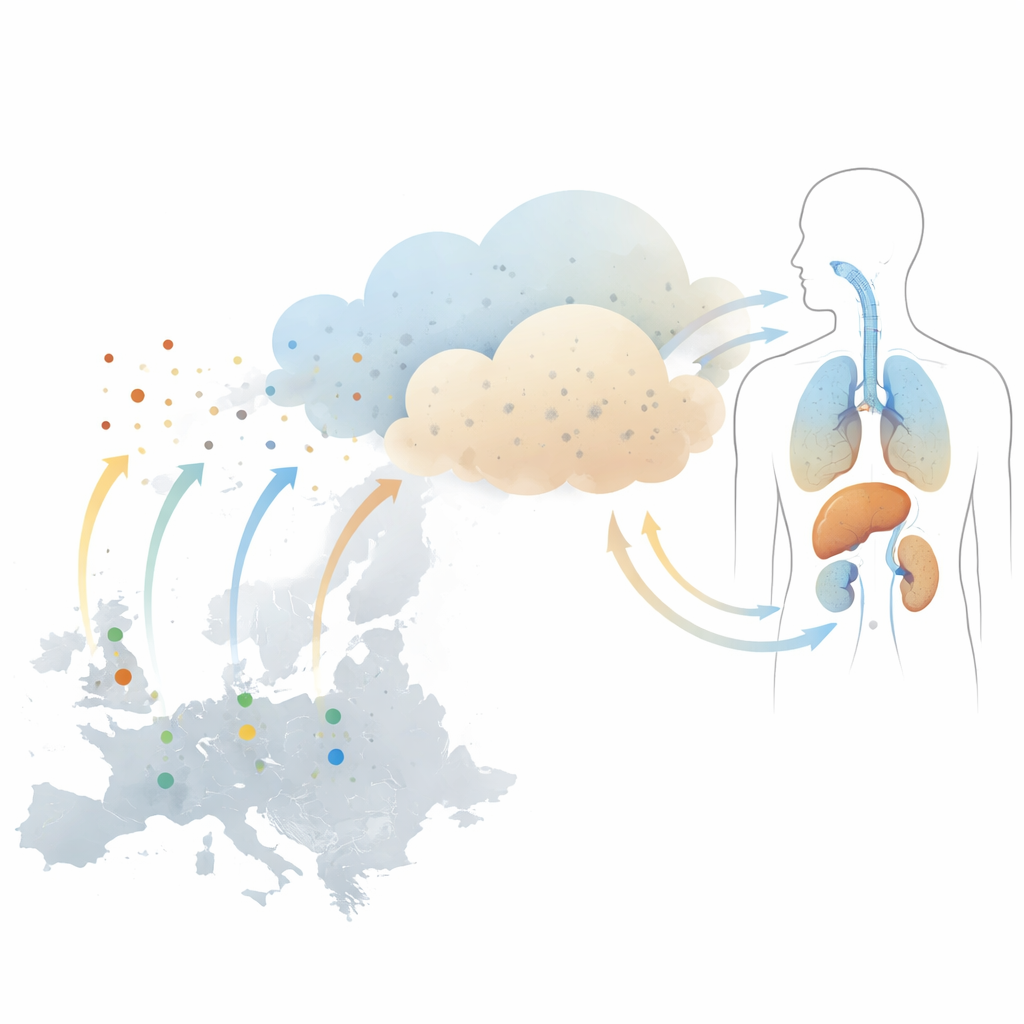
Tracking city air across a continent
The team brought together VOC records from 21 monitoring sites in Belgium, Finland, France, Spain, Switzerland and the United Kingdom, covering the years 2002 to 2023. These sites included busy roads, industrial zones, typical city neighborhoods, and a suburban location. Because each country used slightly different instruments and tracked somewhat different chemicals, the researchers first harmonized the data, focusing on 20 common gases that were measured at most sites. Total VOC levels varied widely: industrial and traffic sites had the highest concentrations, while urban background sites away from major roads were much lower. Even among background sites, France generally showed higher levels than Belgium and Finland, with coastal cities tending to be more polluted than inland Switzerland—likely reflecting both local industry and ship traffic.
Cleaner engines, changing mixtures
Looking at trends over time, the study found that overall VOC levels have fallen across much of urban Europe since the early 2000s, although not everywhere and not for every chemical. Using statistical tools that detect gradual shifts, the researchers showed that most of the biggest declines occurred after 2010, overlapping with a wave of tighter European rules on vehicle and industrial emissions. Aromatic gases such as benzene, toluene and xylenes—strongly linked to fuel use and solvents—dropped by a few percent per year at many sites, especially near traffic. Nonetheless, some sites showed relatively stable totals because decreases in some compounds were partly offset by increases in others, including gases linked to consumer products and natural emissions from plants. This means that Europe has not only cut the amount of VOCs in the air, but also changed which types are most common.
From street fumes to smog and haze
VOCs are important not just because they are present in the air, but because of what they become. Using established metrics, the authors estimated how strongly each gas contributes to forming ozone and secondary organic aerosols—tiny particles that form in the air from gases. They found that a handful of compounds, led by toluene and related aromatics, account for most of the potential to create both ozone and these fine particles. At traffic sites, toluene and xylenes were especially dominant, while industrial sites showed a stronger role for certain highly reactive gases associated with petrochemical processes. Seasonal patterns also mattered: natural emissions from vegetation, particularly isoprene, played a larger role in summer ozone formation, yet man-made aromatics remained the main drivers of particle formation in all seasons. This close overlap between the gases that drive ozone and those that build particles suggests that targeted cuts in a small group of VOCs could help reduce both forms of pollution at once.
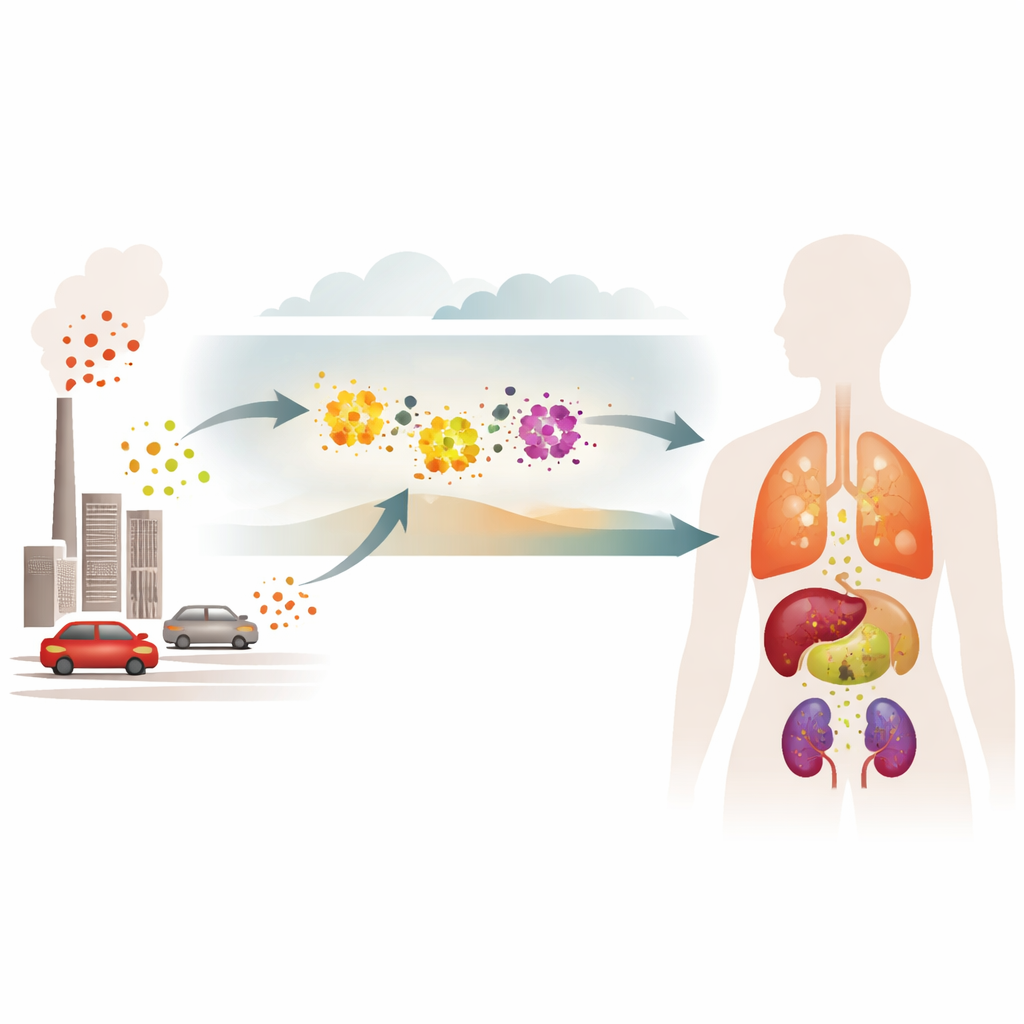
Following the chemicals inside the human body
To move beyond outdoor air and into health implications, the researchers used a physiologically based toxicokinetic model—a kind of virtual body that tracks how chemicals are absorbed, transported, stored and removed. Feeding the measured air concentrations into this model for four representative aromatics (benzene, toluene, ethylbenzene and 1,2,4-trimethylbenzene), they calculated how much of each would accumulate in organs under typical daily inhalation. The simulations showed that these VOCs tend to concentrate most in the kidneys and liver, with internal levels in these organs many times higher than in the blood. Among the four, toluene consistently reached the highest internal amounts, highlighting its importance despite declining outdoor concentrations. Sites near traffic and industry produced the largest modeled organ burdens, mirroring the spatial patterns seen in the air data.
What this means for people living in cities
From a layperson’s point of view, the message is mixed but hopeful. Decades of European regulations have clearly lowered many harmful gases from traffic and industry, and with them the potential to form smog and pollution particles. Yet the study also shows that a small set of VOCs, especially aromatic compounds from fuels and solvents, still drive much of the problem and build up in internal organs linked to detoxification and excretion. Even when outdoor levels meet current standards, long-term low-dose exposure can lead to non-negligible body burdens, particularly when different chemicals act together. The authors argue that future air quality rules should pay more attention to the specific VOC mixtures that most efficiently create ozone and particles, expand monitoring of overlooked compounds, and integrate internal exposure modeling into health assessments. Doing so would better connect emission cuts on paper with the real protection of lungs, livers and kidneys across Europe’s cities.
Citation: Liu, X., Wang, M., An, T. et al. Analysis of the abundance and impacts of volatile organic compounds across Europe. npj Clim Atmos Sci 9, 103 (2026). https://doi.org/10.1038/s41612-026-01378-9
Keywords: urban air pollution, volatile organic compounds, ozone and particle formation, European emission controls, health exposure modeling