Clear Sky Science · en
Anthropogenic aerosols can shape the winter mid-latitude cyclone tracks
Why winter storms and air pollution matter
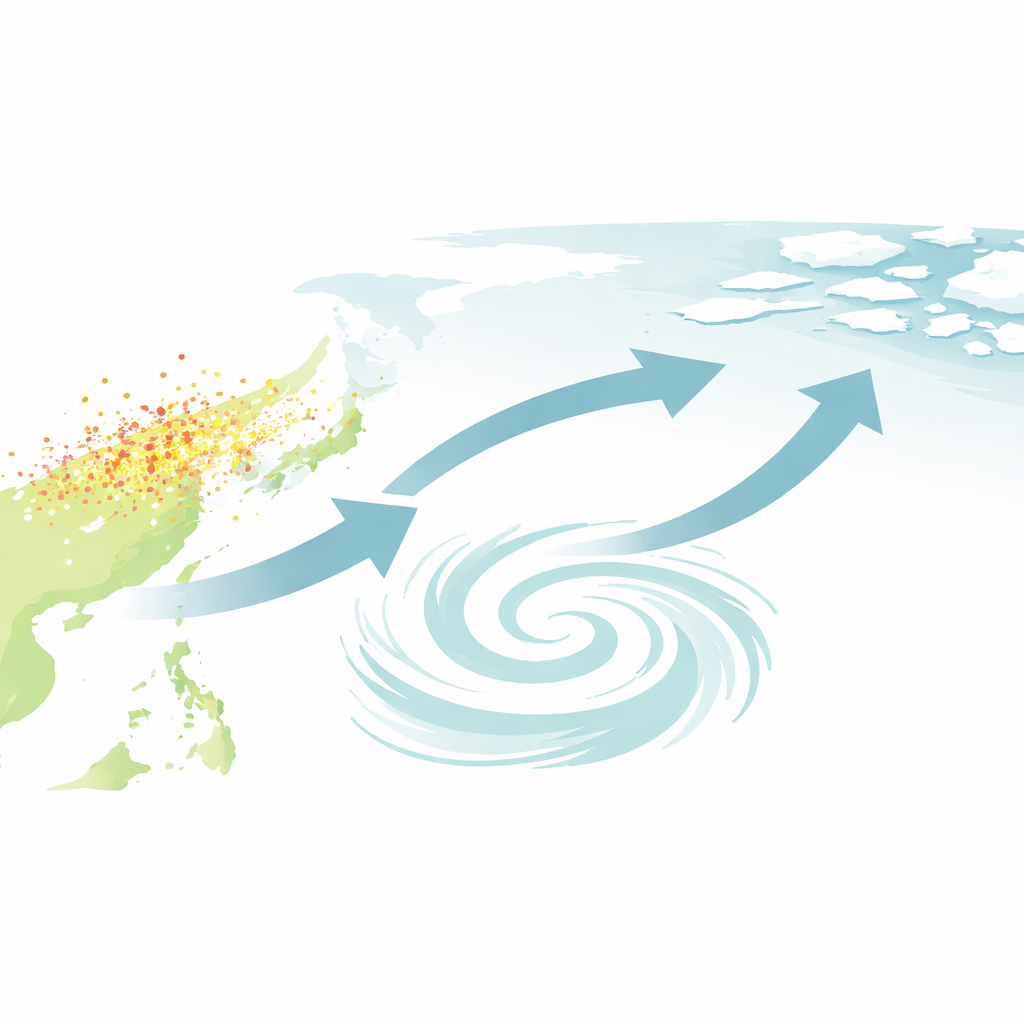
Winter storms sweeping across the North Pacific do far more than bring rain and wind to coastal cities. These mid-latitude cyclones help move heat and moisture toward the Arctic, shaping sea ice, fisheries, and weather patterns felt across the Northern Hemisphere. This study shows that human-made air pollution from East Asia is not only changing how strong these storms are, but also where they travel—nudging their paths farther toward the pole and potentially speeding up Arctic sea-ice loss.
Storm highways in a changing atmosphere
Mid-latitude cyclones follow preferred “storm tracks,” much like airplanes follow busy flight corridors. Using four decades of weather data, the authors compared winters with relatively clean air over East Asia to winters with much hazier conditions, focusing on storms that form downwind of the region. They found that in high-pollution winters, North Pacific storms end up, on average, noticeably farther north than in cleaner years. More storms cross into very high latitudes, meaning more of these weather systems can carry heat and moisture into the Arctic environment. The starting points of the storms, however, hardly shift at all, suggesting that it is the storms’ development and evolution—not where they are born—that is being altered.
Putting the effect to the test in a climate model
To tease apart the impact of aerosols from other influences, such as rising greenhouse gases and natural climate swings, the team ran long simulations with a detailed atmospheric model. In one set of runs, they used a standard level of human-made aerosol emissions. In another, they boosted emissions over East Asia by a factor of ten, bringing the model’s haze levels closer to what satellites actually see. Sea surface temperatures and sea ice were kept fixed to a repeating annual cycle so that each simulated year behaved like an independent test. When pollution levels were raised, the model reproduced a clear northward shift of the North Pacific storm track. Storms became less common over the central Pacific and more common near Japan and into the Bering Sea, and the high-altitude jet stream also edged poleward.
How tiny particles steer giant storms
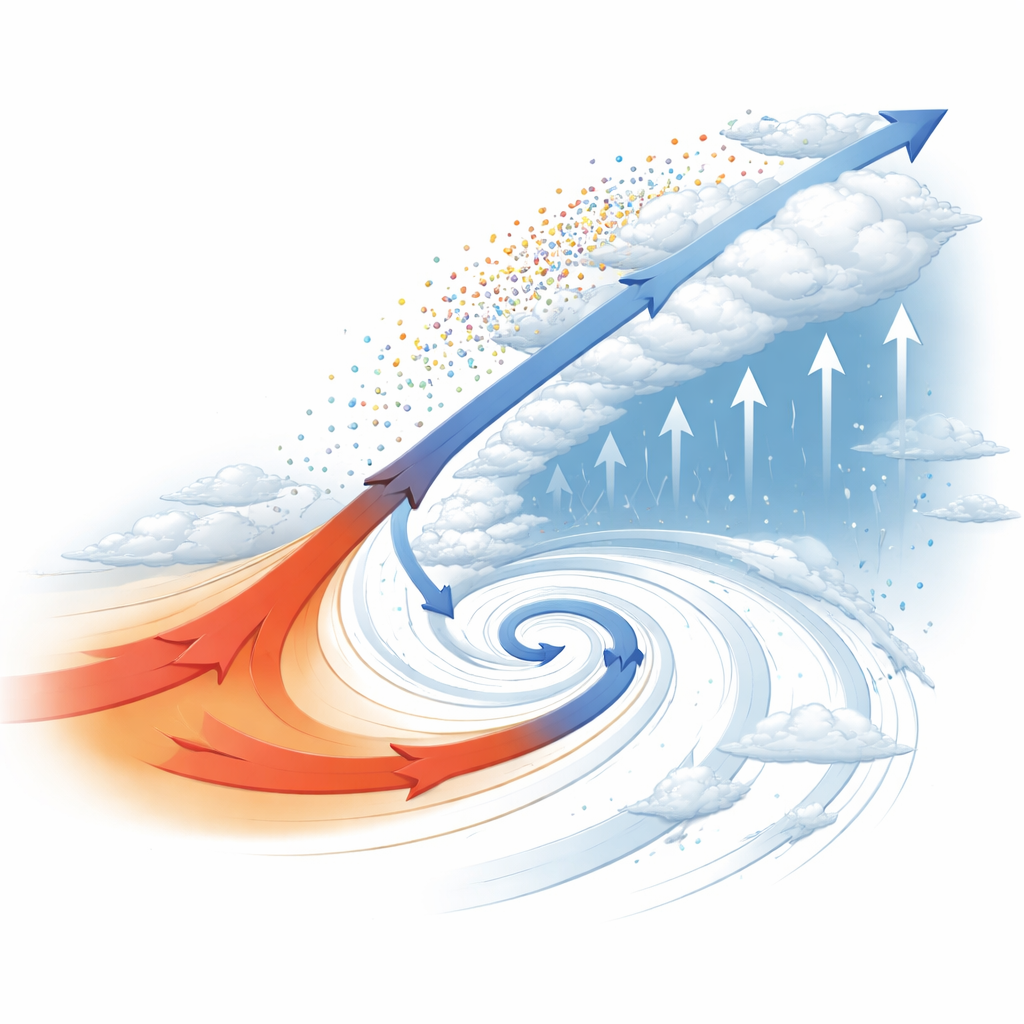
The key to this shift lies in how aerosols interact with clouds and rainfall inside the storms. Aerosol particles act as seeds for cloud droplets. When they are abundant, they produce many small droplets instead of fewer large ones, which tends to delay rainfall. In the model, this meant that less rain fell in the southern and southeastern parts of the cyclones, allowing more moisture to ride upward and northward along the storms’ warm conveyor belts. As that moisture condensed and froze higher in the atmosphere, it released extra heat in the northeastern parts of the storms. This heating changed the storms’ internal balance of spin and temperature in a way that favored a gentle push toward the pole.
A chain reaction from clouds to the Arctic
To diagnose this behavior, the researchers examined the storms using a quantity called potential vorticity, which combines rotation and stability in the atmosphere. They found that in polluted conditions, there was a stronger increase in this measure on the northeast side of the storms, both because of altered wind patterns and because of the extra heat released by cloud processes. This pattern of changes encourages the storm centers near the surface to migrate poleward as they intensify. The study also hints that these shifts are more strongly driven by aerosols than by the modest amount of global warming over the same period, at least in this region and season.
What this means for sea ice and future policies
By nudging winter storms toward higher latitudes, East Asian air pollution may already be helping to funnel more heat and moisture into the Arctic, where it can eat away at sea ice. The authors find that years with more North Pacific cyclones entering the Arctic tend to have less sea ice in the Bering Sea, implying a link between storm behavior and ice retreat. Looking ahead, global warming on its own is expected to push storm tracks poleward, but cutting aerosol emissions in East Asia could partially counteract this shift. In other words, cleaning up the air might slightly ease the pressure on Arctic sea ice, even as climate change continues. The work underscores how actions taken in one industrial region can reshape storm paths and polar climate thousands of kilometers away.
Citation: Cao, D., Xu, D., Lin, Y. et al. Anthropogenic aerosols can shape the winter mid-latitude cyclone tracks. npj Clim Atmos Sci 9, 109 (2026). https://doi.org/10.1038/s41612-026-01377-w
Keywords: mid-latitude cyclones, East Asian aerosols, North Pacific storms, Arctic sea ice, storm track shift