Clear Sky Science · en
A hybrid framework for global weather forecasting via low-resolution dynamical core and multigrid neural operator
Why faster, smarter forecasts matter
Weather forecasts shape daily choices and protect lives and property, from planning flights to preparing for storms. But the most accurate forecasts come from huge computer models that devour energy and time. At the same time, new artificial intelligence systems can predict weather quickly but sometimes break basic rules of physics, which worries forecasters. This study presents a new way to blend both worlds, aiming to keep the speed of AI while preserving the physical realism of traditional weather models.

Blending two ways of seeing the atmosphere
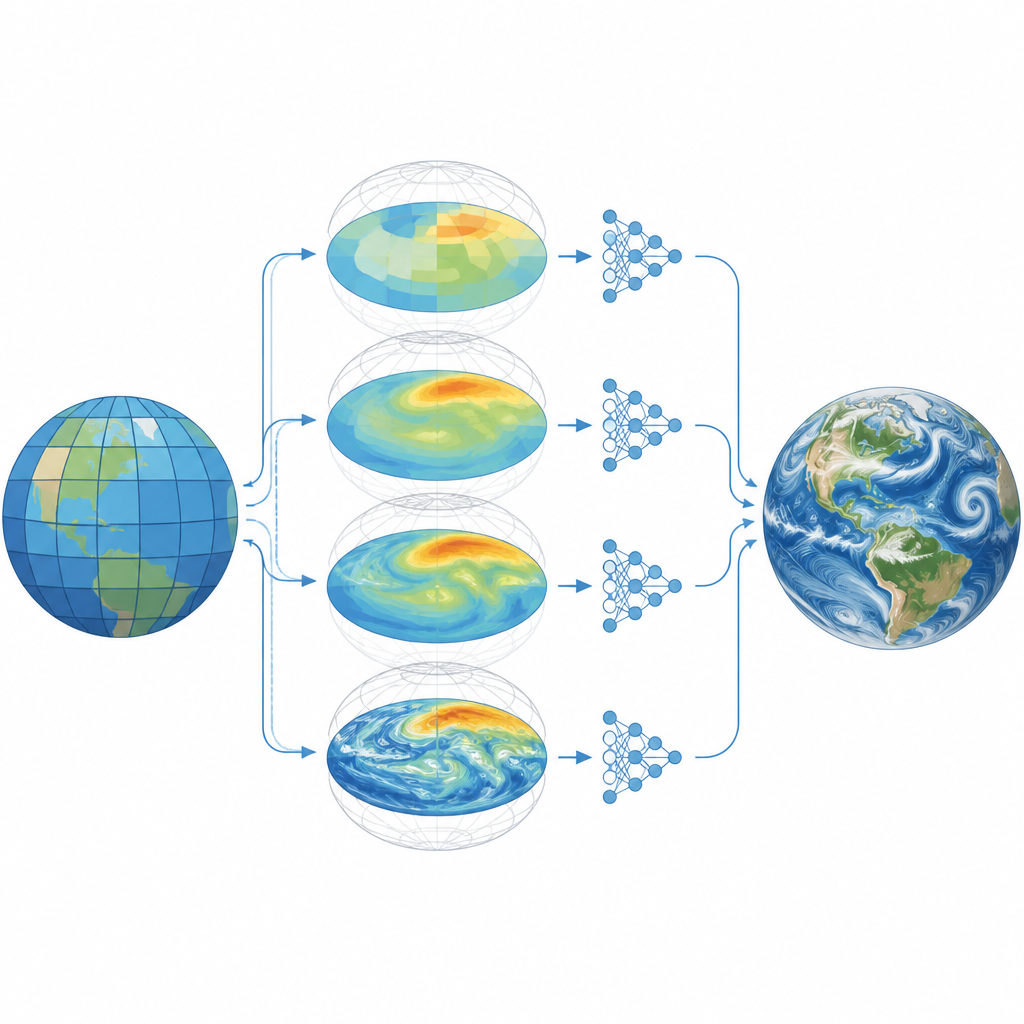
Conventional numerical weather prediction uses equations that describe how air moves and changes. These models are trusted but very expensive to run at high detail across the globe. Pure AI models learn patterns directly from past data and can run much faster, yet they may drift away from real-world behavior over time. The authors propose a hybrid system, called HMgNO, that couples a simple, low-detail physical model with a neural network that acts as a smart corrector, nudging forecasts back toward reality.
How the hybrid system works
The hybrid framework follows a repeated cycle. First, a low-resolution physical model steps the atmosphere forward using the known equations of motion. Its coarse forecast is then scaled back to a finer grid. Next, a neural operator, trained on years of historical data, estimates and corrects the forecast errors. The corrected state becomes the starting point for the next round. Because the neural network only sees inputs and outputs from the physical model, it does not need to send gradients through the physical code. This “plug and play” design means many existing weather models can be slotted into the framework without being rewritten.
How well it predicts the weather
The researchers tested HMgNO on global forecasts up to 10 days ahead and compared it with three strong competitors: an operational forecast system called HRES, a leading AI model known as Pangu-Weather, and another hybrid model called NeuralGCM. Using standard measures of forecast error and pattern matching, HMgNO matched or beat these models at longer lead times for many key quantities such as winds and pressure patterns high in the atmosphere. While it is slightly less accurate than HRES in the first few days, its errors grow more slowly and become smallest toward day 10, especially for upper-air fields that steer large-scale weather systems.
Staying true to real-world physics
Beyond raw accuracy, the team examined how physically realistic the forecasts are. They focused on the balance between pressure fields and winds in mid and high latitudes, where the atmosphere normally follows a well-known relationship called geostrophic balance. Pure AI models tended to lose this balance as forecasts extended in time, leading to unrealistic wind patterns. In contrast, HMgNO and the other hybrid model maintained a vertical structure much closer to that of a trusted reanalysis dataset, indicating healthier linkages between mass and wind fields. Case studies of near-surface temperature over ocean, rainforest, and desert showed that HMgNO could also learn daily heating and cooling cycles over very different landscapes without using the complex surface formulas that standard models rely on.
Speed, cost, and energy savings
Large AI and hybrid models often require vast training data and powerful clusters of specialized chips. Pangu-Weather and NeuralGCM were trained on nearly four decades of high-quality data using hundreds of high-end processors over days to weeks, representing costly and energy-intensive efforts. HMgNO, by contrast, reached comparable forecast skill using only 12 years of data and four consumer-grade graphics cards, finishing training in under two days and storing less than one terabyte of data. This dramatic reduction in cost and hardware lowers the barrier for research groups and weather agencies that cannot access giant computing facilities.
What this means for future forecasts
The study shows that a carefully designed partnership between physics-based models and AI can deliver accurate, stable, and physically consistent global forecasts at a fraction of the training cost of current leaders. HMgNO is not perfect: limited vertical detail in the training data and a trade-off between sharp small-scale features and overall error still constrain performance. However, the framework is flexible and ready to benefit from richer data, higher resolution, and new methods to estimate uncertainty. For the public, this line of work points toward faster, more accessible, and more reliable weather guidance that can support everyday decisions and help societies better prepare for extreme events.
Citation: Hu, Y., Yin, F., Zhang, W. et al. A hybrid framework for global weather forecasting via low-resolution dynamical core and multigrid neural operator. npj Clim Atmos Sci 9, 112 (2026). https://doi.org/10.1038/s41612-026-01374-z
Keywords: hybrid weather forecasting, neural operator, numerical weather prediction, artificial intelligence, global climate data