Clear Sky Science · en
Asymmetric response of day-to-day temperature variability to CO₂ forcing over Northern Hemisphere mid–high latitudes
Why small temperature jumps matter
Most of us notice when the weather whiplashes from warm to freezing in a day or two. These rapid swings can harm crops, strain power grids, and affect human health. This study asks a subtle but important question: if humanity someday manages to pull large amounts of carbon dioxide (CO₂) out of the air, will these day‑to‑day temperature jumps simply return to how they were before global warming, or will the climate system "remember" the past in a way that changes everyday weather?
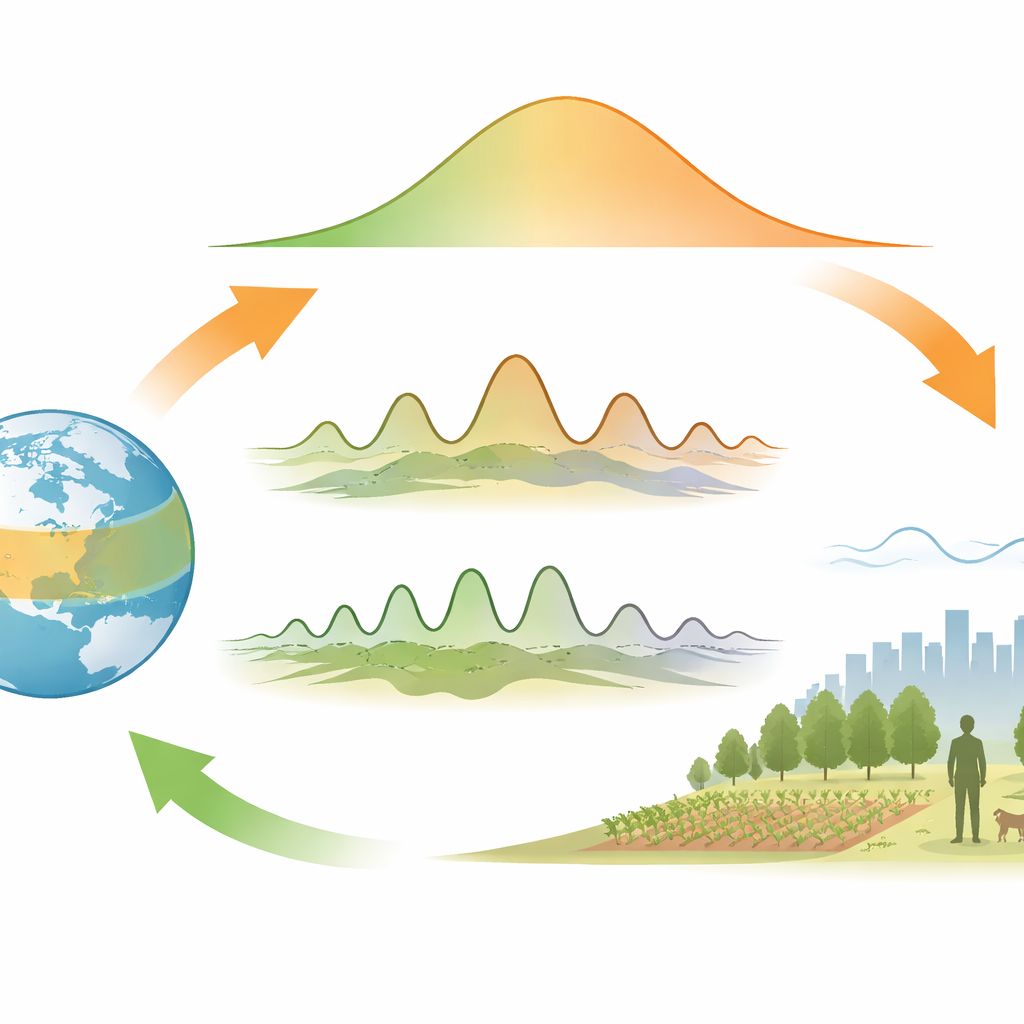
Looking at climate’s daily mood swings
The researchers focus on day‑to‑day temperature variability over the Northern Hemisphere’s mid‑ to high‑latitude land areas, roughly from 50° to 75°N. They measure it with a simple index: how much the average temperature changes from one day to the next. Using six state‑of‑the‑art climate models, they run an idealized experiment: first, atmospheric CO₂ rises by 1% per year from pre‑industrial levels until it reaches four times the starting value. Then CO₂ is reduced at exactly the same rate back down to the original level. This symmetric ramp‑up and ramp‑down pathway is designed to mimic strong climate mitigation that includes CO₂ removal, while allowing scientists to compare conditions with the same CO₂ concentration but different climate histories.
Unequal behavior during warming and cooling
The models agree that as CO₂ rises, day‑to‑day temperature swings generally shrink across northern land, especially in winter. But the surprising result appears when CO₂ is later brought back down. For the same CO₂ levels, everyday temperature fluctuations are markedly weaker during the ramp‑down period than during the ramp‑up. Over Eurasia and North America, the annual average day‑to‑day change in temperature is roughly three to four times smaller during ramp‑down than during ramp‑up at equal CO₂. The strongest asymmetry occurs in autumn, spring, and winter, while summer shows a much smaller and more patchy response, with even slight local increases in variability in parts of northern Eurasia.
Fewer sharp jolts in temperature
To understand what this means in practical terms, the authors examine how often different sizes of temperature jumps occur. During the CO₂ ramp‑down, weak changes of less than 1 °C from one day to the next become more common, while moderate and strong shifts of 2–5 °C become less frequent, especially in the colder seasons. In other words, the distribution of daily changes is skewed toward smaller swings once CO₂ starts to fall. This suggests that under a CO₂ removal future, people and ecosystems in northern regions may experience fewer abrupt cold snaps or warm surges, even if the overall climate is still warmer than it was before industrialization.
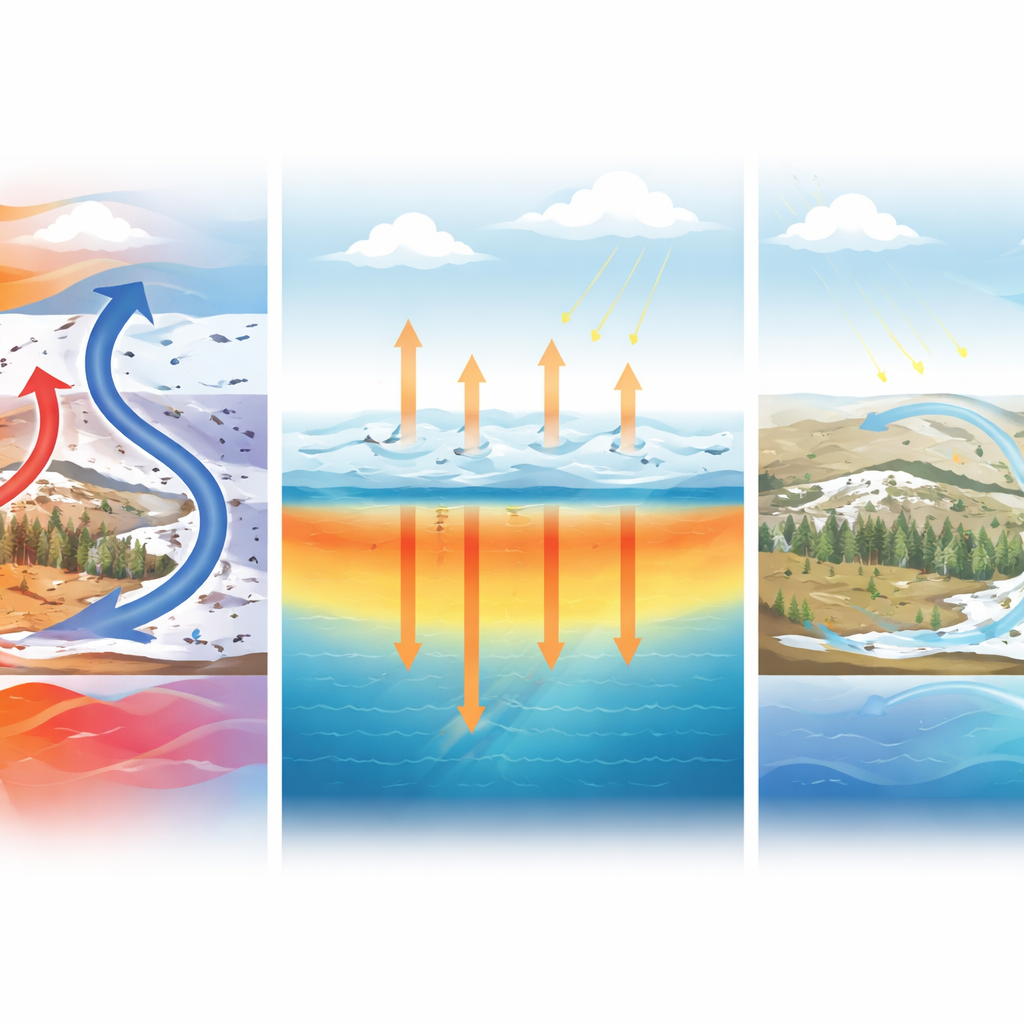
What in the atmosphere is changing
The team then asks what physical processes are responsible for this asymmetric behavior. They use a standard energy‑balance equation near the surface to decompose the day‑to‑day temperature changes into contributions from moving air masses (horizontal temperature advection) and from changes in heating and cooling at the ground (radiative forcing). They find that the dominant driver is a systematic weakening of near‑surface horizontal temperature advection during the ramp‑down phase, particularly in the north–south direction. In simpler terms, the exchange of warm and cold air between lower and higher latitudes becomes less vigorous, so rapid swings in local temperature are muted. This weakening goes hand‑in‑hand with a reduced contrast between warm and cold regions and with calmer, more stable large‑scale weather patterns.
Subtle effects of sunshine, clouds, and soil
On top of these circulation changes, the study finds secondary roles for variations in surface radiation and land conditions. During ramp‑down, much of the northern land surface tends to be drier, with less variable humidity and cloud cover. These shifts dampen day‑to‑day changes in longwave radiation, further smoothing temperature fluctuations in some regions, especially in winter over northern Eurasia. In summer, certain high‑latitude areas show more variable incoming sunlight, linked to local cloud and soil‑moisture patterns, which aligns with the small local increases in day‑to‑day variability seen there. Overall, however, these radiative effects only modify the picture painted by the circulation: weaker movements of contrasting air masses are the main reason daily temperatures swing less.
What this means for a cooled‑down future
The study concludes that even if humanity successfully reduces CO₂ concentrations back to pre‑industrial levels, the rapid ups and downs of daily temperatures in northern regions will not simply bounce back to their old behavior. Instead, they are likely to stay suppressed for decades, especially in the cold seasons, because the ocean’s long‑lasting heat storage and resulting circulation changes continue to dampen the exchange of warm and cold air. This delayed and asymmetric recovery of everyday temperature variability matters for planning: fewer sharp cold snaps may reduce some risks, but weaker variability can also extend warm episodes, alter growing seasons, and affect pests, diseases, and ecosystems. The message is that climate recovery under CO₂ removal will be uneven across different aspects of the system, and adaptation strategies need to account not just for average temperatures, but also for how restless—or calm—the day‑to‑day weather becomes.
Citation: Gan, R., Hu, K., Liu, Q. et al. Asymmetric response of day-to-day temperature variability to CO₂ forcing over Northern Hemisphere mid–high latitudes. npj Clim Atmos Sci 9, 102 (2026). https://doi.org/10.1038/s41612-026-01372-1
Keywords: day-to-day temperature variability, carbon dioxide removal, Northern Hemisphere climate, Arctic amplification, weather extremes