Clear Sky Science · en
Bias-targeted deep learning enhances short-range heavy rainfall forecasts
Why this matters for everyday life
Sudden downpours can shut down cities, flood roads, and threaten lives. Yet even with today’s advanced computer models, predicting exactly where and how hard heavy rain will fall a day or two ahead is still surprisingly difficult. This study introduces a fresh way to use artificial intelligence to fine‑tune existing weather forecasts, making short‑range heavy‑rain predictions more accurate and more useful for disaster preparedness across large parts of China.
Where current forecasts fall short
Modern weather models simulate the atmosphere in three dimensions, but they still struggle with rain. Heavy rainfall tends to be very patchy and extreme, and the models often either miss the most intense areas or place them in the wrong spots. Traditional statistical methods try to correct these errors by looking at long‑term averages, assuming that the model’s mistakes are steady over time. That assumption breaks down for storms driven by different weather systems, such as monsoon fronts or tropical cyclones, which leaves emergency planners with forecasts that can underplay real dangers or raise too many false alarms.
A clever shift in what the AI learns
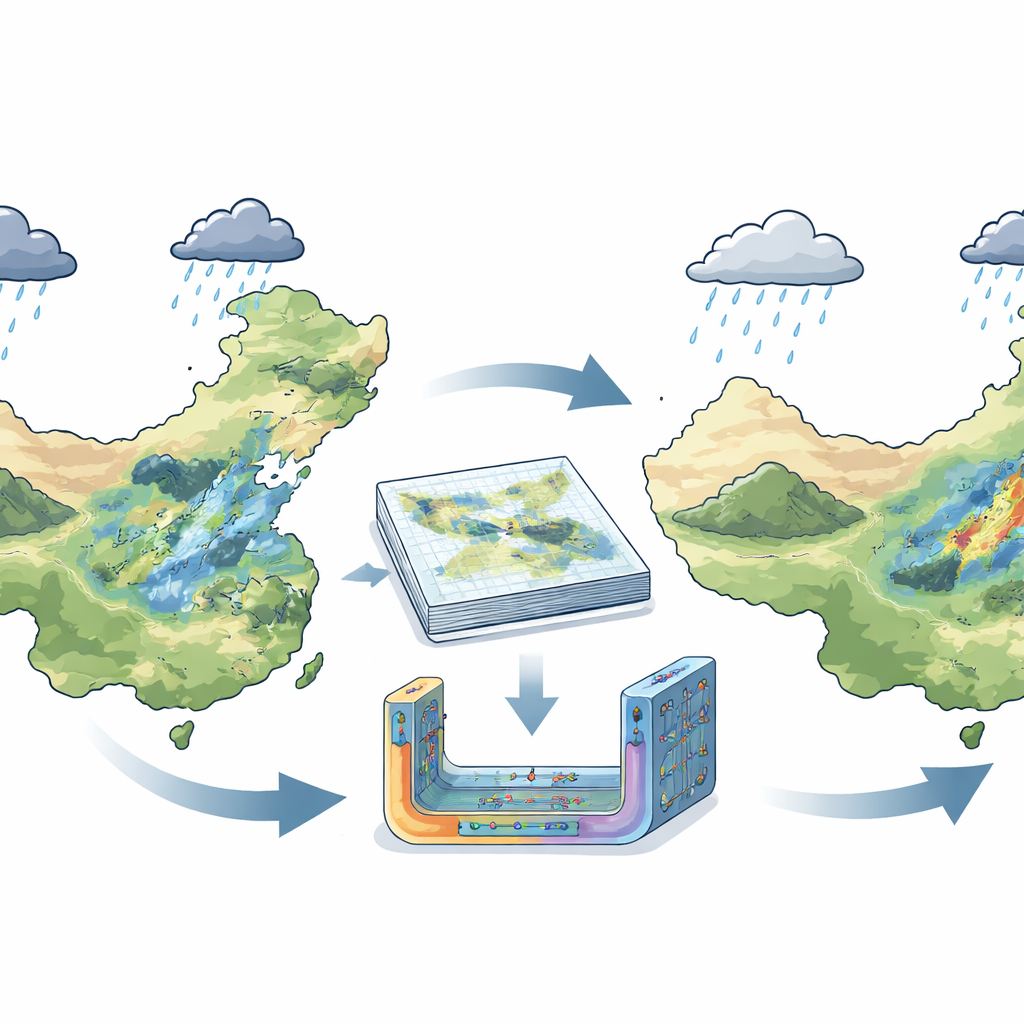
Most deep‑learning approaches for improving rainfall forecasts teach the neural network to reproduce the observed rain itself. The problem is that rainfall is never negative and can occasionally be extremely large, making it statistically awkward for standard AI training methods. The authors examined forecasts from the European Centre for Medium‑Range Weather Forecasts over the Yangtze River Delta, a densely populated and flood‑prone region of China. They discovered a crucial pattern: even when the actual rain amounts formed a strongly skewed, long‑tailed distribution, the difference between forecasts and observations during heavy‑rain events clustered neatly around a bell‑shaped, almost Gaussian curve. In other words, while the rain itself is wild, the forecast errors behave in a much more regular way.
Teaching the network to fix errors, not make rain
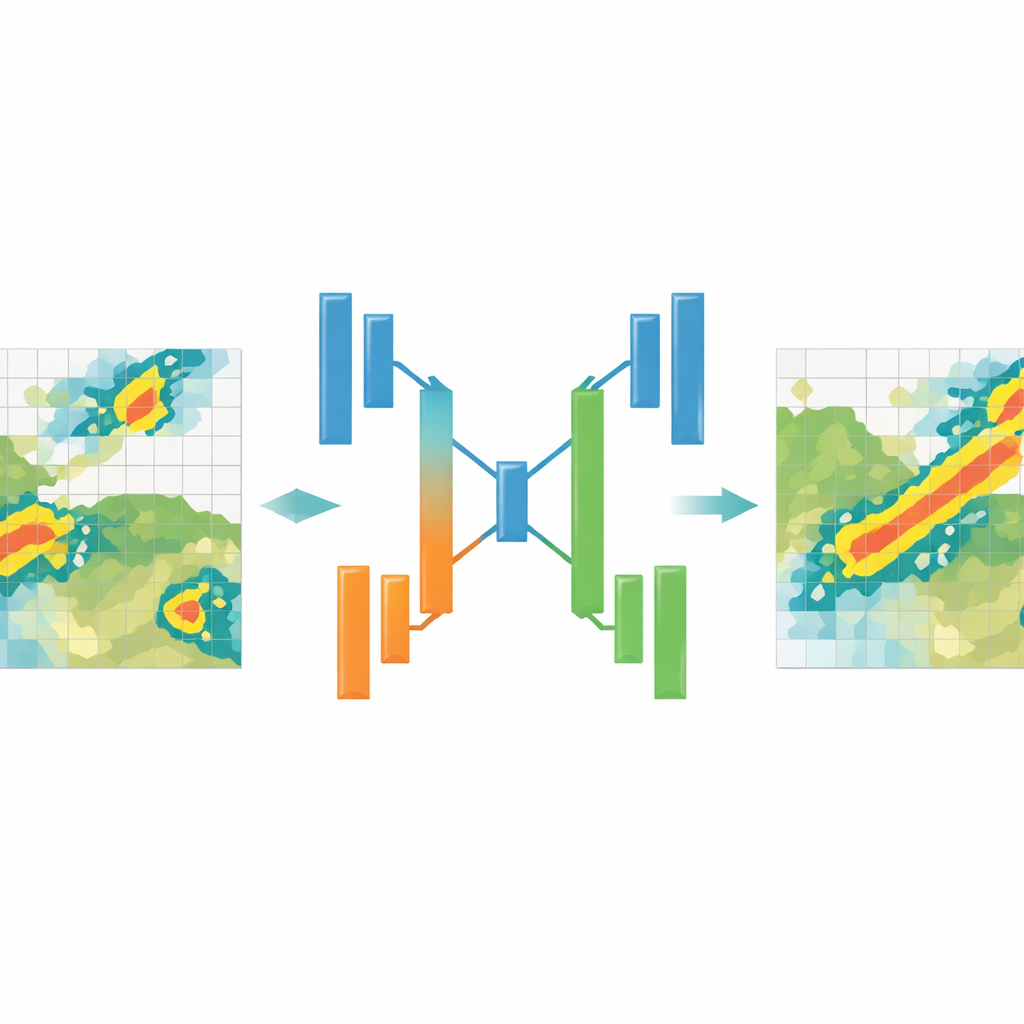
Building on this insight, the researchers designed a deep‑learning model based on a U‑Net architecture that takes in dozens of weather‑model variables plus topography and learns to predict the bias—the forecast’s error—at every grid point. This “bias‑targeted” model, called UnetDif, estimates how much the original forecast should be adjusted up or down, and it also learns when to suppress rain that should not be there. For comparison, they trained another U‑Net, UnetOri, that tries to predict the rainfall amounts directly from the same inputs, a strategy similar to most previous work. Both approaches were tested on three forecast lead times (from about 1½ to 2½ days ahead) and evaluated with several standard measures of forecast quality.
Sharper warnings for dangerous downpours
Over the Yangtze River Delta, the bias‑targeted UnetDif substantially improved forecasts of daily rainfall above 50 millimeters, a level often associated with serious impacts. It boosted a key accuracy measure by more than 20 percent compared with the raw model and clearly outperformed both the direct‑rainfall network and a common statistical correction method known as quantile mapping. UnetDif was particularly good at reducing missed heavy‑rain events without inflating the number of false alarms, and it produced spatial patterns of intense rain that better matched observed storm bands. When the same technique was applied to three other major rainy regions of China, it consistently raised heavy‑rain forecast skill, sometimes by more than 30 percent, showing that the method can transfer across different climates and terrains.
What this means going forward
By asking the neural network to learn the model’s mistakes rather than the rain itself, this study turns an awkward forecasting problem into one that AI can handle more naturally. The result is a relatively simple and widely applicable tool that makes short‑range heavy‑rain forecasts more reliable—exactly the kind of improvement that can help officials issue better warnings, manage reservoirs, and plan emergency responses. While predicting the most extreme cloudbursts remains difficult because they are so rare, this bias‑focused strategy offers a practical and scalable path to safer communities in a world where intense rainfall is becoming more common.
Citation: Tang, T., Shen, W., Fu, J. et al. Bias-targeted deep learning enhances short-range heavy rainfall forecasts. npj Clim Atmos Sci 9, 78 (2026). https://doi.org/10.1038/s41612-026-01366-z
Keywords: heavy rainfall forecasting, deep learning, weather model bias, flood risk, numerical weather prediction