Clear Sky Science · en
Tibetan Plateau’s freshwater bridge shifts the Indian Ocean Dipole to a high-frequency regime
Mountains, Monsoons, and a Hidden Ocean Link
The Tibetan Plateau, often called the “Roof of the World,” is thousands of kilometers from many coastlines, yet this study shows it quietly reshapes the Indian Ocean deep below the surface. By changing winds and rainfall patterns, the plateau helps decide how heat is stored in the ocean down to a kilometre in depth. That, in turn, affects regional climate swings such as the Indian Ocean Dipole, which can bring floods to East Africa and drought to Australia and parts of Asia. Understanding this hidden connection helps us see how distant parts of the Earth system work together—and how they may change in a warming world.
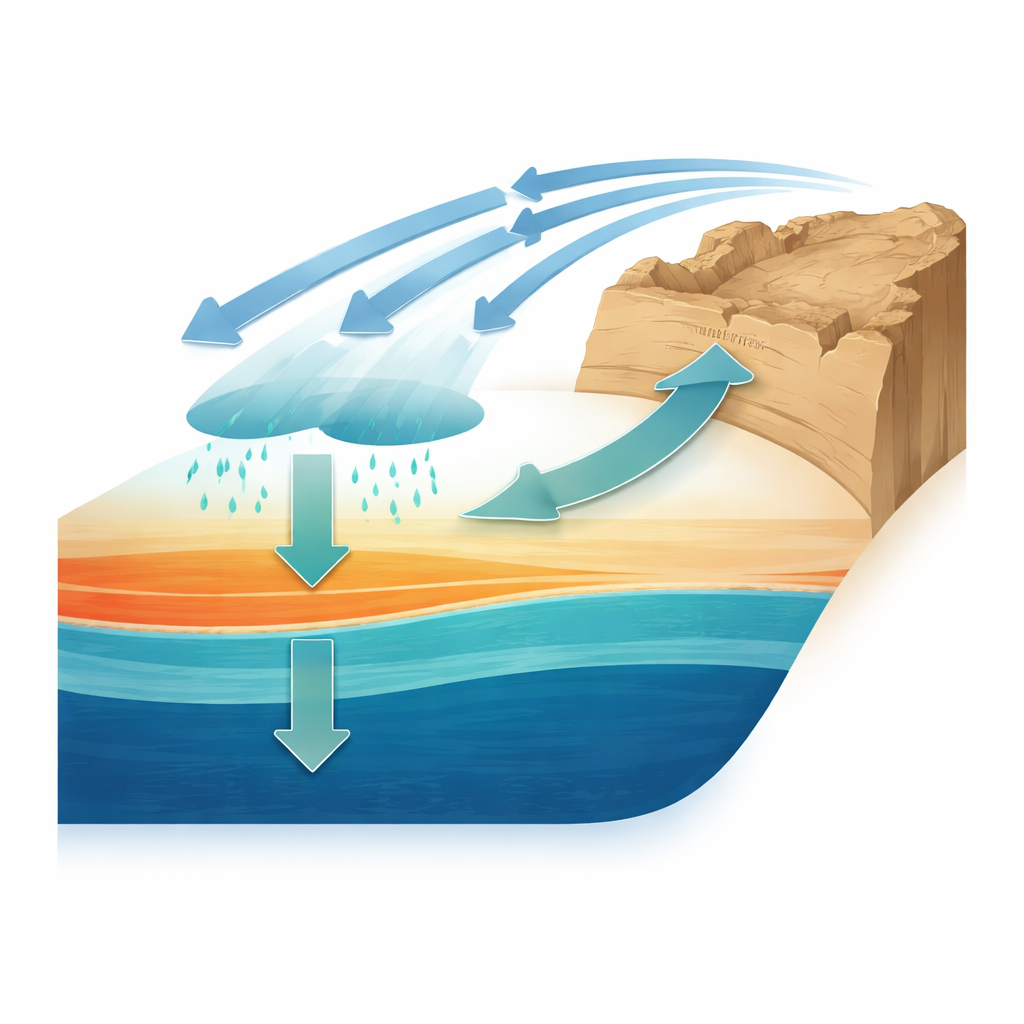
How a High Plateau Steers the Monsoon
The Tibetan Plateau stands as a massive obstacle and heat source in the atmosphere, strengthening the Asian summer monsoon. Using a sophisticated Earth system model, the authors compared two worlds: one with a realistic plateau and one where the plateau was virtually flattened. In the realistic world, stronger southwesterly winds blow across the northern Indian Ocean. These altered winds rearrange clouds, sunshine, and evaporation. As a result, some regions of the ocean surface gain more heat, while others lose it, and large-scale wind patterns push warm surface waters downward in certain areas by changing the way the ocean is stirred from above.
A Warm Cap and a Cold Interior
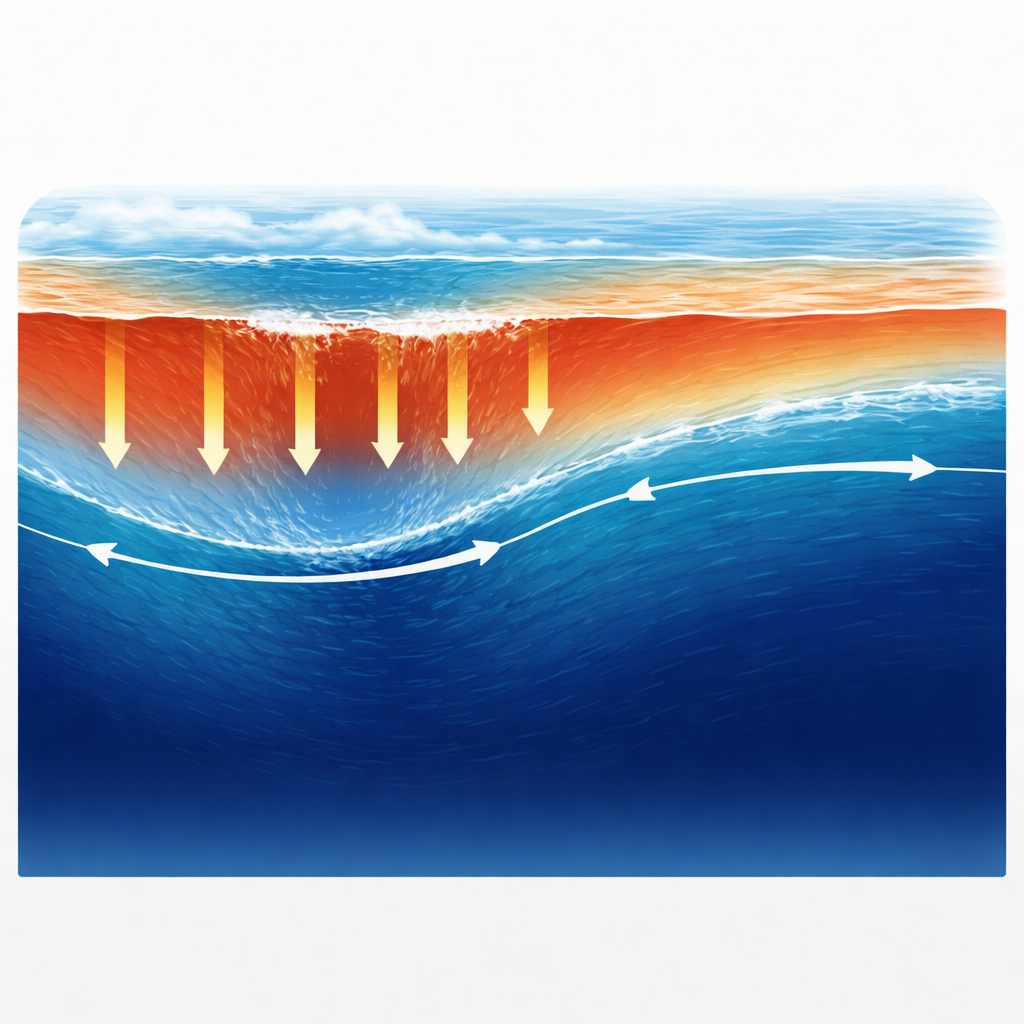
These wind-driven changes alone, however, could not explain what the researchers saw in the model: a striking “upper-warm, lower-cold” pattern throughout much of the Indian Ocean. With the plateau present, the top roughly 150 meters of the ocean warmed and the boundary separating warm and cold waters—the thermocline—sank deeper. Below about 150 meters and down to about 1000 meters, the water actually became colder. This means the ocean stores more heat near the surface while keeping deeper layers unusually cool, a vertical temperature dipole that reshapes how and where the ocean holds energy over many years.
Freshwater as the Ocean’s Locking Mechanism
The key to this locked-in pattern turned out not to be wind alone, but freshwater. The stronger monsoon tied to the plateau shifts where rain falls over the Indian Ocean. Near the equator, rainfall decreases and surface waters become saltier and denser. Farther north, particularly between about 10° and 20° north, rainfall increases and surface waters become fresher and lighter. Ocean currents spread this fresh water downward and southward, carving out a mid-depth zone of fresher, lighter water. This rearrangement of salt and density weakens the layering near the surface—making mixing easier there—but greatly strengthens layering a few hundred meters down. That deeper “stratification shield” acts like an invisible lid, allowing heat to slosh around and mix in the upper ocean while blocking it from leaking into the colder interior.
Faster Climate Swings in the Indian Ocean
This new background structure, set by the plateau-driven freshwater changes, alters how the Indian Ocean behaves during its own climate swings. The Indian Ocean Dipole—an irregular see-saw of warm and cool waters between the western and eastern basin—relies on interactions between winds, surface temperature, and subsurface structure. In the model with the plateau, these events occur more often, with a typical rhythm of about three and a half years, compared with nearly seven years when the plateau is removed. Detailed analysis shows that the strengthened mid-depth layering weakens some of the positive feedbacks that would otherwise allow anomalies to grow slowly and persist. Instead, disturbances are less self-sustaining and flip phase more quickly, shifting the system toward higher-frequency, moderate-sized events.
Why This Hidden Bridge Matters
To a layperson, the main message is that a faraway mountain range helps control not only the monsoon rains but also how the Indian Ocean stores heat deep below the surface—and how often major climate swings occur. The Tibetan Plateau intensifies the monsoon, which rearranges rainfall and freshwater over the ocean. That freshwater builds a strong barrier a few hundred meters down, keeping the upper ocean warm and the layers below cold. This “freshwater bridge” from land to sea shows that topography can shape the inner structure of the ocean, not just the winds above it. Because many climate models struggle with rainfall over the plateau and the Indian Ocean, capturing this mechanism is crucial for reliable projections of future monsoons, Indian Ocean extremes, and their impacts on surrounding societies and ecosystems.
Citation: Zhao, Y., Ma, Z., Qiao, B. et al. Tibetan Plateau’s freshwater bridge shifts the Indian Ocean Dipole to a high-frequency regime. npj Clim Atmos Sci 9, 94 (2026). https://doi.org/10.1038/s41612-026-01362-3
Keywords: Tibetan Plateau, Indian Ocean, monsoon, ocean stratification, Indian Ocean Dipole